

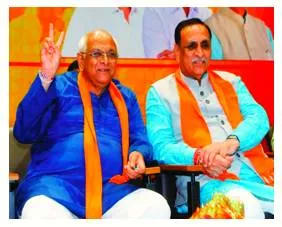
Gujarat and the game of change
Unlike elsewhere, the State's youth favour modern schemes, progress and qualitative development in society and economy over casteism.India’s ancient wisdom lay in distributing duties to Brahma, Vishnu and Mahesh (the Creator, the Preserver and the Destroyer), when necessary. No single deity can handle everything, no matter how powerful or versatile He is. But our people expect one Minister or Chief Minister to win elections, run the Government, supervise Ministers, keep a tab over all MLAs and then win the elections again. In Gujarat’s case, the Chief Minister was not credited with winning the 2017 poll. It was won on the strength of PM Modi’s popularity. It is an old belief that once elected, the Chief Minister should carry on until the next poll, normally five years. Even American Presidents occasionally break their firm four-year term.
There is a firm impression among the political class that it was Bhupendrabhai, whose small company built the Sabarmati River Front which helped boost the beauty of Ahmedabad. The other impression is that he also constructed Ahmedabad’s Bus Rapid Transit System, which is running successfully unlike other cities where such a scheme did not take off. Since these achievements, Bhupendrabhai has been on the BJP’s mind which likes modern schemes delivered in perfection and on time. He is a Kadva Patel, not a Leuva. They are supposed to have descended from Rama’s sons Lav and Kush; hence their names begin with ‘L’ and ‘K’.
Another unnoticed factor is opportunity. Most MLAs, 182 in Gujarat, contest elections in the hope of becoming Ministers if they win, provided they belong to the winning party. Those who don’t, generally have to shelve their hope unless and until there is floor crossing on a big scale. If the party with a majority has, say, 100 seats, 25 might get a portfolio each. What about the remaining 75? They don’t have much opportunity of self-promotion except the odd MLA who might rise by chance. It is, therefore, appropriate that the party in power should make changes as the Government moves along. Not all Ministers are efficient and, therefore, need to be replaced.
True, in the peculiar Indian situation, most parties need to replace an OBC with an equally representative OBC. The quality of his/her work is then usually sidelined. However, times are changing; today’s youth do not give priority to caste as their fathers or grandfathers did. These youth want to get on in life. There is only a limited chance of this happening if the society or economy does not get on. That means qualitative development and quantitative growth of professions. They realise that they cannot expect development when the country’s politics is hamstrung by caste. If politics does not change, society would be all politics, no progressive economy and a static society — a recipe for misery. In short, if the leader of the party trying to win an election cannot inspire development and only a status quo, the other party might win by default.
It is notable that Gujarat has not digested a third party — there are only the Congress and the BJP. All those who tried to be a third force have failed. The last to experiment with a third party was Keshubhai Patel, Gujarat’s former (now deceased) Chief Minister. However, the only one elected from this new party was Keshubhai himself. In the upcoming Assembly poll, there will be three parties contesting. Apart from the BJP and the Congress, the Aam Aadmi Party (AAP) will also contest. The triangular contest should make things easier for the BJP.
Gujarat is one State where economics subordinates politics. But the Congress, especially when Madhavsihnbhai Solanki was the CM, escalated casteism to extraordinary heights, a strategy borrowed from UP and Bihar, but spelt the Congress’ decline in Gujarat. The party for a few elections fought on a combination of castes called KHAM or Kshatriyas, Harijans, Adivasis and Muslims. The other mistake the Congress made was its socialism which clashes with the Gujarati psyche. He is sold on business and free enterprise. The Congress remained in power for years only because there was none other.
Remarkably, Gujarat’s tallest leaders have devoted themselves to the service of the country rather than confine themselves to their State. Swami Dayanand Saraswati founded the Arya Samaj movement as well as revived the Vedic practice of shuddhi or return to Hinduism voluntarily. Gandhi was never a State leader although he had the Kochrab Ashram in Ahmedabad. Sardar Patel worked for India phenomenally and unified the country following Independence. Two-fifths of it comprised princely States and not British India. Now we have PM Modi, about whom volumes have been written and will continue to be written.
But the change of guard in Gujarat, as in Assam a few months ago, does demonstrate that the BJP does not shy away from making decisions for upgrading the polity. In pursuit of this goal, the party is least hesitant to replace incumbents. In complete contrast stands the Congress, which has been reduced to a family business, where only fawning courtiers are tolerated. The recent resignation of Captain Amarinder Singh, barely four months away from Assembly elections, says it all. His humiliation at the hands of newcomers bespeaks volumes of how a once grand party now lives on a glory that has long vanished.
Can quad restrain wayward china
May 29, 2022
Concerns over finland sweden joining nato
May 22, 2022
Sustainability road to a better future
May 16, 2022
Aap lays out its goal
May 11, 2022
Shanghai covid crisis a test for xi’s leadership
May 09, 2022
The idea of universal equality
May 06, 2022





Stay updated with The Hindu Editorial Vocab24 app, your definitive source for breaking news and comprehensive coverage from India and around the globe. Whether it's political developments, business updates, sports highlights, the latest technology trends, or current events, The Hindu brings live, accurate, and reliable news directly to your device.
Don’t fall for sensationalized or fake news shared online. Read and share accurate updates with friends and family through The Hindu Editorial Vocab24 app. Download it today!
News Coverage in The Hindu Editorial Vocab24 App
Breaking News: Receive instant notifications on breaking news stories as they unfold. Stay informed about major events and developments in India and around the world with live blogs, news in shorts videos, and concise articles.
Politics: Get the latest updates on Indian politics, including elections, policy changes, government decisions, and political events that shape the nation.
Business and Economy: Stay ahead in the economic landscape with detailed business news and market analysis. Learn about stock market trends, financial reports, corporate news, and economic developments to make informed investment decisions.
Current Events: Follow stories on social issues, policy changes, global events, and daily current affairs, tailored for UPSC and other competitive exam preparations.
Technology: Keep up with the latest gadgets, innovations, and tech trends. Read expert reviews and analyses in short, concise updates on cutting-edge technology from India and beyond.
Sports: Never miss a moment of your favorite sports. Get live scores, match reports, and expert analysis on cricket, football, tennis, and more.
International News: Stay informed about global events and geopolitical developments, including the Russia-Ukraine war, Israel-Palestine conflict, and other key international stories.
Local News: Stay connected to your community with the latest updates on city events, issues, and local news. Coverage includes hyperlocal updates from cities like Bangalore, Chennai, Delhi, Hyderabad, Mumbai, Kolkata, and more.
Trending Topics: Discover what's trending today with the most talked-about stories and hot topics across India and the world.
Experience journalism that values integrity, accuracy, and reliability. Download The Hindu Editorial Vocab24 app today and stay connected with the world.
Subscribe to our newsletter!







