

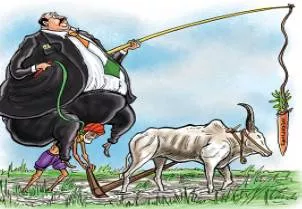
Get out of farmers’ way
In the end government interventions end up sustaining, not reducing, rural poverty.While most other sectors were liberalised in 1991, agriculture was not. Indian farmers arguably remain among the most unfree in the world.
Some claim India won’t be able to feed itself without the government playing a hands-on role in agriculture. But countries like New Zealand and Australia with liberalised agriculture have become more productive. Each Australian farmer produces enough to feed 600 people, 150 at home and 450 overseas. Liberalization of agriculture in 1991 in India could well have made us a middle-income nation by now. Instead, our small farmers remain under chronic stress.
Another argument, sometimes made, is that farmers are frequently seen to agitate for government support. That’s not necessarily true. Farmer organisations like the Kisan Coordination Committee and Shetkari Sangathana have for decades opposed government intervention (The process of becoming purposefully entangled in another’s affairs.) in agriculture. After their leader Sharad Joshi passed away in 2015, new leaders like Anil Ghanwat have vigorously argued for the government to leave farmers alone. As a liberal party, we oppose all statist approaches, including in agriculture. Thus, we oppose MS Swaminathan’s recommendations that we believe will create an even more interventionist bureaucratic state and increase farmer dependence on subsidies. Swaminathan’s scientific credentials are impeccable but he may like to seek expert advice on the workings and benefits of a free market price system.
India’s farm sector restrictions and subsidies end up distorting incentives. This has led to insufficient use of modern technology, low and volatile agricultural productivity growth, excessive ground water withdrawal, poor soil fertility and declining agro-biodiversity. In the end government interventions end up sustaining, not reducing, rural poverty.
The government should therefore get out of the way of farmers. Deregulation must start from the Constitution. Land ceiling laws and the entire Ninth Schedule must be repealed. The Essential Commodities Act must go. Restrictions on the slaughter and trade of cattle must be lifted. So also restrictions, including ‘dumping’ restrictions, on untrammeled global free trade of all agricultural produce and commodities: whether onion, sugar or oilseeds.
Barriers to the import of farm technology must go, and also any remaining restrictions on the domestic movement, storage and processing of agricultural commodities – such as the minimum distance requirement between farm and mills. The whole apparatus of Agricultural Produce Marketing Committees must go. The minimum support price system must be disbanded.
These liberalisation measures will boost domestic and foreign private investment in agriculture. One can then expect to see high quality markets and cold chains for farm produce. Hundreds of millions of farmers will get a new lease of life from the injection of capital.
In addition all subsidies must go, with a suggested three-year transition period. Everyone ends up paying for subsidies either through taxes or through inflation while the benefits of subsidies are captured mainly by the rich, including fertiliser producers, rich farmers, corrupt politicians and bureaucrats. Some subsidies, such as for power, have perverse consequences through excessive use of groundwater. During the transitional period some sweeteners can be introduced, such as a moratorium (A temporary prohibition of an activity.) on principal amounts owed by farmers.
Apart from getting out of the way, the government will need to play a new, stewardship role. This will include facilitating futures markets to smoothen prices and motivate private investment in grain storage. Likewise, government will need to facilitate a well-regulated crop insurance market and private laboratory networks for soil testing and certification of produce.
None of this will, however, be possible without critically needed governance reforms that deliver the rule of law and strong property rights. Without that, any new investments will get bogged down in our typically corrupt, bureaucratic quagmires.
The farm sector particularly needs a good land records management system that supports the easy confirmation of ownership, valuation, and trade of land. Change in land use, particularly in the vicinity of towns and cities, is another key issue. Land use decisions today can feel like a minefield to investors, with a mix of corruption and delays.
Instead of a discretionary system, we need a non-discretionary way to allow markets to determine the best and highest use of land. This can be done through the auction of development rights with a reserve price that includes funding for appropriate infrastructure and compensation for any negative externalities. With such a system we won’t need to reserve any land for the farm sector; markets will provide the right answer.
There is one area which will need much greater government involvement: enforcing incentive-based regulation, including through Pigovian taxes, to deal with pollution, preserve biodiversity and motivate water-saving technologies to sustain the water table. Farmers must pay the full price for any negative externalities they impose.
But with around 70% of India’s population still living in villages, agriculture sector reforms will not be enough. Mining sector reforms are needed to provide employment to lakhs of people in locations close to their homes. Education sector privatisation with a focus on vocational (Of or relating to occupation or employment) education is needed to allow millions of farm-related workers to move into manufacturing and construction. Our party’s manifesto (A written public statement reflecting the philosophy, aims, policies of an organization or person) details many such reforms.
Two hundred years ago, 90% of a typical Western economy had linkages with agriculture. Today, this figure is just 5%. India is best advised to go through market driven restructuring in order to avoid lumpy adjustments, minimise social stress and give every Indian an equal opportunity to succeed.











Stay updated with The Hindu Editorial Vocab24 app, your definitive source for breaking news and comprehensive coverage from India and around the globe. Whether it's political developments, business updates, sports highlights, the latest technology trends, or current events, The Hindu brings live, accurate, and reliable news directly to your device.
Don’t fall for sensationalized or fake news shared online. Read and share accurate updates with friends and family through The Hindu Editorial Vocab24 app. Download it today!
News Coverage in The Hindu Editorial Vocab24 App
Breaking News: Receive instant notifications on breaking news stories as they unfold. Stay informed about major events and developments in India and around the world with live blogs, news in shorts videos, and concise articles.
Politics: Get the latest updates on Indian politics, including elections, policy changes, government decisions, and political events that shape the nation.
Business and Economy: Stay ahead in the economic landscape with detailed business news and market analysis. Learn about stock market trends, financial reports, corporate news, and economic developments to make informed investment decisions.
Current Events: Follow stories on social issues, policy changes, global events, and daily current affairs, tailored for UPSC and other competitive exam preparations.
Technology: Keep up with the latest gadgets, innovations, and tech trends. Read expert reviews and analyses in short, concise updates on cutting-edge technology from India and beyond.
Sports: Never miss a moment of your favorite sports. Get live scores, match reports, and expert analysis on cricket, football, tennis, and more.
International News: Stay informed about global events and geopolitical developments, including the Russia-Ukraine war, Israel-Palestine conflict, and other key international stories.
Local News: Stay connected to your community with the latest updates on city events, issues, and local news. Coverage includes hyperlocal updates from cities like Bangalore, Chennai, Delhi, Hyderabad, Mumbai, Kolkata, and more.
Trending Topics: Discover what's trending today with the most talked-about stories and hot topics across India and the world.
Experience journalism that values integrity, accuracy, and reliability. Download The Hindu Editorial Vocab24 app today and stay connected with the world.
Subscribe to our newsletter!







