

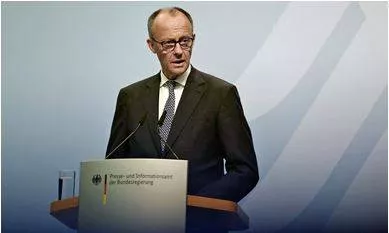
Germany’s merz faces an uphill battle amid trump tariffs slowing economy
Germany’s economy has contracted for two straight years; tensions have risen since Trump’s tariff announcement on the EU; as an EU member, the country cannot act alone on tariffs, and the EU is unlikely to retaliate since its major U.S. imports include oil, gas and pharmaceuticals, says an expert.On May 6, Friedrich Merz became the new Chancellor of Germany. In what was meant to be a mere formality of the Bundestag (German Parliament) members electing him as the next Chancellor, Mr. Merz couldn’t gather enough votes in the first round to be approved by the MPs. This has never happened with any previous Chancellor in post-War Germany. Mr. Merz managed to get 325 votes in the second round (Chancellor candidates need at least 316 votes) and was eventually sworn in. The ruling coalition comprises Mr. Merz’s conservative Christian Democrats (CDU/CSU) and the centre-left Social Democrats (SPD).
Even though migration was one of the key planks that Mr. Merz doubled down on during the election campaign, the focus has once again shifted to the German economy.
Speaking on national TV after becoming the Chancellor, Mr. Merz said, “We are undergoing a profound structural change, but for me the overriding message is that Germany must remain a country of manufacturing industry. We will improve the framework conditions of our economy so that in the coming years we will remain, or again become, an efficient country at the top of the world’s industrialised nations.”
The German economy has shown negative growth for two consecutive years. Things aren’t looking too promising for 2025 either, following U.S. President Donald Trump’s tariff announcements.
Ever since Mr. Trump’s ‘Liberation Day’ announcement on April 2, imposing 20% tariffs on the EU (now at 10%), economic tensions in Germany have been on the rise. Many economic institutes and think-tanks have run simulation studies on the impact this could have on individual EU member countries. Germany, being the country that exports the most to the U.S. (in the EU bloc), faces a lot of challenges.
Auto industry impacted
Despite the 90-day pause announced by Mr. Trump, the 25% tariffs on cars and car parts are in place. Germany exported close to 4,50,000 cars to the U.S. in 2024. It is estimated that the new tariffs would add $6,000 on average to every imported car to the U.S.
Sonali Chowdhry, a trade economist at the German Institute for Economic Research (DIW), co-authored a policy brief looking at the impact of U.S. tariffs on the EU.
Quantitative model analysis conducted by DIW and Kiel Institute for the World Economy, note that if there is a protracted trade war between the EU and the U.S. (both regions imposing the same tariffs on each other), then EU exports to the U.S. would be slashed by half. This could have an impact across industries in the EU, noted Ms. Chowdhry.
“Germany, in particular, could be looking at a real GDP contraction of 0.3%. It’s not only the actual tariff increases, but also the uncertainty created by the threats of tariffs that can depress economic activity as businesses and consumers defer investments and purchases,” said Ms. Chowdhry.
Thomas Obst, senior economist at the German Economic Institute (IW), feels that the impact of the tariffs would be immediate in the U.S., while it would build up over time in Germany.
“We, at IW, did a few studies to estimate the impact of Trump’s tariffs on Germany. If the EU is to retaliate with a 20% counter-tariff on the U.S., it could lower the German GDP by up to 1.5% till 2028. In Germany, it would build up over the next four years because of the structure of the economy. We would see second-round effects,” said Mr. Obst. Second-round effects refer to the indirect consequences (from the tariffs in this case) impacting wages, prices, and other economic variables.
As Germany is part of the EU, when it comes to matters around tariffs, it cannot retaliate unilaterally. The EU has little incentive to retaliate, notes Ms. Chowdhry, as most of the EU’s imports from the U.S. are in the areas of oil and gas, pharmaceuticals, chemicals and so on.
“Unless the EU is willing to bear higher energy costs and disrupt these supply chains, it makes more sense to de-escalate rather than retaliate. It is in the EU’s interest to seek an agreement with the U.S., while expanding trade with other partners,” said Ms. Chowdhry.
Mr. Obst concurs: “The EU does not want to retaliate, but offer something on the table that could reduce the tariff impact. It would also signal that the EU is taking a stronger stand against China,” said Mr Obst.
On May 8, the European Commission said that it would launch a dispute with the World Trade Organisation over the U.S. tariff policy and duties on cars and car parts, which are as high as 25%. It’s also preparing a list of counter-tariffs on U.S. products, amounting to 95 billion Euros, if trade talks with the U.S. fail.
‘Violates WTO rules’
In its statement, the EU Commission noted that US tariffs “blatantly violate fundamental WTO rules.”
“A more long-term strategy for the EU would be to deepen its trade relations with existing partners such as Canada, Mexico, Japan, South Korea, among others. Deepening trade with these partners and expanding free trade agreement (FTA) partners would neutralise the economic damages from U.S. tariffs,” said Ms. Chowdhry.
India could be a potential beneficiary if the EU decides to double down on expanding its FTAs.
“While a deep EU-India FTA would be difficult to realise soon, sectoral agreements (for instance, in the area of industrial goods) that focus on tariffs would be more feasible,” said Ms. Chowdhry.
“With India, there is no FTA on the horizon. However, the first international trip by the newly formed EU Commission was to India, which says a lot. India is seen as a partner in the Asia region, a very attractive market, but it’s also very protection is,” said Mr. Obst.
While Mr. Trump announced a 90-day pause on tariffs for most countries, there was one country that did not get that benefit — China. On 9 April, the tariffs directed at China stood at 145%, with China announcing counter-tariffs of 125% on U.S. imports. It was only on May 12, that the U.S. announced a 90-day pause with regards to Chinese tariffs and it currently stands at 30%.
In many circles in Germany and Europe, there are fears that this will lead to China dumping its excess production in Europe.
According to Ms. Chowdhry, China can reroute trade flows to Europe. “The EU must be very careful in its response to this, as it cannot afford to be drawn into a global spiral of protectionism. The EU should continue to use more targeted instruments to address dumping issues and not take a heavy-handed approach,” she said.
Mr. Obst feels the dumping will depend a lot on which sector is involved. “When it comes to standardised goods, it’s not a big deal as Germany or EU do not directly compete there. One industry that is very concerned is the automotive industry,” he said.





Stay updated with The Hindu Editorial Vocab24 app, your definitive source for breaking news and comprehensive coverage from India and around the globe. Whether it's political developments, business updates, sports highlights, the latest technology trends, or current events, The Hindu brings live, accurate, and reliable news directly to your device.
Don’t fall for sensationalized or fake news shared online. Read and share accurate updates with friends and family through The Hindu Editorial Vocab24 app. Download it today!
News Coverage in The Hindu Editorial Vocab24 App
Breaking News: Receive instant notifications on breaking news stories as they unfold. Stay informed about major events and developments in India and around the world with live blogs, news in shorts videos, and concise articles.
Politics: Get the latest updates on Indian politics, including elections, policy changes, government decisions, and political events that shape the nation.
Business and Economy: Stay ahead in the economic landscape with detailed business news and market analysis. Learn about stock market trends, financial reports, corporate news, and economic developments to make informed investment decisions.
Current Events: Follow stories on social issues, policy changes, global events, and daily current affairs, tailored for UPSC and other competitive exam preparations.
Technology: Keep up with the latest gadgets, innovations, and tech trends. Read expert reviews and analyses in short, concise updates on cutting-edge technology from India and beyond.
Sports: Never miss a moment of your favorite sports. Get live scores, match reports, and expert analysis on cricket, football, tennis, and more.
International News: Stay informed about global events and geopolitical developments, including the Russia-Ukraine war, Israel-Palestine conflict, and other key international stories.
Local News: Stay connected to your community with the latest updates on city events, issues, and local news. Coverage includes hyperlocal updates from cities like Bangalore, Chennai, Delhi, Hyderabad, Mumbai, Kolkata, and more.
Trending Topics: Discover what's trending today with the most talked-about stories and hot topics across India and the world.
Experience journalism that values integrity, accuracy, and reliability. Download The Hindu Editorial Vocab24 app today and stay connected with the world.
Subscribe to our newsletter!







