

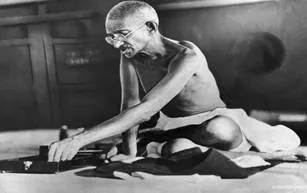
Gandhi and the socratic art of dying
There is a process of learning in the Gandhian act of self-sufferingToday is the 71st anniversary of Gandhi’s death. His assassination was a great shock. But, strangely, his death unified those in India who had lost faith in non-violent co-existence. As Nehru said, “the urgent need of the hour is for all of us to function as closely and co-operatively as possible.”
As a matter of fact, Gandhi’s death taught everyone about the worth of civic friendship and social solidarity. Gandhi himself was well aware of this, long before his return to India and his rise as the non-violent leader of the Indian independence movement. For example, in a letter to his nephew on January 29, 1909, he wrote, “I may have to meet death in South Africa at the hands of my countrymen... If that happens you should rejoice. It will unite the Hindus and Mussalmans... The enemies of the community are constantly making efforts against such a unity. In such a great endeavour, someone will have to sacrifice his life.”
It is interesting, how Gandhi, all through his life, talked about his death with a great deal of openness and with no sanctimony. It is as if for him the fundamental philosophical question — ‘should I live or die; to be or not to be’? — had already found its answer in the idea of self-sacrifice.
An intertwining
In the Gandhian philosophy of resistance, we can find the intertwining of non-violence and exemplary suffering. Perhaps, self-sacrifice is the closest we come to ethical dying, in the sense that it is a principled leave-taking from life; an abandonment of one’s petty preoccupations in order to see things more clearly. As such, there is a process of learning in the Gandhian act of self-suffering. For Socrates, to philosophise was to learn how to die. In the same way, for Gandhi, the practice of non-violence began with an act of self-sacrifice and the courage of dying for truth.
Socrates inspired Gandhi on the importance of self-sacrifice and the art of dying at a time when the latter was developing his idea of satyagraha in South Africa. Gandhi referred to Socrates as a “Soldier of Truth” (satyavir) who had the willingness to fight unto death for his cause. His portrayal of Socrates as a satyagrahi and a moral hero went hand in hand with the affirmation of the courage and audacity of a non-violent warrior in the face of life-threatening danger. Consequently, for Gandhi, there was a close link between the use of non-violence and the art of dying, in the same manner that cowardice was sharply related to the practice of violence.
Socratic aspects
Gandhi remained a Socratic dissenter all his life. Though not a philosopher, Gandhi admired moral and political philosophers, who, as a manner of Socrates, were ready to struggle for the truth. Like Socrates, Gandhi was neither a mystic nor a hermit. He was a practitioner of dissident citizenship. Gandhi considered Socrates’ civic action as a source of virtue and moral strength. He affirmed: “We pray to God, and want our readers also to pray, that they, and we too, may have the moral strength which enabled Socrates to follow virtue to the end and to embrace death as if it were his beloved. We advise everyone to turn his mind again and again to Socrates’ words and conduct.” Gandhi’s approach to death exemplified another Socratic aspect: courage. Gandhi believed that when fighting injustice, the actor must not only have the courage of his/her opinions but also be ready to give his/her life for the cause. As George Woodcock says, “the idea of perishing for a cause, for other men, for a village even, occurs more frequently in Gandhi’s writings as time goes on. He had always held that satyagraha implied the willingness to accept not only suffering but also death for the sake of a principle.”
Gandhi’s dedication to justice in the face of death was an example of his courageous attitude of mind as a Socratic gadfly. Further, one can find in Gandhi a readiness to raise the matter of dying as public policy. This is a state of mind which we can find as the background motto of Gandhi’s political and intellectual life. Indeed, for Gandhi, the art of dying was very often a public act and an act of publicising one’s will to be free.
There is something revealing in the parallel that Gandhi established between the struggle for freedom and the art of dying. In a speech at a meeting of the Congress in Bombay in August 1942, he invited his fellow freedom fighters to follow a new mantra: “Here is a mantra, a short one, that I give to you. You may imprint it on your hearts and let every breath of yours give expression to it. The mantra is ‘Do or Die.’ We shall either free India or die in the attempt; we shall not live to see the perpetuation of our slavery... He who loses his life will gain it, he who will seek to save it shall lose it. Freedom is not for the coward or the faint-hearted.”
Note here both the conviction in Gandhi that no other decision but dying was possible if the declaration of freedom was unachieved. Unsurprisingly, straightforward and honest. Which brings us back to January 30, 1948 when Mahatma Gandhi fell to the bullets of Nathuram Godse. One can understand this event as a variety of the Sophoclean saying: “Call no man happy until he is dead.” Like it or not, it seems that for Gandhi, to be human was to have the capacity, at each and every moment, to confront death as fulfillment of a Socratic life.




Top court quashes FIRs against Gen Z protesters
Sep 04, 2026






Stay updated with The Hindu Editorial Vocab24 app, your definitive source for breaking news and comprehensive coverage from India and around the globe. Whether it's political developments, business updates, sports highlights, the latest technology trends, or current events, The Hindu brings live, accurate, and reliable news directly to your device.
Don’t fall for sensationalized or fake news shared online. Read and share accurate updates with friends and family through The Hindu Editorial Vocab24 app. Download it today!
News Coverage in The Hindu Editorial Vocab24 App
Breaking News: Receive instant notifications on breaking news stories as they unfold. Stay informed about major events and developments in India and around the world with live blogs, news in shorts videos, and concise articles.
Politics: Get the latest updates on Indian politics, including elections, policy changes, government decisions, and political events that shape the nation.
Business and Economy: Stay ahead in the economic landscape with detailed business news and market analysis. Learn about stock market trends, financial reports, corporate news, and economic developments to make informed investment decisions.
Current Events: Follow stories on social issues, policy changes, global events, and daily current affairs, tailored for UPSC and other competitive exam preparations.
Technology: Keep up with the latest gadgets, innovations, and tech trends. Read expert reviews and analyses in short, concise updates on cutting-edge technology from India and beyond.
Sports: Never miss a moment of your favorite sports. Get live scores, match reports, and expert analysis on cricket, football, tennis, and more.
International News: Stay informed about global events and geopolitical developments, including the Russia-Ukraine war, Israel-Palestine conflict, and other key international stories.
Local News: Stay connected to your community with the latest updates on city events, issues, and local news. Coverage includes hyperlocal updates from cities like Bangalore, Chennai, Delhi, Hyderabad, Mumbai, Kolkata, and more.
Trending Topics: Discover what's trending today with the most talked-about stories and hot topics across India and the world.
Experience journalism that values integrity, accuracy, and reliability. Download The Hindu Editorial Vocab24 app today and stay connected with the world.
Subscribe to our newsletter!







