

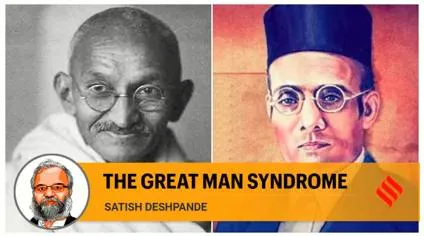
Gandhi savarkar and the irrelevance of facts
Successful politicians must place rhetoric before reason and reason before facts, even as they try to use all three. Tacitly acknowledged by politicians across all ideologies, this hierarchy recognises that though they may all be necessary, rhetoric, reason and facts are not equally important for the success of a political agenda. In order to blend them into a seamless persuasive mix, practitioners of politics must learn to interweave them in such a way that, taken together, they can cover up mutual weaknesses. Critics not trained in the art of political weaving often miss the synergy that drives a successful political programme. They pounce on factual errors — the polite term for political lies — and are puzzled when exposure fails to produce the expected results.When Rajnath Singh claimed that V D Savarkar’s mercy petitions to the British government were written at Gandhi’s behest, he could be accused not simply of lying, but of uttering a political lie. One of the archaic meanings of the English word “utter” is to pass or circulate counterfeit currency. This is a useful reference because political lies can be understood in analogy with currency. When you or I try to print money, we become criminals no matter what we wanted to spend the money on. But when a government “prints money” to spend more than it earns, this act is evaluated entirely on the basis of what is done with the money. In a roughly similar way, the impact of a political lie depends on the larger project it supports rather than the factual deficit it incurs.
That is why establishing the facts of the matter in painstaking detail to expose the falsity of Singh’s claims is unlikely to dent the political project that he espouses. In the big picture, the facts of Savarkar’s petitions (like their number or tone) do not matter much. What matters is the ideological work that the figure of Savarkar is made to do, the kind of political reason that he symbolises. And since he is also invoked as a referent, the same holds for Gandhi — what matters is not what he said or wrote in some specific context, but the larger political project that he is made to represent.
At this point, we run into a different set of problems arising from the fact that the dominant political discourse relies excessively on “great men”. Political debate in India often becomes a matter of your great man versus mine. This is problematic because the great man tends to be an indivisible icon who must be worshipped or despised in toto. Political competition takes a theological form, with rivals denounced as worshippers of false gods. When the great man becomes a political icon, the historical individual fades into the background, and the details of his life get separated from his iconic avatar. Simply put, the great-man-as-icon becomes “fact-proof”, and inconvenient biographical facts are met with “hurt sentiments”, followed by the forceful reassertion of hagiography.
How do we escape this impasse? One way out is to focus attention on the iconic role of the great man rather than his factual biography. What is the form of political reason that he is supposed to represent? What is the larger narrative attached to his name, the story in which followers are invited to find their place? And most importantly, what are the non-negotiable parts of this story?
The task seems relatively simple for Savarkar-as-icon: He stands for “Hindutva”. More accurately, iconic-Savarkar represents an idea of India in which Muslims and Christians — all the communities whose “punyabhoo” (or sacred place) is not within the geographical borders of India — can be second-class citizens at best. Regardless of the details about Savarkar-as-person, Savarkar-as-icon is designed to represent this ideal. This is where no room can be spared for ambiguity or interpretation — are we for this ideal, or against it? Choosing to fight on this ground (rather than on biographical details) raises the risks without improving the chances of victory, but it allows for a sharp focus on what is at stake.
A second method of avoiding dead-ends is to break down the monolith of the great man into coherent biographical segments. For example, what if we counterpose the Savarkar of the Ratnagiri anti-caste campaigns (roughly 1925 to 1937) to the Savarkar of Hindutva? At this time, Savarkar was pursuing a programme for the eradication of caste distinctions that was far more radical than that of Gandhi. This is the phase of the “Jatyuchhedak Nibandh”, the writings on caste eradication. Would the proponents of Hindutva be willing to accept this avatar of Savarkar and all of its implications? Shifting the debate to this level allows more room for manoeuvre by refusing the all-or-nothing frame of the monolithic great-man.
Finally, there is the most difficult option of all — subjecting one’s own great man to similar scrutiny. Gandhi is the obvious exemplar: Unlike Savarkar’s worshippers, those who worship Gandhi-as-icon have enjoyed state power for decades. Because of this, the iconic avatar of Gandhi has been normalised to such an extent that it is difficult to map its ideological boundaries. Broadly speaking, Gandhi-as-icon stands for an inclusive India where every community is assured of full membership. Such an avatar is usually surrounded by a halo of taken-for-granted legitimacy. But what about the less-discussed and more controversial aspects of this avatar such as the claim that the celebrated inclusionary acts associated with this icon have often demanded the surrender of agency? The starkest example here is the Poona Pact, which gave birth to reservation but paralysed Dalit and Adivasi political mobilisation for four decades. The “trusteeship” model of paternalistic relations between capitalists and workers could be another example. It is sobering to reflect on the fact that, for a long time, Gandhi-as-icon provoked more hurt sentiments than any other in our political pantheon.
Iconic great men matter because of what they symbolise, they are not monoliths — neither ours nor theirs are infallible. Nevertheless, they are not all the same.












Stay updated with The Hindu Editorial Vocab24 app, your definitive source for breaking news and comprehensive coverage from India and around the globe. Whether it's political developments, business updates, sports highlights, the latest technology trends, or current events, The Hindu brings live, accurate, and reliable news directly to your device.
Don’t fall for sensationalized or fake news shared online. Read and share accurate updates with friends and family through The Hindu Editorial Vocab24 app. Download it today!
News Coverage in The Hindu Editorial Vocab24 App
Breaking News: Receive instant notifications on breaking news stories as they unfold. Stay informed about major events and developments in India and around the world with live blogs, news in shorts videos, and concise articles.
Politics: Get the latest updates on Indian politics, including elections, policy changes, government decisions, and political events that shape the nation.
Business and Economy: Stay ahead in the economic landscape with detailed business news and market analysis. Learn about stock market trends, financial reports, corporate news, and economic developments to make informed investment decisions.
Current Events: Follow stories on social issues, policy changes, global events, and daily current affairs, tailored for UPSC and other competitive exam preparations.
Technology: Keep up with the latest gadgets, innovations, and tech trends. Read expert reviews and analyses in short, concise updates on cutting-edge technology from India and beyond.
Sports: Never miss a moment of your favorite sports. Get live scores, match reports, and expert analysis on cricket, football, tennis, and more.
International News: Stay informed about global events and geopolitical developments, including the Russia-Ukraine war, Israel-Palestine conflict, and other key international stories.
Local News: Stay connected to your community with the latest updates on city events, issues, and local news. Coverage includes hyperlocal updates from cities like Bangalore, Chennai, Delhi, Hyderabad, Mumbai, Kolkata, and more.
Trending Topics: Discover what's trending today with the most talked-about stories and hot topics across India and the world.
Experience journalism that values integrity, accuracy, and reliability. Download The Hindu Editorial Vocab24 app today and stay connected with the world.
Subscribe to our newsletter!







