

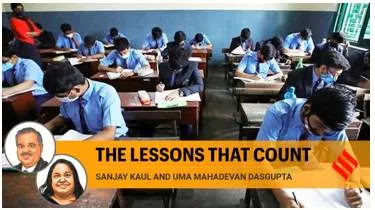
For better learning in post covid classroom
The Covid-19 pandemic has been devastating for school children. Of India’s 265 million children enrolled in school, the vast majority have barely set foot in the classroom for almost two years.Now that schools are reopening, they must first welcome the return of children, with warmth and reassurance. The classroom must be a safe and non-threatening space where children can shed the anxiety, stress and isolation of the last two years.
Thereafter, the immediate imperative is to address learning gaps. Failure to do so would leave this generation of children irreparably affected. E-content can only have minimal impact, as less than 12 per cent of government schools have internet connectivity, and only 24 per cent of families have smartphones. Most poor households do not own a TV. Hence, along with school reopening, we need a massive basic instruction and revision programme in the first year, to help primary school children consolidate the skills of reading, writing, numeracy, and comprehension at their own pace. Older children will also be able to settle back into the school rhythm without added stress. Government schools must institutionalise this revision and support programme to bridge learning gaps before embarking on new stages of the syllabus.
Equally, we must resolve the fundamental systemic issues of weak learning and an unimaginative curriculum. Primarily due to the obsessive and misplaced focus on rote learning, many children of low-income households struggle with basic reading, writing, and arithmetic skills, even after eight years of schooling. Compounding this situation is mismanagement and lack of accountability in state education departments. School education should go much beyond merely monitoring numbers – students enrolled, teachers appointed, textbooks distributed, mid-day meals supplied, buildings constructed and toilets built.
While these are essential, they are the basic minimum inputs; school education should aim to do much more. Nor are marks and test scores the correct measure of the system’s efficacy. The real goals of education are to enhance cognitive development and creative thinking.
The starting point to improve quality is a focus on meaningful learning. This requires school education departments to work closely with teachers, improve their pedagogic practices, and shift the focus from the rigid curriculum. For this, teachers should be given greater autonomy inside classrooms.
Would such recalibration further exacerbate the divide between children of poor and rich households? Superficially so. However, the Brazilian philosopher of education Paulo Freire, in his classic Pedagogy of the Oppressed, flipped mainstream pedagogy on its head by pointing out that knowledge and expertise already exist within children. Children from low-income families acquire complex and nuanced learning from their experiences and everyday environment. Conventional thinking presumes educators are experts, while students are empty and passive receptacles. According to Freire, this frame of thinking must be replaced by making teachers “liberating educators” who help children to build on their knowledge and understanding. One way to achieve this would be for each school to incorporate strong local elements within a common curriculum framework. Teachers need space for creativity and a freer classroom environment.
Besides curriculum reform, pedagogic practices must change. There are one million government schools and five million government school teachers in India. Training teachers to change pedagogic practices poses considerable challenges and requires enhanced budgets and well-trained faculty; quite unlike the present situation where budgets are modest and faculty are mostly drawn from the cadre of education administrators.
Alongside the above supply-side recommendations on instruction, pedagogy, curricular reform and training, there is a need to address the demand side. Parents from low-income families perceive government school education as offering little value, resulting in their sense of indifference and resignation. Further, as educated and well-off parents send their children to private schools, there is little societal pressure on the state to improve education quality. However, the perception of poor quality can be quickly changed — as has been shown in a few states, such as Kerala and Delhi, with equal equipment of government schools, and improved exam performance. An attractive physical school environment may not be adequate to change long-held perceptions.
Children will attend school and participate happily if, alongside the regular curriculum, it offers activities that enrich their school experience and make it fun. Even at the cost of reducing the time allocated to formal classroom teaching, it would be valuable to reorganise the school day with time devoted to activities such as art, music, and sports, along with the formal curriculum and the focus shifted to providing holistic education.
Not least of all, school governance reform and teacher motivation are vital factors to improve quality. As education officials are preoccupied with supply chain management issues, academic management and supervision require an exclusively dedicated cadre. The major pain point of government school teachers is in the manner of their posting to schools. Teachers are often constrained to use political influence or corruption to get themselves posted to locations of their preference. With rapidly increasing numbers of women working as primary school teachers, their safety and convenience must also become a priority. Transparency and fairness in postings and transfers are vital to motivate teachers and improve their performance.












Stay updated with The Hindu Editorial Vocab24 app, your definitive source for breaking news and comprehensive coverage from India and around the globe. Whether it's political developments, business updates, sports highlights, the latest technology trends, or current events, The Hindu brings live, accurate, and reliable news directly to your device.
Don’t fall for sensationalized or fake news shared online. Read and share accurate updates with friends and family through The Hindu Editorial Vocab24 app. Download it today!
News Coverage in The Hindu Editorial Vocab24 App
Breaking News: Receive instant notifications on breaking news stories as they unfold. Stay informed about major events and developments in India and around the world with live blogs, news in shorts videos, and concise articles.
Politics: Get the latest updates on Indian politics, including elections, policy changes, government decisions, and political events that shape the nation.
Business and Economy: Stay ahead in the economic landscape with detailed business news and market analysis. Learn about stock market trends, financial reports, corporate news, and economic developments to make informed investment decisions.
Current Events: Follow stories on social issues, policy changes, global events, and daily current affairs, tailored for UPSC and other competitive exam preparations.
Technology: Keep up with the latest gadgets, innovations, and tech trends. Read expert reviews and analyses in short, concise updates on cutting-edge technology from India and beyond.
Sports: Never miss a moment of your favorite sports. Get live scores, match reports, and expert analysis on cricket, football, tennis, and more.
International News: Stay informed about global events and geopolitical developments, including the Russia-Ukraine war, Israel-Palestine conflict, and other key international stories.
Local News: Stay connected to your community with the latest updates on city events, issues, and local news. Coverage includes hyperlocal updates from cities like Bangalore, Chennai, Delhi, Hyderabad, Mumbai, Kolkata, and more.
Trending Topics: Discover what's trending today with the most talked-about stories and hot topics across India and the world.
Experience journalism that values integrity, accuracy, and reliability. Download The Hindu Editorial Vocab24 app today and stay connected with the world.
Subscribe to our newsletter!







