

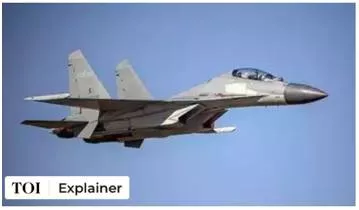
Explainer why is china staging military drills around taiwan
BEIJING: China is staging live-fire military drills in six self-declared zones surrounding Taiwan in response to a visit by US House Speaker Nancy Pelosi to the island Beijing claims as its own territory.China has warned aircraft and ships to avoid the areas during the exercises, which run through Sunday. The drills appear to be a rehearsal for a potential blockade and invasion of the island that would almost certainly draw in Taiwan’s chief supporter, the United States, along with American allies including Japan and Australia.
China’s 2 million-strong military is the world’s largest and its navy has more ships than the US Taiwan’s armed forces can’t compare in numbers, but it has vowed to resist coercive measures to impose Chinese Communist Party rule over the self-governing island democracy.
‘It will take some hard diplomacy to reestablish a stable equilibrium,’ said Stanford University political scientist Kharis Templeman. ‘I don’t know how this confrontation will ultimately play out, but I think we are in for a rocky few weeks.’
The following is a look at the issues surrounding the escalation of tensions.
What is China doing in seas and skies around Taiwan?
China says it has begun exercises involving warplanes, navy ships and missile strikes in six zones surrounding Taiwan. Those lie as little as 20 kilometers (12 miles) off the island’s coast, potentially infringing on Taiwan’s territorial waters. Few details have been given by Beijing, but it has described the drills as punishment for the US allowing Pelosi’s visit to proceed, even though President Joe Biden did not have the authority to prevent her traveling to the island.
Live-fire exercises are a test of a military’s ability to perform missions under conditions most resembling actual warfare. In this case, they are designed to show the level of force China could unleash against Taiwan if Beijing decided to make good on the pledge to seize control of the island and punish those supporting its independence.
The exercises are thought to be the largest and most threatening toward Taiwan since Beijing launched missiles into waters north and south of the island in 1995 and 1996 in response to a visit to the US by then-President Lee Teng-hui. China regularly sends warplanes into Taiwan’s air defense identification zone and has at times crossed the middle line of the Taiwan Strait dividing the sides, but has stopped short of direct incursions or attacks that could spark a regional conflict.
Why is China taking these actions and what does it hope to achieve?
China has increasingly forcefully declared that Taiwan must be brought under its control by force if necessary and in defiance of Washington and other backers of the island’s democracy. Pelosi’s visit came at a particularly sensitive time when Chinese President and head of the armed forces Xi Jinping is preparing to seek a third five-year term as leader of the ruling Communist Party. Xi has named no successor and he’s accumulated vast powers despite criticism of his handling of the economy, partly as a result of his hardline approach to Covid-19 and a marked downturn in relations with the West.
Xi has said Taiwan’s fate cannot remain unsettled indefinitely and US military officials have said China may seek a military solution within the next few years. China’s constitution incorporates Taiwan in its national territory and its 2005 anti-secession law threatens invasion if ‘possibilities for a peaceful reunification should be completely exhausted,’ seen to apply in the case of a formal declaration of independence or foreign intervention.
China insists that Taiwan accept its contention that the island is a part of China, whose sole legitimate government sits in Beijing. In the face of China’s military threats and relentless campaign to isolate Taiwan diplomatically, islanders overwhelmingly support the status quo of de facto independence. That sentiment has been further reinforced by Beijing’s ruthless crackdown on political rights and free speech in Hong Kong, which China has long touted as a model for its future governance of Taiwan.
What has been the response from Taiwan and the US?Taiwan has put its military on alert and staged civil defense drills. While its air force, navy and 165,000-member armed forces are a fraction of the size of China’s, they have been bolstered by high-tech weaponry and early-warning systems intended to make a Chinese invasion as difficult as possible. Russia’s invasion of Ukraine, which China has tacitly supported, has also served as a wakeup call to Taipei, which is now looking to overhaul training and tactics.
Numerous US naval and other military assets are currently deployed in areas close to Taiwan, including the aircraft carrier USS Ronald Reagan and its battle group. Washington has comprehensively rejected China’s claims that the Taiwan Strait is sovereign Chinese territory and maintains the right to sail past Chinese outposts in the South China Sea, despite Chinese protests.
What are the risks and how long will tensions persist?
It remains unclear whether China will seek to keep tensions at a high pitch even after the end of the current round of exercises. Spokespeople from the Foreign and Defense Ministries, the Cabinet’s Taiwan Affairs Office and other departments have vowed President Tsai Ing-wen’s administration and the US government will pay a price over Pelosi’s visit, but have not given details on how and when that objective will be achieved.
Following the visit, White House National Security Advisor Jake Sullivan told US National Public Radio that ‘the possibility of some kind of incident is real,’ given the scale of the Chinese exercises.
‘And we believe that what China is doing here is not responsible. We believe that it is escalating tensions unnecessarily,’ Sullivan said.
The long-standing modus vivendi between Washington and Beijing is being ‘seriously challenged’ by both sides, said Templeman, the Stanford University political scientist.
Washington has pushed back against Beijing with high-level visits, a relaxation of official contact restrictions and arms sales.
‘Washington as a whole has become much less concerned about offending China and much less deferential to Beijing’s demands related to Taiwan,’ Templeman said.












Stay updated with The Hindu Editorial Vocab24 app, your definitive source for breaking news and comprehensive coverage from India and around the globe. Whether it's political developments, business updates, sports highlights, the latest technology trends, or current events, The Hindu brings live, accurate, and reliable news directly to your device.
Don’t fall for sensationalized or fake news shared online. Read and share accurate updates with friends and family through The Hindu Editorial Vocab24 app. Download it today!
News Coverage in The Hindu Editorial Vocab24 App
Breaking News: Receive instant notifications on breaking news stories as they unfold. Stay informed about major events and developments in India and around the world with live blogs, news in shorts videos, and concise articles.
Politics: Get the latest updates on Indian politics, including elections, policy changes, government decisions, and political events that shape the nation.
Business and Economy: Stay ahead in the economic landscape with detailed business news and market analysis. Learn about stock market trends, financial reports, corporate news, and economic developments to make informed investment decisions.
Current Events: Follow stories on social issues, policy changes, global events, and daily current affairs, tailored for UPSC and other competitive exam preparations.
Technology: Keep up with the latest gadgets, innovations, and tech trends. Read expert reviews and analyses in short, concise updates on cutting-edge technology from India and beyond.
Sports: Never miss a moment of your favorite sports. Get live scores, match reports, and expert analysis on cricket, football, tennis, and more.
International News: Stay informed about global events and geopolitical developments, including the Russia-Ukraine war, Israel-Palestine conflict, and other key international stories.
Local News: Stay connected to your community with the latest updates on city events, issues, and local news. Coverage includes hyperlocal updates from cities like Bangalore, Chennai, Delhi, Hyderabad, Mumbai, Kolkata, and more.
Trending Topics: Discover what's trending today with the most talked-about stories and hot topics across India and the world.
Experience journalism that values integrity, accuracy, and reliability. Download The Hindu Editorial Vocab24 app today and stay connected with the world.
Subscribe to our newsletter!







