

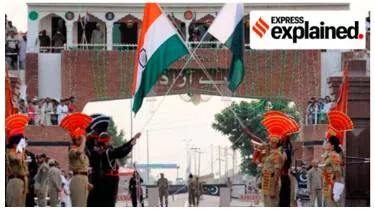
Explained books the complex india pak relationship and ground realities to live with
India’s Pakistan Conundrum: Managing a Complex Relationship.Pakistan is in the midst of another spiralling political and economic crisis. Prime Minister Shahbaz Sharif, who took office in April after the opposition voted out the Imran Khan government, has to take tough economic decisions, which risk making the ruling combine unpopular, that too with just a year to go for elections. The former prime minister, meanwhile, is drawing huge crowds as he rails against an alleged U.S. conspiracy that unseated him. His bete noire, Army chief General Javed Qamar Bajwa, is due to retire in November. Who his successor will be may well decide the political course over the next five years. Meanwhile, even if the Sharif government had wanted to take some steps such as the restarting of trade ties with India, Khan’s reckless readiness to throw anything at Sharif and Bajwa has diminished the space once again for any improvement in India-Pakistan relations.
At this moment of great flux in India’s neighbour comes Sharat Sabharwal’s book, India’s Pakistan Conundrum (Routledge), to guide us through the country’s complexities. In a matter-of-fact manner, Sabharwal, who was Indian High Commissioner at Islamabad from 2009 to 2013, and served there in the 1990s too, explains why a Pakistan policy, “born out of anger and false notions of national honour can cause more harm than good” and “accepting the ground realities and working accordingly is sagacity, not pusillanimity”.
What are those ground realities? Sabharwal lays these out: yes, Pakistan is a dysfunctional state because of its civil-military imbalance and the the use of jihadi/terrorist groups. But Pakistan is here to stay, and any strategy premised on its disintegration is bound to be flawed, not least because the resulting chaos will not stop at the boundaries of that country. Plus it has nuclear weapons. An all-out war is not a great idea. India’s tactical military options to deter Pakistan’s terror machine (“surgical strikes”, Balakot for Pulwama) may carry only temporary impact. Coercion through trade or water does not work – in the first case, the volumes are too small, and the second could lead to unintended consequences for India where it is the lower riparian (as with China). With the snug China-Pakistan relationship, Pakistan is now part of India’s bigger China problem.
Sabharwal favours a pragmatic approach that stresses the region’s co-prosperity, in which Pakistan will realise it has more to gain by bettering itself economically than pulling India down, but is also clear that this realisation may take time to dawn on Pakistan, as its fragile self-identity — “not India” — comes in the way of rational decision-making and good sense. That is happening in India too, and Sabharwal has a word of advice on this: if you want to change Pakistan’s behaviour, there is work to be done at home, and this is not just about military strength and counter-terror capabilities. It is about denying Pakistan opportunities to fish in troubled waters by putting India’s own house in order, including in Jammu & Kashmir, rebuilding what used to be the broad national consensus on foreign policy that no longer exists, and avoiding competitive show of nastiness towards the neighbour.
But one of the more fascinating stories Sabharwal tells is about how at one time, in the not too distant past, the two sides were prepared to put aside differences and make rational choices. This was in the trade negotiations between 2011 and 2012. This is especially interesting after the Imran Khan government last year did a U-turn on the decision to reopen the Wagah border for limited trade in sugar and cotton until India reversed its August 2019 decisions on Kashmir. These talks succeeded in breaking much new ground, only to crash on the beheadings of three Indian soldiers at the Line of Control.
But there’s a twist in the tale. In Pakistan, Nawaz Sharif was elected in 2013, and his government decided to take up the all but final trade agreement with India once again. In March 2014, writes Sabharwal, he learnt from Indian official circles – he had retired from service the previous year – that if necessary, the UPA government was prepared even to seek approval from the Election Commission to complete the trade normalisation process. But the momentum slowed. A retired Pakistani official told Sabharwal that the Pakistan High Commission conveyed to the government that they had been advised by a BJP honcho that Nawaz Sharif should wait and sign the trade deal with the incoming BJP government. The rest, as they say, is history – of a missed opportunity.
The book has solid chapters on Pakistan’s internal dynamics, including on the Army and the civil-military imbalance, the J&K question and the backchannel process, and the nuclear dimension in the India-Pakistan relationship.
Sabharwal has permitted himself to narrate only a few personal incidents, but he weaves them in nicely. As a Punjabi from India, he spoke the language of Pakistan’s predominant ethnic group, and built an easy rapport with many members of its political elite, including Nawaz Sharif. When he paid a farewell call to President Asif Ali Zardari in July 2013 after his rival Sharif had won the election, the PPP leader told him jovially: “Tussi apne yaar nu PM bana key chal paye”. He also recalled his 80-year-old mother’s visit to her home in Lahore, and the easy conversation between her and the lady of the house, as if they had known each other all their lives.










Stay updated with The Hindu Editorial Vocab24 app, your definitive source for breaking news and comprehensive coverage from India and around the globe. Whether it's political developments, business updates, sports highlights, the latest technology trends, or current events, The Hindu brings live, accurate, and reliable news directly to your device.
Don’t fall for sensationalized or fake news shared online. Read and share accurate updates with friends and family through The Hindu Editorial Vocab24 app. Download it today!
News Coverage in The Hindu Editorial Vocab24 App
Breaking News: Receive instant notifications on breaking news stories as they unfold. Stay informed about major events and developments in India and around the world with live blogs, news in shorts videos, and concise articles.
Politics: Get the latest updates on Indian politics, including elections, policy changes, government decisions, and political events that shape the nation.
Business and Economy: Stay ahead in the economic landscape with detailed business news and market analysis. Learn about stock market trends, financial reports, corporate news, and economic developments to make informed investment decisions.
Current Events: Follow stories on social issues, policy changes, global events, and daily current affairs, tailored for UPSC and other competitive exam preparations.
Technology: Keep up with the latest gadgets, innovations, and tech trends. Read expert reviews and analyses in short, concise updates on cutting-edge technology from India and beyond.
Sports: Never miss a moment of your favorite sports. Get live scores, match reports, and expert analysis on cricket, football, tennis, and more.
International News: Stay informed about global events and geopolitical developments, including the Russia-Ukraine war, Israel-Palestine conflict, and other key international stories.
Local News: Stay connected to your community with the latest updates on city events, issues, and local news. Coverage includes hyperlocal updates from cities like Bangalore, Chennai, Delhi, Hyderabad, Mumbai, Kolkata, and more.
Trending Topics: Discover what's trending today with the most talked-about stories and hot topics across India and the world.
Experience journalism that values integrity, accuracy, and reliability. Download The Hindu Editorial Vocab24 app today and stay connected with the world.
Subscribe to our newsletter!







