

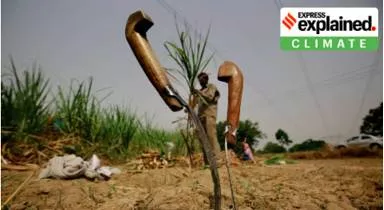
Explained why drought is looming over uttar pradesh jharkhand and bihar
Never have Uttar Pradesh and Jharkhand experienced such poor monsoon rainfall in the last 122 years. As farmers in the two states await a good spell to take up sowing, the administration is finalising contingency plans. Food and water scarcity are going to be the real issues in the country’s major rice producing states, with a potential to affect India’s kharif produce this year.The worst monsoon for Jharkhand and Uttar Pradesh in a century
Jharkhand and Uttar Pradesh are experiencing the worst monsoon season of the century.
Between June 1 and August 12, the rainfall recorded over Jharkhand was 371.9mm against a normal of 627.6mm, a 41 per cent seasonal deficit. This is the lowest ever rainfall recorded over Jharkhand (June to August) since 1901, the IMD’s rainfall data stated. Only twice before in the last 122 years has Jharkhand experienced such poor rainfall (below 500mm for June to August period) — in 2010 (439mm), and 1993 (469.6mm). A closer rainfall deficit was reported in 2019 (593mm).
For Uttar Pradesh, too, the picture is grim, as the state has recorded only 251.7mm of the seasonal average of 449.1mm till August 12.
UP is the most rain deficient Indian state this year and has remained so since the start of the monsoon season, like Jharkhand.
Between 1901 and 2021 , UP’s driest monsoon months (June to August) were during 1987 (349.3mm), 2009 (365mm), 1996 (392mm), 2014 (394.3mm), and 1972 (424.3mm).
Except Dhanbad (2 weeks), East Singhbhum (8 weeks), West Singhbhum (2 weeks), and Giridih and Saraikela (1 week each), the other 19 districts of Jharkhand have not received normal rainfall during any of the past 10 monsoon weeks, the IMD’s week-wise rainfall (till August 10) stated.
The driest districts in Jharkhand this season (in per cent) include Pakur (-70), Jamtara and Sahebganj (-69, each), Godda (-68), Chatra (-64), Garhwa (-61), Deoghar (-56), Latehar (-54), Palamu and Dumka (-52,each), Lohardaga (-48), Giridih (-47), Koderma (-44), Sindega and Hazaribagh (-43 each), and Dhanbad and Gumla (-42 each).
The worst affected districts in UP include Farrukhabad (-77), Jaunpur (-72), Kanpur Dehat (-70), Mau (-65), Chandauli (-63), Ballia and Bahraich (-62 each), Basti (-59), Amethi (-57), Banda (-52) and Ayodhya (-51).
The reservoir storage report dated August 11 by the Central Water Commission stated that the water reserves in the six major reservoirs in Jharkhand was 0.594 Billion Cubic Metre (BCM) against a 10-year average of 1.18 BCM. That is, the available water stocks measure only 30 per cent of the total storage capacity. For comparison, the same stocks at this time last year were 78 per cent of the total storage capacity.
UP’s reservoirs have filled up to 28 per cent of the total storage capacity of eight dams. In 2021, it was 53 per cent. The current water reserves is 2.15BCM against a 10-year average of 3.09BCM.
In a departure from the norm of overflowing Ganges and flooding, the 2022 monsoon has been anything but normal for Bihar. During the ongoing season, Bihar has recorded 376.5mm versus a normal of 602.6mm, a deficit of 38 per cent, till August 12.
The 2022 monsoon could turn out to be Bihar’s worst — only once before, in 1972, the state received 375mm during June to August. Earlier poor monsoon seasons for these three months have been in 2010 (466.6mm), 2013 (50.32mm), 2012 (573.9mm) and 1992 (588.7mm).
Overall, the month of July was the driest over the East and Northeast India since 1903; it ended with a 45 per cent rain deficit. Since the monsoon onset, Manipur (-41 per cent), Tripura (-29 per cent) and West Bengal (-21 per cent) remain in the rainfall ‘deficient’ category. Only Assam and Meghalaya, Sub-Himalayan West Bengal and Sikkim (5 per cent each) and Arunachal Pradesh (-12 per cent, but normal) in the east and northeast India regions have recorded normal rainfall this monsoon season.
What are the long-term monsoon trends?
Jharkhand: July and August amount to the highest rainfall during the monsoon season at 31 per cent and 28 per cent, respectively. 84 per cent of the state’s annual rainfall occurs between June and September.
Rainfall has been decreasing over Garhwa, Chatra and Koderma districts in June. For September, a similar decreasing trend was observed over Chatra, Koderma, Godda, Sahebganj and Dhanbad districts.
For July and August, there emerged no trend and no district showed an increase in rainfall during the monsoon season.
During the southwest monsoon season, rainfall over Garhwa, Chatra, Koderma, Godda, Sahebganj, Dhanbad, Bokaro and Simdega districts have been on a decline, the IMD’s report on rainfall variability over Jharkhand (1989-2018) stated. The annual rainfall, which is about 1211.4mm, too has been decreasing in recent decades.
During the period June to September, the maximum number of rainy days ranges between 46 and 50 days. This was mostly limited to Gumla, Simdega, West Singhbhum, East Singhbhum, Dhanbad, Jamtara and Pakur districts.
Uttar Pradesh: 34 per cent of the monsoon seasonal rainfall occurs in July and 31 per cent in August. 89 per cent of the annual rainfall is realised during the June to September months.
There is a declining rainfall quantum during the southwest monsoon season and in the total annual rainfall, according to the IMD’s report on rainfall variability over Uttar Pradesh (1989-2018). There is an insignificant rainfall increasing trend observed during June, July and August, while the rainfall during September has been significantly declining.
Gorakhpur district receives the highest rainfall in UP across the southwest monsoon season.
Districts in the northeast of Uttar Pradesh (except Khushi Nagar and Ballia) receive high rainfall amounts in comparison to districts in the southwest.
During the southwest monsoon season, rainfall between 421-560 mm is commonly received over Baghpat, Bulandshahar, Aligarh, Mathura, Mahamaya Nagar, Etah, Ayodhya, Agra, Etawah, Kannauj, Auraiya, Kanpur Dehat, Kanpur, Mahoba, Rae Bareli, Kaushambi and Khushi Nagar districts.
The lowest rainfall during June to September was recorded over Mathura, Auraiya, Rae Bareli and Mahoba.
Bihar: 33 per cent of Bihar’s monsoonal rainfall occurs in July and 28 per cent occurs in August. More than 85 per cent of the annual rainfall is realised between June and September.
According to the IMD’s rainfall variability over Bihar (1989-2018) report, rainfall during the June to September period has been decreasing.
Kishanganj, Arariya, Purnia and West Champaran receive the highest rainfall during the southwest monsoon season. The seasonal and annual rainfall over districts along Bihar’s southwest is lesser than the other regions in the state.
Month-wise rainfall (in mm) over Jharkhand, Bihar and Uttar Pradesh during the southwest monsoon season. (Source: IMD)
So, what are the causes for rain deficit?
This season, only three low pressure systems developed in the Bay of Bengal, mostly off the coast of Odisha. None of these systems impacted Jharkhand, Uttar Pradesh or Bihar. Thus, one of the two rain-bearing causes remained out of favour for these states.
In addition, this year, the monsoon trough — an east-west low-pressure area extending from the heat low over Pakistan to head Bay of Bengal – remained to the south of its normal position for majority of the days in July and in August, so far.
‘The low pressure systems did not move along Bihar, Jharkhand and Uttar Pradesh,’ said Pulak Guhathakurta, head, Climate Research Division at IMD, Pune.
Such unfavourable conditions contributed to high rainfall deficits throughout the season, he noted.
The monsoon trough’s location, oscillation, and duration over a specific location, all directly affect the rainfall activity over the regions exactly to the south of its position.
That is, when it is located to the south of its normal position, there is active or vigorous rainfall over most parts of central, peninsular India regions. When it shifts to the north of its normal position or lays along the Himalayan foothills, Uttar Pradesh, Bihar, Jharkhand, West Bengal and the northeastern states benefit.
So, what should farmers do?
In UP, the Agriculture Meteorology division has advised carrying out transplantation of rice till August 15, and suggested the use of short duration rice varieties. Experts have encouraged cultivation of red gram.
‘We recommend farmers opt for inter-cropping and take up short duration rice varieties,’ said Kripan Ghosh, head, Agriculture Meteorology division of IMD.
For farmers in Jharkhand, the Agrimet has suggested adopting measures to conserve moisture in the soil. No sowing is advised until there is 50 to 60mm rainfall and sufficient moisture for at least three consecutive days. Short duration rice, millet, maize, and arhar must be considered for cultivation during the rest of the season.












Stay updated with The Hindu Editorial Vocab24 app, your definitive source for breaking news and comprehensive coverage from India and around the globe. Whether it's political developments, business updates, sports highlights, the latest technology trends, or current events, The Hindu brings live, accurate, and reliable news directly to your device.
Don’t fall for sensationalized or fake news shared online. Read and share accurate updates with friends and family through The Hindu Editorial Vocab24 app. Download it today!
News Coverage in The Hindu Editorial Vocab24 App
Breaking News: Receive instant notifications on breaking news stories as they unfold. Stay informed about major events and developments in India and around the world with live blogs, news in shorts videos, and concise articles.
Politics: Get the latest updates on Indian politics, including elections, policy changes, government decisions, and political events that shape the nation.
Business and Economy: Stay ahead in the economic landscape with detailed business news and market analysis. Learn about stock market trends, financial reports, corporate news, and economic developments to make informed investment decisions.
Current Events: Follow stories on social issues, policy changes, global events, and daily current affairs, tailored for UPSC and other competitive exam preparations.
Technology: Keep up with the latest gadgets, innovations, and tech trends. Read expert reviews and analyses in short, concise updates on cutting-edge technology from India and beyond.
Sports: Never miss a moment of your favorite sports. Get live scores, match reports, and expert analysis on cricket, football, tennis, and more.
International News: Stay informed about global events and geopolitical developments, including the Russia-Ukraine war, Israel-Palestine conflict, and other key international stories.
Local News: Stay connected to your community with the latest updates on city events, issues, and local news. Coverage includes hyperlocal updates from cities like Bangalore, Chennai, Delhi, Hyderabad, Mumbai, Kolkata, and more.
Trending Topics: Discover what's trending today with the most talked-about stories and hot topics across India and the world.
Experience journalism that values integrity, accuracy, and reliability. Download The Hindu Editorial Vocab24 app today and stay connected with the world.
Subscribe to our newsletter!







