

Explained where ukraine war stands after 6 months
When Russian President Vladimir Putin invaded Ukraine on February 24 in an unprovoked act of aggression, many expected a quick victory.'India will have to take an ethical stand on Ukraine war'
Six months later, the largest military conflict in Europe since World War II has turned into a grinding war of attrition. The Russian offensive has largely bogged down as Ukrainian forces increasingly target key facilities far behind the front lines, including in Russia-occupied Crimea.
Ukrainian President Volodymyr Zelenskyy vowed in an Independence Day address on Wednesday that his country will fight Russia's invasion ‘until the end’ and will not be making ‘any concession or compromise’.
‘We don't care what army you have, we only care about our land. We will fight for it until the end,’ Zelensky says in a video address, on the day which also marks six months since the invasion began.
Since Russian President Vladimir Putin sent in troops on February 24, 2022, Zelensky has led the resistance from Kyiv.
Six months on, Ukraine fights war, faces painful aftermath
Big miscalculation
When Putin declared the start of the ‘special military operation,’ he urged Ukraine's military to turn against the government in Kyiv, reflecting the Kremlin's belief that the population would broadly welcome the invaders.
Some of the Russian troops coming in from Moscow's ally of Belarus, just 200 kilometers (about 125 miles) north of the capital, reportedly brought their parade uniforms with them in preparation for a quick triumph.
Those hopes were quickly shattered by fierce Ukrainian resistance, backed by Western-supplied weapons systems.
Airborne troops sent to seize airfields around Kyiv suffered heavy losses and armored convoys stretching along the main highway leading to the capital were pummeled by Ukrainian artillery and scouts.
One month into the war, Moscow pulled its troops back from areas near Kyiv, Kharkiv, Chernihiv and other major cities in a tacit acknowledgment of the blitz's failure.
Shift in Kremlin's strategy
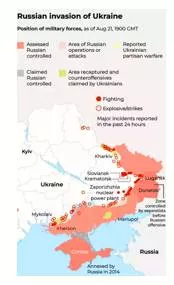
The Kremlin then shifted its focus to the Donbas, Ukraine's eastern industrial heartland, where Moscow-backed separatists had been fighting government troops since 2014 following Russia's annexation of the Crimean Peninsula.
Relying on their massive edge in artillery, Russian forces inched forward in ferocious battles that devastated the region. The strategic port of Mariupol on the Sea of Azov that became a symbol of Ukrainian resistance fell in May after a nearly three-month siege that reduced the city to ruins.
More than 2,400 Mariupol defenders who holed up at the giant Azovstal steel mill later surrendered and were taken prisoner. At least 53 of them died last month in an explosion at a prison in eastern Ukraine that Moscow and Kyiv blamed on each other.
The Russians have taken control of the entire Luhansk region, one of two provinces that make up the Donbas, and also seized just over half of the second, Donetsk.
Russia currently occupies about 20% of Ukraine's territory.
Weapons supplied by the West
Western weapons, including US HIMARS multiple rocket launchers, have boosted Ukraine's military's capability, allowing it to target Russian munitions depots, bridges and other key facilities with precision and impunity.
In a major symbolic victory in April, the flagship of Russia's Black Sea Fleet, the Moskva missile cruiser, exploded and sank while on patrol after reportedly being hit by a Ukrainian missile. That dealt a heavy blow to Russia's pride and forced it to limit naval operations.
Another big win for Ukraine came when Russian troops pulled back from strategic Snake Island, located on shipping lanes near Odesa, following relentless Ukrainian attacks. The retreat reduced the threat of a seaborne Russian attack on Odesa, helping pave the way for a deal to resume Ukrainian grain exports.
Lives lost and disrupted
Both Russia and Ukraine mostly focus on the casualties they inflict on each other, avoiding mention of their own losses.
But Ukraine's military chief, Gen. Valerii Zaluzhnyi, said Monday that nearly 9,000 Ukrainian soldiers have been killed in action.
The Russian defense ministry last reported its casualties on March 25, one month into the war, when it said 1,351 soldiers had been killed and 3,825 were wounded.
Western estimates of Russian dead have ranged from more than 15,000 to over 20,000 - more than the Soviet Union lost during its 10-year war in Afghanistan.
The Pentagon said last week that between 70,000 to 80,000 Russian troops have been killed or wounded in action - losses that have eroded Moscow's capability to conduct big offensives.
The UN High Commissioner for Human Rights has recorded over 5,500 civilian deaths in the war, but noted the actual numbers could be significantly higher.
The invasion has created the largest postwar refugee crisis in Europe. The UN refugee agency says a third of Ukrainians have fled their homes, with more than 6.6 million displaced within the country and over 6.6 million more across the continent.
In the coming months
The war's outcome will depend on the ability of Russia and Ukraine to muster additional resources.
While Ukraine has conducted a mobilisation and declared a goal to form a 1 million-member military, Russia has continued to rely on a limited contingent of volunteers, an approach reflecting Kremlin fears that a mass mobilisation could fuel discontent and destabilise the country.
Moscow has opted for interim steps, trying to encourage people to sign contracts with the military, increasingly engaging private contractors such as the Wagner Group, and even rounding up some prisoners for service - half-measures unable to meet the needs for any big offensives.
Ukraine also lacks resources for any quick reclamation of its territory, with retired British Gen. Richard Barrons estimating it could take well into next year to amass a force capable of driving the Russians out.
He said the West should be prepared to continue supporting Ukraine for a long time, despite soaring energy prices and other economic challenges stemming from sanctions imposed on Russia. Abandoning Ukraine, he said, would send a message ‘to Russia and China and everybody else that the West does not have the stomach to stand up for its friends or even its own interests.’









Stay updated with The Hindu Editorial Vocab24 app, your definitive source for breaking news and comprehensive coverage from India and around the globe. Whether it's political developments, business updates, sports highlights, the latest technology trends, or current events, The Hindu brings live, accurate, and reliable news directly to your device.
Don’t fall for sensationalized or fake news shared online. Read and share accurate updates with friends and family through The Hindu Editorial Vocab24 app. Download it today!
News Coverage in The Hindu Editorial Vocab24 App
Breaking News: Receive instant notifications on breaking news stories as they unfold. Stay informed about major events and developments in India and around the world with live blogs, news in shorts videos, and concise articles.
Politics: Get the latest updates on Indian politics, including elections, policy changes, government decisions, and political events that shape the nation.
Business and Economy: Stay ahead in the economic landscape with detailed business news and market analysis. Learn about stock market trends, financial reports, corporate news, and economic developments to make informed investment decisions.
Current Events: Follow stories on social issues, policy changes, global events, and daily current affairs, tailored for UPSC and other competitive exam preparations.
Technology: Keep up with the latest gadgets, innovations, and tech trends. Read expert reviews and analyses in short, concise updates on cutting-edge technology from India and beyond.
Sports: Never miss a moment of your favorite sports. Get live scores, match reports, and expert analysis on cricket, football, tennis, and more.
International News: Stay informed about global events and geopolitical developments, including the Russia-Ukraine war, Israel-Palestine conflict, and other key international stories.
Local News: Stay connected to your community with the latest updates on city events, issues, and local news. Coverage includes hyperlocal updates from cities like Bangalore, Chennai, Delhi, Hyderabad, Mumbai, Kolkata, and more.
Trending Topics: Discover what's trending today with the most talked-about stories and hot topics across India and the world.
Experience journalism that values integrity, accuracy, and reliability. Download The Hindu Editorial Vocab24 app today and stay connected with the world.
Subscribe to our newsletter!







