

Explained the executions in myanmar
The Myanmar junta’s execution of four political prisoners, two of them well-known in Myanmar and abroad as pro-democracy activists, signals the military rulers’ defiance of appeals by the international community not to carry out the death sentences and to free political prisoners arrested since the February 2021 coup. The executions, likely to have taken place on Saturday in the infamous Insein prison in Yangon, may have also been intended to spread fear among those in the resistance.When Myanmar announced its intention in June, the United Nations, the United States and France, and international human rights organisations had condemned the decision, but the junta had dismissed the criticism as ‘reckless’. It did not consider an appeal from a friend either. Cambodian Prime Minister Hun Sen, said to be close to the junta, wrote to Gen Min Aung Hliang, the military ruler who goes by the designation of chairman of the State Administration Council, on June 12. ‘I would like to earnestly request you [to] refrain from carrying out the death sentences,’ he wrote on June 11, saying he was motivated by ‘deep concern and sincere desire to help Myanmar achieve peace and national reconciliation’, he wrote, according to a report in the Frontier Myanmar at the time.
‘At least 50 innocent civilians, excluding security forces, died because of them,’ spokesman Zaw Min Tun is reported to have said. ‘… Required actions are needed to be done in the required moments.’
The last known executions in Myanmar were in 1988, according to Amnesty International. While death sentences were handed down even after that, it is certain that there were no executions at least in the last 10 years, when the junta began to put in place a controlled transition to democracy.
The February 2021 military coup, following an election sweep by Aung San Suu Kyi’s National League for Democracy (NLD), reversed the transition, taking Myanmar back three decades to 1990, when the military cancelled Suu Kyi’s first election victory and jailed her for the next 20 years. The executions have confirmed that the regression is complete.
Thousands have been arrested in the 18 months since the coup. The news site Myanmar Now, quoting the Assistance Association for Political Prisoners, reported that 117 people have been sentenced to death by military tribunals, including 41 in absentia.
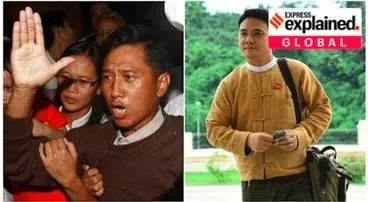
HLA MYO AUNG (left in photo) and AUNG THURA ZAW were convicted of torturing and killing a woman in March 2021 who they allegedly believed was a military informer. (Courtesy Myanmar Now)
Soon after grabbing power last year, the junta added 23 penal offences to crimes that attract the death penalty. In March 2021, it imposed martial law in many areas, handing over both executive and judicial functions to the military. Proceedings in the military tribunals take place behind closed doors and have been condemned as unfair trials.
The four executed were Phyo Zeya Thaw, Ko Jimmy, Hla Myo Aung, and Aung Thura Zaw. The last two were convicted of torturing and killing a woman in March 2021 who they allegedly believed was a military informer.
According to Myanmar Now, Ko Jimmy and Phyo Zayar Thaw were accused of leading and planning guerrilla attacks against the junta’s forces and allied militias last year. They were tried under terrorism charges as the junta has labelled all resistance as terrorism. These two were well-known, had a high social media profile, and could mobilise people for protests.
Ko Jimmy, also known as Kyaw Min You, was arrested last October. Days after taking over, the junta had issued an arrest warrant for him, accusing him of inciting unrest and threatening ‘public tranquillity’ with social media posts critical of the coup. For the next eight months, he had moved locations frequently while participating in demonstrations.
KO JIMMY, 53 was one of the leaders of the 88 Generation Students Group, veterans of a failed 1988 popular uprising against military rule. He had already spent more than a dozen years behind bars for political activism before his arrest in Yangon last October. (Courtesy Myanmar Now)
In 1988, Ko Jimmy was jailed for his role in the student uprising against General Ne Win following the military ruler’s demonetisation of several currency denominations rendering savings of students useless. The general had to resign at the end of July 1988, and August 8, 1988 (also known as 8888), was celebrated as victory day. Those who participated in the protest are known as 88 Generation.
Ko Jimmy spent nearly 20 years in jail, until his release in 2012. He is survived by his wife, Nilar Thein, also a well known 1988-generation activist, and a teenage daughter.
Phyo Zayar Thaw was arrested in November. He was Myanmar’s pioneer hip hop artiste who went by the state name Nitric. His band was known as Acid. He won elections as an NLD candidate in 2012 and 2015, and worked closely with Suu Kyi.
He had cut his political teeth during the 2007 anti-junta ‘saffron revolution’, so-called because of the participation of a large number of Buddhist monks.
The executions pose a dilemma for countries that have advocated engagement with the junta to persuade and encourage them to pick up the threads of the transition to democracy once more.
Given its security concerns in the Northeast states, and its concerns about China growing a bigger footprint in Myanmar, India has so far adopted a policy of engaging with the junta, but also pushing the generals to return to democracy.
Days after the coup, the US, UK, EU, Canada and Australia imposed sanctions on several generals, ranging from travel bans and freezing of assets to denial of financial, legal and medical services. With Russia and China opposing, the UN Security Council did not discuss a sanctions resolution against Myanmar, and instead called on the junta to desist from violence and release all political prisoners.
Earlier this year, External Affairs Minister S Jaishankar said India did not believe in imposing sanctions, and placed faith in ASEAN’s position on Myanmar and its efforts to engage it.
In March this year, Myanmar Foreign Minister Wunna Maung Lwin was invited to the virtually held BIMSTEC meeting hosted by Colombo, which India also attended. The US had criticised Myanmar’s participation.










Stay updated with The Hindu Editorial Vocab24 app, your definitive source for breaking news and comprehensive coverage from India and around the globe. Whether it's political developments, business updates, sports highlights, the latest technology trends, or current events, The Hindu brings live, accurate, and reliable news directly to your device.
Don’t fall for sensationalized or fake news shared online. Read and share accurate updates with friends and family through The Hindu Editorial Vocab24 app. Download it today!
News Coverage in The Hindu Editorial Vocab24 App
Breaking News: Receive instant notifications on breaking news stories as they unfold. Stay informed about major events and developments in India and around the world with live blogs, news in shorts videos, and concise articles.
Politics: Get the latest updates on Indian politics, including elections, policy changes, government decisions, and political events that shape the nation.
Business and Economy: Stay ahead in the economic landscape with detailed business news and market analysis. Learn about stock market trends, financial reports, corporate news, and economic developments to make informed investment decisions.
Current Events: Follow stories on social issues, policy changes, global events, and daily current affairs, tailored for UPSC and other competitive exam preparations.
Technology: Keep up with the latest gadgets, innovations, and tech trends. Read expert reviews and analyses in short, concise updates on cutting-edge technology from India and beyond.
Sports: Never miss a moment of your favorite sports. Get live scores, match reports, and expert analysis on cricket, football, tennis, and more.
International News: Stay informed about global events and geopolitical developments, including the Russia-Ukraine war, Israel-Palestine conflict, and other key international stories.
Local News: Stay connected to your community with the latest updates on city events, issues, and local news. Coverage includes hyperlocal updates from cities like Bangalore, Chennai, Delhi, Hyderabad, Mumbai, Kolkata, and more.
Trending Topics: Discover what's trending today with the most talked-about stories and hot topics across India and the world.
Experience journalism that values integrity, accuracy, and reliability. Download The Hindu Editorial Vocab24 app today and stay connected with the world.
Subscribe to our newsletter!







