

Everything you need to know about gravitational waves
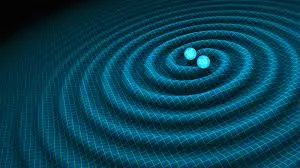
What are gravitational waves?Ripples in spacetime, a bit like ripples on a pond, that propagate out at the speed of light. Throw something really big into the stillness of space – like two black holes colliding, or two pulsars merging – and gravitational waves created by the event should spread not just across the galaxy, but ultimately through all of spacetime.
Why did we think they exist?
Gravitational waves were predicted by Albert Einstein’s general theory of relativity, 100 years ago. Almost everything the theory predicted has been confirmed by observation or experiment, except gravitational waves.
Hang on, hadn’t they already been detected?
For a blissful few weeks in 2014, physicists working on the BICEP-2 telescope in Antarctica were sure they had seen a sign of primordial gravitational waves left over from the big bang. Hope ebbed though as it became increasingly possible that they had instead seen an artefact created by dust in distant space after claims of a flawed analysis.
Two physicists got a Nobel Prize in 1993 for studies of a binary pulsar which behaved in a way that could best be explained by Einstein’s prediction: gravity waves would drain away the orbital energy of the two massive bodies and these would then spiral ever closer. But that was seen as inference, not definitive evidence.
Why persevere?
The hunt for them has been going on for decades. Fifty years ago Joseph Weber dangled metal bars in the hope of detecting telltale movement that could only be explained by a passing warp in spacetime. Nasa even sent a lunar surface gravimeter to the moon on Apollo 17 in 1972.
In the 90s German and British scientists began work on GEO600 at Hanover in Germany; the Italians have an experiment, as do the Japanese. Gravitational wave detection at LIGO - which has an L-shaped detector that uses a laser and mirrors - began in 2002. But accuracy remains the problem: a wave from millions of light years away would distort a four kilometre laser beam by less than a thousandth of the diameter of the nucleus of an atom. Which is hard to spot.
So is the experiment big enough?
Physicists proposed LISA, the ultimate Laser Interferometer Space Antenna: a trio of satellites huge distances apart in orbit, keeping a laser eye on each other for evidence of gravity waves. Europe last year launched LISA Pathfinder, to see if the experiment was even possible with present technologies.
Why bother at all?
Because gravity waves can answer questions about the moment of creation. Astronomers look back in time as well as space. To see something 13 billion light years away, they capture light that began its journey 13 billion years ago. But no matter how perfect the telescope, an optical astronomer could never peer into the first 400,000 years of the universe, because it would have been so dense and murky that even light could not break free of the primeval soup. But gravity waves must have been there, right from the beginning.
Now that gravitational waves have been found, is that it? Is that the end of physics?
No. The questions multiply. Why is the visible universe made of matter, and not antimatter? And why is 96% of the universe invisible and undetectable, existing as dark matter, and even more mysterious dark energy? Why does it seem to be stable? Is this all there is, or are we one of a zillion universes? Why does it exist all? This ultimate confirmation of Einstein’s theory would be the end of one set of questions, but it would open up a whole new set of puzzle.











Stay updated with The Hindu Editorial Vocab24 app, your definitive source for breaking news and comprehensive coverage from India and around the globe. Whether it's political developments, business updates, sports highlights, the latest technology trends, or current events, The Hindu brings live, accurate, and reliable news directly to your device.
Don’t fall for sensationalized or fake news shared online. Read and share accurate updates with friends and family through The Hindu Editorial Vocab24 app. Download it today!
News Coverage in The Hindu Editorial Vocab24 App
Breaking News: Receive instant notifications on breaking news stories as they unfold. Stay informed about major events and developments in India and around the world with live blogs, news in shorts videos, and concise articles.
Politics: Get the latest updates on Indian politics, including elections, policy changes, government decisions, and political events that shape the nation.
Business and Economy: Stay ahead in the economic landscape with detailed business news and market analysis. Learn about stock market trends, financial reports, corporate news, and economic developments to make informed investment decisions.
Current Events: Follow stories on social issues, policy changes, global events, and daily current affairs, tailored for UPSC and other competitive exam preparations.
Technology: Keep up with the latest gadgets, innovations, and tech trends. Read expert reviews and analyses in short, concise updates on cutting-edge technology from India and beyond.
Sports: Never miss a moment of your favorite sports. Get live scores, match reports, and expert analysis on cricket, football, tennis, and more.
International News: Stay informed about global events and geopolitical developments, including the Russia-Ukraine war, Israel-Palestine conflict, and other key international stories.
Local News: Stay connected to your community with the latest updates on city events, issues, and local news. Coverage includes hyperlocal updates from cities like Bangalore, Chennai, Delhi, Hyderabad, Mumbai, Kolkata, and more.
Trending Topics: Discover what's trending today with the most talked-about stories and hot topics across India and the world.
Experience journalism that values integrity, accuracy, and reliability. Download The Hindu Editorial Vocab24 app today and stay connected with the world.
Subscribe to our newsletter!







