

Eu’s vaccine travel pass is highly discriminatory towards low income countries
Travel has been badly hit due to the Covid-19 pandemic and the consequent restrictions on cross-border movement across the world. There has been a decline of 42-47 per cent in the world’s total passengers in 2021 compared to 2019. For India, while the number of passengers travelling by air picked up after the first wave, it fell drastically when the second wave hit. For June 2021, the average daily departures were at 1,100, higher than 700 in June 2020, but still significantly lower than 2,000 in April 2021.Travel becomes an important medium for trade in services, especially where consumers or firms make use of a service in another country. It is, therefore, necessary to revive travel and to provide conducive and safe conditions for it.
The introduction of Covid-19 vaccines has opened up opportunities to help revive travel. However, it is important to carefully design policies that help revive travel demand. In a recent guideline, the World Health Organisation (WHO) has recommended its member states do not seek proof of Covid-19 vaccination or recovery as a mandatory condition for entry to or exit from a country. As per the agency, vaccinated people can be exempted from testing and quarantine requirements. In this direction, many countries like China and Israel have introduced vaccine certificates that ease the process of entering and travelling across the destination country for vaccinated travellers.
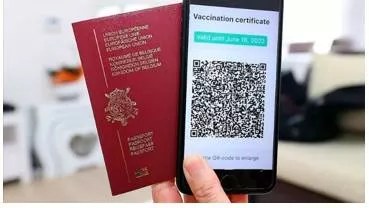
Though these certificates can be looked at from the lens of trade facilitation, they can potentially act as a trade barrier if they encourage discriminatory treatment. The recent and the most contentious issue in this regard is the European Union’s “Green Pass” scheme. Through this vaccine certificate, the European Commission intends to remove travel restrictions such as entry bans, quarantine obligations and testing. The EU has listed only four vaccines approved by the European Medicines Agency (EMA) for the pass: Pfizer-BioNTech’s Comirnaty, Moderna’s Spikevax, Oxford-AstraZeneca Vaxzevria and Johnson & Johnson’s Janssen.
This approach creates a schism between low and high-income countries and the first source of this divide stems from the difference in the vaccination rates across the globe. Vaccine doses administered per 100 people is 1.4 for low-income countries as compared to 93.2 for high-income countries. This makes travellers from low-income countries ineligible to avail these certificates.
The second source of discrimination is based on the type of vaccines administered in a country. As the Green Pass scheme includes only four selected vaccines approved by the EMA, it makes travellers from countries administering alternate vaccines ineligible for certification. When it was launched, the policy did not even allow AstraZeneca’s Indian-manufactured vaccine, Covishield. Due to the immense pushback, 16 EU countries have now accepted Covishield. However, despite this inclusion, travel rules vary across the region and in some cases, are still discriminatory — for instance, travellers from India vaccinated with Covishield still need to quarantine in the Netherlands, as India is considered a high-risk country. The only relief for them is the removal of any possible restriction on their movement within the destination country.
This goes against the policy of COVAX, which has categorically stated that “any measure that only allows people protected by a subset of WHO-approved vaccines to benefit from the re-opening of travel into and with that region would effectively create a two-tier system… (and) would negatively impact the growth of economies that are already suffering the most”.
As per estimates based on information from the WHO, countries not administering any of the EMA-approved vaccines account for at least 14 per cent of the vaccinated population. These lie mostly in low and middle-income countries, including India.Along with African and South Asian regions, this population also includes South East Asian countries. Nationals from many of these countries also serve in the hospitality industries in countries across the world, including Europe. With this exclusion criteria, an indirect cost burden is put on their domestic service sectors that are already reeling due to the pandemic.
With such discriminatory intervention, the EU policy does not go well with the globalisation policy of collective welfare. To achieve the desired goal, countries need to cooperate on vaccine production to accelerate the global vaccination process. The Covid vaccine supply chain can involve more than 100 components and it is important to strengthen the global supply chain. This makes lifting trade barriers on raw materials for vaccine production critical.
There is some policy movement in this direction. Covid vaccine makers across the world have created a platform, led by the Coalition for Epidemic Preparedness Innovations, to connect with key raw material suppliers needed for boosting production. Also, in a recent declaration, WTO members have agreed to review and eliminate unnecessary existing export restrictions on essential medical goods needed to combat the pandemic. The two relevant bodies, WHO and WTO, should also work together to sort out such selective criteria for international movement.












Stay updated with The Hindu Editorial Vocab24 app, your definitive source for breaking news and comprehensive coverage from India and around the globe. Whether it's political developments, business updates, sports highlights, the latest technology trends, or current events, The Hindu brings live, accurate, and reliable news directly to your device.
Don’t fall for sensationalized or fake news shared online. Read and share accurate updates with friends and family through The Hindu Editorial Vocab24 app. Download it today!
News Coverage in The Hindu Editorial Vocab24 App
Breaking News: Receive instant notifications on breaking news stories as they unfold. Stay informed about major events and developments in India and around the world with live blogs, news in shorts videos, and concise articles.
Politics: Get the latest updates on Indian politics, including elections, policy changes, government decisions, and political events that shape the nation.
Business and Economy: Stay ahead in the economic landscape with detailed business news and market analysis. Learn about stock market trends, financial reports, corporate news, and economic developments to make informed investment decisions.
Current Events: Follow stories on social issues, policy changes, global events, and daily current affairs, tailored for UPSC and other competitive exam preparations.
Technology: Keep up with the latest gadgets, innovations, and tech trends. Read expert reviews and analyses in short, concise updates on cutting-edge technology from India and beyond.
Sports: Never miss a moment of your favorite sports. Get live scores, match reports, and expert analysis on cricket, football, tennis, and more.
International News: Stay informed about global events and geopolitical developments, including the Russia-Ukraine war, Israel-Palestine conflict, and other key international stories.
Local News: Stay connected to your community with the latest updates on city events, issues, and local news. Coverage includes hyperlocal updates from cities like Bangalore, Chennai, Delhi, Hyderabad, Mumbai, Kolkata, and more.
Trending Topics: Discover what's trending today with the most talked-about stories and hot topics across India and the world.
Experience journalism that values integrity, accuracy, and reliability. Download The Hindu Editorial Vocab24 app today and stay connected with the world.
Subscribe to our newsletter!







