

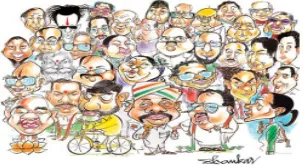
End politics of polarization
If America threw up post-truth politics as the word of the year, India in 2016 gave new meaning to the politics of polarization. Starting with nationalists versus supposed anti-nationals in the Kanhaiya Kumar case at JNU to the spectacle of aggressive cow vigilantism (सतर्कता) , near-shutdown of debate in Parliament and the apex court weighing in on the national anthem, this has been a year of extremes.
Political discourse needs to soften and both government and opposition must realize that their primary duty is to legislate and provide succor (सहायता देना /मदद देना) to the common man. One can argue over policies and ways of implementing them in a democracy, but that cannot come at the cost of shutting down Parliament and civil discourse.
This winter session of Parliament was the least productive in 15 years: Lok Sabha and Rajya Sabha lost 83% and 80% of their time respectively due to disruptions, costing around Rs 144 crore to the taxpayer. The primary onus (दायित्व /कर्त्तव्य) for smooth functioning of Parliament lies with the government, but opposition parties too have some responsibility.
It need not have been like this. While it was advantage BJP in Assam’s assembly elections in May 2016, regional players like Mamata Banerjee’s Trinamool Congress, the late J Jayalalithaa’s AIADMK, and CPM-led Left Democratic Front formed governments in West Bengal, Tamil Nadu and Kerala respectively. The Assam campaign, which yielded BJP and allies 86 of the state’s 126 assembly seats, showed that projecting a regional face like Sarbananda Sonowal and aligning with regional outfits like AGP and BPF pay dividends. At the heart of BJP’s Assam success was a politics of accommodation that should be a template for the party as it seeks to expand to further states.What we need in 2017 is a new politics of accommodation – from all sides – where differences must be debated in the larger public interest, not lost in the constant din (शोरगुल//हंगामा) of political grandstanding. The trend of political polarization was also reflected in ugly social tensions in 2016. Self-proclaimed cow vigilantes or gau rakshaks attacked Dalits and Muslims at various places across the country for allegedly possessing beef or skinning dead cows. Clearly, gau rakshaks felt emboldened (प्रोत्साहित करना) by the political climate to perpetrate (करना) violence in the name of cow protection.
However, cow vigilantism also witnessed Dalit counter-mobilisation. After the brutal flogging (मारना पीटना) of four Dalit youths by gau rakshaks in Gujarat’s Una in July, several large protests were organized. Organizing the Dalits were new activist groups such as Jignesh Mevani’s Dalit Atyachar Ladat Samiti that did not have any political backing or monetary support from traditional caste-based political parties. Yet they were able to strike a chord with people and mobilize them.
Similarly, 2016 also saw an expansion in quota agitations with Jats in Haryana and Marathas in Maharashtra demanding reservations in jobs and education. This was a continuation of the trend started by the Patidar agitation in Gujarat last year and highlights a growing clamor (कोलाहल) for quotas even among relatively well-off communities. That things have come to this pass not only shows that quota politics has set off a race to the bottom, but also that the economy simply isn’t delivering the number of jobs that it needs to.
In the context of India needing 10 million new jobs every year, socio-political events in 2016 confirmed that the economy is underperforming. And given India’s youthful demography – 50% of the country’s population is under 25 years of age – this means we have a growing pool of young people without career prospects. This in turn is feeding the demand for caste-based quotas and providing a fillip (प्रोत्साहन) to criminal trends such as cow vigilantism – gau rakshaks are essentially jobless youths seeking an identity and some monetary remuneration (हर्जाना/मुआवज़ा) .
This is also the reason why new social movements are throwing up young leaders such as Mevani, Kanhaiya Kumar and Hardik Patel. There’s clearly a sense of frustration and a yearning to be heard among the country’s youth. But the traditional political parties dominated by gerontocratic leaderships failed to respond to this in 2016, creating fertile grounds for social polarization. The open division within UP’s ruling Samajwadi Party between party patriarch Mulayam Singh Yadav and his son and chief minister Akhilesh Yadav is a clear case of the young resisting the old.
Taken together, 2016 exemplified the social tensions building up in society. To address these in 2017, the country’s political leadership needs to come together to boost the economy and give more space to youth. Playing caste games and pushing Hindutva for short-term electoral gains can easily backfire and turn India’s demographic dividend into a demographic nightmare. It’s time to cast aside the politics of the past and make accommodation and genuine development the key political agenda.
Communalism vs corruption
Jul 31, 2017
Temple politics
Jun 01, 2017
Three years after
May 26, 2017
Battle of bengal
May 07, 2017
India's politics of fear
Apr 08, 2017
Victorious pm modi did well to embrace inclusion
Mar 15, 2017





Stay updated with The Hindu Editorial Vocab24 app, your definitive source for breaking news and comprehensive coverage from India and around the globe. Whether it's political developments, business updates, sports highlights, the latest technology trends, or current events, The Hindu brings live, accurate, and reliable news directly to your device.
Don’t fall for sensationalized or fake news shared online. Read and share accurate updates with friends and family through The Hindu Editorial Vocab24 app. Download it today!
News Coverage in The Hindu Editorial Vocab24 App
Breaking News: Receive instant notifications on breaking news stories as they unfold. Stay informed about major events and developments in India and around the world with live blogs, news in shorts videos, and concise articles.
Politics: Get the latest updates on Indian politics, including elections, policy changes, government decisions, and political events that shape the nation.
Business and Economy: Stay ahead in the economic landscape with detailed business news and market analysis. Learn about stock market trends, financial reports, corporate news, and economic developments to make informed investment decisions.
Current Events: Follow stories on social issues, policy changes, global events, and daily current affairs, tailored for UPSC and other competitive exam preparations.
Technology: Keep up with the latest gadgets, innovations, and tech trends. Read expert reviews and analyses in short, concise updates on cutting-edge technology from India and beyond.
Sports: Never miss a moment of your favorite sports. Get live scores, match reports, and expert analysis on cricket, football, tennis, and more.
International News: Stay informed about global events and geopolitical developments, including the Russia-Ukraine war, Israel-Palestine conflict, and other key international stories.
Local News: Stay connected to your community with the latest updates on city events, issues, and local news. Coverage includes hyperlocal updates from cities like Bangalore, Chennai, Delhi, Hyderabad, Mumbai, Kolkata, and more.
Trending Topics: Discover what's trending today with the most talked-about stories and hot topics across India and the world.
Experience journalism that values integrity, accuracy, and reliability. Download The Hindu Editorial Vocab24 app today and stay connected with the world.
Subscribe to our newsletter!







