

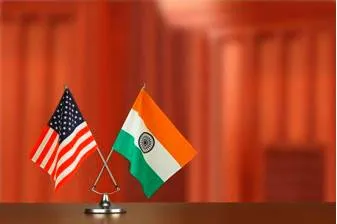
Drive a harder bargain at the delhi meet
At the 2+2 Ministerial forum, India must ensure that its gamble with Trump’s regime so close to the U.S. election pays off.In August 2016, just months before the United States presidential elections, then U.S. Secretary of State John Kerry and India’s External Affairs Minister Sushma Swaraj had detailed discussions about the Paris Climate Change Agreement, with the U.S. urging India to sign it at the earliest. Part of the statement they issued included the U.S.’s [developed countries] commitment to mobilise $100 billion per year by 2020 as part of a Green Climate Fund (GCF) to help developing countries such as India with climate adaptation methods and renewable technologies.
Then, the Paris Accord push
The ratification of the Paris Agreement was then U.S. President Barack Obama’s legacy project, and Washington was pushing for India to join before election day, November 8, in a bid to help Democrat nominee Hillary Clinton with her campaign against Republican nominee Donald Trump, who was against the Paris deal.
While New Delhi could have chosen to wait for the results of the U.S. elections, Prime Minister Narendra Modi did not, and announced a few weeks after Mr. Kerry’s visit that India would ratify the UN climate protocol on October 2, to mark Mahatma Gandhi’s birthday.
Months later, on June 1, 2017, the new U.S. President, Donald Trump, announced that the U.S. would exit the Paris agreement, and also revoked U.S. promises towards the GCF, calling it “very unfair”. “India makes its participation contingent on receiving billions and billions and billions of dollars in foreign aid from developed countries,” Mr. Trump added, conveniently ignoring the fact that it was based on his predecessor’s promises that India had made its calculations.
This time, the Indo-Pacific
As the U.S. Secretary of State, Mike Pompeo, makes his way to India next week, history may just be repeating itself. This time, Mr. Pompeo is coming exactly a week before the election, and his brief is clear: to ensure that New Delhi (also Sri Lanka, the Maldives and Indonesia that are on his itinerary, from October 25 to October 30), makes a strong, public, strategic commitment to the U.S. on its plans in the Indo-Pacific. Mr. Pompeo has made no bones about his mission. In Washington on Wednesday, he said he was sure that his meetings “would include discussions about how free nations can work together to thwart threats posed by the Chinese Communist Party”.
Just a few weeks ago, at the Quad Foreign Ministers meeting in Tokyo, Mr. Pompeo had said that as partners in this Quad (Australia-India-Japan-U.S.), “it is more critical now than ever that we collaborate to protect our people and partners from the Chinese Communist Party’s exploitation, corruption, and coercion.” In contrast, India has maintained that its membership of the Quad is aligned to its Indo-Pacific policy, and as Prime Minister Narendra Modi stated at the Shangri-La dialogue, in June 2018, “by no means... directed against any country”. While there is no doubt that Beijing’s relentless aggression against India at the Line of Actual Control this year and its refusal to disengage or withdraw from land China’s People’s Liberation Army has occupied for more than six months is changing India’s priorities, the Narendra Modi government has maintained that it will resolve issues with China bilaterally. Any shift in that position at the U.S.’s prompting must also accrue benefits for India.
Electoral calculations
Mr. Pompeo’s tenuous position must also be considered closely. For one, it is by no means clear that Mr. Trump will win the presidential elections or that Mr. Pompeo will remain in that spot. In fact, all presidential polls, as well as predictions for the U.S. electoral college point to a probable win for Democratic presidential nominee Joe Biden.
Even if Mr. Trump does win the election, it remains to be seen how far he will take ties with China to the brink once he dusts off his campaign rhetoric. The weight of commitments made by Mr. Pompeo during his India visit could thus be assessed better in a similar visit made even a week later, once the election results are more clearly known.
In the event Mr. Biden wins the election, India will hardly have endeared itself to the incoming administration by making strong statements of solidarity with Trump policy, strategic or otherwise. The two rallies Mr. Modi has held with Mr. Trump in Houston (2019) and in Ahmedabad (2020), as well as his use of the Trump campaign slogan, “Ab ki baar Trump Sarkar”, have already been noted within the Democratic campaign, and it may be recalled that most supporters of India in the Democratic leadership skipped the Houston rally.
China and India’s three fronts
As a result, South Block must consider carefully just what it discusses and projects from the meeting with Mr. Pompeo and U.S. Defence Secretary Mark Esper as they arrive for the Third India-U.S. 2+2 Ministerial Dialogue with External Affairs Minister S. Jaishankar and Defence Minister Rajnath Singh. China has gone from being the “Elephant in the Room” (as U.S. Deputy Secretary of State Stephen Biegun described it earlier this month) to becoming an agenda item on the table. Therefore, it is critical to study just how India hopes to collaborate with the U.S. on the challenge that Beijing poses on each of India’s three fronts: at the LAC, in the maritime sphere, and in the South Asian Association for Regional Cooperation (SAARC) region surrounding India.
On the maritime sphere, discussions will no doubt include strengthening ties in the Indo-Pacific, enhancing joint military exercises like the ‘Malabar’, where the entire Quad including Australia will participate next month in the Bay of Bengal and the Arabian Sea, and completing the last of the “foundational agreements” with the Basic Exchange and Cooperation Agreement for Geospatial Cooperation (BECA). On the SAARC region, Mr. Pompeo is speaking with his feet, given that his travels will take him to Male and Colombo as well. In Male, the U.S. has already announced a defence agreement that will pave the way for a strategic dialogue, and unlike in the past, New Delhi has not objected to ceding space in its area of influence in the Indian Ocean Region, as it will allow the U.S. to counter Chinese influence there. With Sri Lanka too, the U.S. has a pending defence agreement, but more importantly, discussions on infrastructure projects, and progress on its “Millenium Challenge Corporation” (MCC) offer of a five-year aid grant of about $480 million, that is meant to offer alternatives to the Rajapaksa government, will be key. At a time when India is delaying Sri Lanka’s requests for debt relief, given its own economic constraints, the U.S. aid offer will be seen as one way of staving off China’s inroads into Sri Lanka.
Finally, and of most interest, will be how the U.S. and India can collaborate, if they can, on dealing with India’s most immediate, continental challenge from China: at the LAC. While the Indian Army will defend its borders with China on its own, there is much that Mr. Pompeo could promise, apart from enhancing and expediting U.S. defence sales to India. Mr. Pompeo must, for example, commit to keeping the pressure on Pakistan on terrorism, despite the U.S. need for Pakistan’s assistance in Afghan-Taliban talks. A firm U.S. statement in this regard may also disperse the pressure the Indian military faces in planning for a “two-front” conflict with China.
Other key areas
Mr. Pompeo should be pushed on resolving trade issues with India, an area the Trump administration has been particularly tough, and perhaps commit to restoring India’s Generalised System of Preferences status for exporters. The government could press for more cooperation on 5G technology sharing, or an assurance that its S-400 missile system purchase from Russia will receive an exemption from the U.S.’s Countering America's Adversaries Through Sanctions Act (CAATSA) sanctions.
By inviting Mr. Pompeo this close to the U.S. elections, New Delhi has taken a calculated and bold gamble. Unlike the experience of 2016, however, our leaders must drive a harder bargain to consolidate the pay-offs from the visit.

Atiqa records two top-four finishes in WSK Final Cup
Sep 05, 2026








Stay updated with The Hindu Editorial Vocab24 app, your definitive source for breaking news and comprehensive coverage from India and around the globe. Whether it's political developments, business updates, sports highlights, the latest technology trends, or current events, The Hindu brings live, accurate, and reliable news directly to your device.
Don’t fall for sensationalized or fake news shared online. Read and share accurate updates with friends and family through The Hindu Editorial Vocab24 app. Download it today!
News Coverage in The Hindu Editorial Vocab24 App
Breaking News: Receive instant notifications on breaking news stories as they unfold. Stay informed about major events and developments in India and around the world with live blogs, news in shorts videos, and concise articles.
Politics: Get the latest updates on Indian politics, including elections, policy changes, government decisions, and political events that shape the nation.
Business and Economy: Stay ahead in the economic landscape with detailed business news and market analysis. Learn about stock market trends, financial reports, corporate news, and economic developments to make informed investment decisions.
Current Events: Follow stories on social issues, policy changes, global events, and daily current affairs, tailored for UPSC and other competitive exam preparations.
Technology: Keep up with the latest gadgets, innovations, and tech trends. Read expert reviews and analyses in short, concise updates on cutting-edge technology from India and beyond.
Sports: Never miss a moment of your favorite sports. Get live scores, match reports, and expert analysis on cricket, football, tennis, and more.
International News: Stay informed about global events and geopolitical developments, including the Russia-Ukraine war, Israel-Palestine conflict, and other key international stories.
Local News: Stay connected to your community with the latest updates on city events, issues, and local news. Coverage includes hyperlocal updates from cities like Bangalore, Chennai, Delhi, Hyderabad, Mumbai, Kolkata, and more.
Trending Topics: Discover what's trending today with the most talked-about stories and hot topics across India and the world.
Experience journalism that values integrity, accuracy, and reliability. Download The Hindu Editorial Vocab24 app today and stay connected with the world.
Subscribe to our newsletter!







