

Don't panic on npas
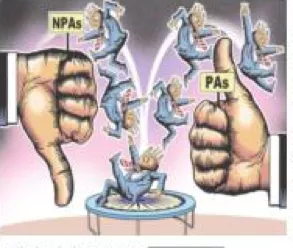
They pose a problem but shouldn't inhibit entrepreneurs and banks from taking risks Is the Insolvency and Bankruptcy Code (IBC) the magic bullet to shoot down the deadly Non-Performing Assets (NPAs)? The finance ministry, Reserve Bank of India (RBI) and public sector banks (PSBs) seem to believe so. There is a sudden note of cheer in the bleak street of financial dead-end. IBC came into force last May but it took a year for the government to issue the Banking Regulation Ordinance this May, empowering RBI to direct banks to deal with companies whose debts have gone bad through the bankruptcy law. It was found that 12 of the biggest accounts of the “top 500 exposures”, accounting for 25% of NPAs, will come under the insolvency law. Of course, the bad debt will not disappear overnight. There is an elaborate process to be gone through, and it is complicated enough. The IBC Board has also announced the fast tracking of cases dealing with NPAs.The intriguing (दिलचस्प) question that pops up is this: Why did it take so long for the government to have discovered the virtues of an insolvency law? It was on the anvil (चर्चा में होना) since 1999. A RBI report of July 1999 made the pertinent (मुनासिब) observation, “In some countries, all or bulk of banks' provisions are general provisions and identified losses are written off at an early stage. Banks in these countries carry very little NPAs in their Balance Sheets. The recovery measures are also expeditious (शीघ्र / तीव्र) in view of stringent bankruptcy and foreclosure laws.”
It has however to be understood that the insolvency law is not meant only for handling the NPA crisis. It would be short-sighted if the purpose of the insolvency law is not understood in the context of a market economy, as having broader implications (निहितार्थ).
The finance ministry had said in its official note on May 11, 2016: “This is considered as the biggest economic reform next only to GST.” IBC was meant to create a friendly and supportive environment for businesses. The point is made clear in the official note: “The vision of the new law is to encourage entrepreneurship and innovation. Some business ventures will always fail, but they will be handled rapidly. Entrepreneurs and lenders will be able to move on, instead of being bogged down (फंस गया) with decisions taken in the past.”
There are two important issues that are likely to be glossed over in the concern over NPAs. First, all NPAs are considered mala fide. That is, it is assumed that banks and borrowers had conspired to defraud (छलना) public money, and they were not sincere in making the business ventures for which the loans were taken a success. The motive cannot be ruled out, especially with regard to government-backed infrastructure projects. But there is need to acknowledge the risk factor in a market economy: unless you dare to fail you will not succeed. Of course, risk cannot be treated cavalierly (अक्खड़ता से/ रूखेपन) but needs to be subjected to rules of commercial prudence. The willful defaulter and genuine business failure will have to be treated differently .
This will require a sensible oversight (चूक) mechanism on the part of the banks. Secondly , the problem of NPAs requires sober analysis. It has to be understood that unlike in the US where the sub-prime mortgage crisis of 2007-08 NPA under a different name brought the big banks down and forced the US Federal Reserve to put in place a humongous bail-out package, in the Indian context the banks have not broken under the burden of NPAs. So the chest-beating over NPAs needs to be subdued (अधीन किया हुआ), and there is need for informed criticism.
RBI figures show that in 2014-15 NPAs constituted 4.3% of gross advances and 2.7% of total assets in of the scheduled commercial banks. In case of PSBs the corresponding figures were 5% and 3.2%. As a matter of fact, the situation in 2014-15 was much better than it was in 2003-04. The figures for 2003-04 were 7.2% of gross advances and 3.3% of total assets for the SCBs, and 7.8% and 3.5% for the PSBs. In absolute terms the moneys involved would run into thousands of crores, but in the context of the transactions of the banking system, the figures assume a more realistic proportion. The central bank's figures for NPAs from 1993 to 1998 show that the situation in those years was far more critical. The figures speak for themselves. Total NPAs: 23.2% (1993); 24.8% (1994); 19.4% (1995); 18% (1996); 17.8% (1997) and 16% (1998).
One of the arguments made in the last five years has been that credit off take from the banks in general and PSBs in particular was inhibited by the monstrous (विकट) presence of NPAs in the balance sheets. While there is no doubt that the issue of NPAs needs to be managed quickly and efficiently, there is need to change the basic attitude towards losses and failures. The Indian economy cannot blossom if it cannot take failures and losses in its stride (तरक़्क़ी / छलाँग). India, its people, government and business folk have to give up aversion (द्वेष/ विमुखता) to risk if the country is to move ahead.
Intriguing (Adjective)
Arousing one's curiosity or interest दिलचस्प
Synonyms: Alluring, Beguiling, Captivating, Enthralling, Fascinating, Interesting
Example: The movie looks intriguing so I’m definitely going to see it.
Pertinent (Adjective)
Relevant or applicable to a particular matter मुनासिब
Synonyms: Applicable, Appropriate, Apropos, Pertaining, Proper
Example: To ensure a prompt reply, please include all pertinent details in your email.
Expeditious (Adjective)
Done with speed and efficiency शीघ्र / तीव्र
Synonyms: Instance, Prompt, Quick, Rapid, Swift
Example: The man was saved because of the doctor’s expeditious diagnosis.
Implications (Noun)
The action or state of being involved in something निहितार्थ / आशय
Synonyms: Assumption, Connotation, Overtone, Ramification, Significance
Example: When Anita received a gym membership as a gift from her husband, she took it as an implication she needed to lose weight.
Defraud (Verb)
Illegally obtain money from (someone) by deception छलना
Synonyms: Deceive, Dupe, Embezzle, Outwit, Pilfer
Example: There was no prison sentence long enough when the employee decided to defraud the company by embezzling money.
Cavalierly (Adverb)
Disdainfully and negligently अक्खड़ता से/ रूखेपन
Synonyms: Arrogantly, Contemptuously, Haughtily, Imperiously, Rudely
Example: Fred sulked while Dean felt guilty for treating the old man's efforts so cavalierly.
Oversight (Noun)
The action of overseeing something चूक
Synonyms: Blunder, Error, Fault, Lapse, Neglect
Example: Because of some inexplicable oversight at the town hall meeting, Rohit was never given a chance to speak.
Monstrous (Adjective)
Frightening appearance of a monster विकट
Synonyms: Diabolical, Frightful, Terrible, Vicious
Example: He concentrated on the monstrous ship.
Stride (Noun)
A step or stage in progress towards an aim तरक़्क़ी / छलाँग
Synonyms: Drill, March, Pace, Parade, Stump
Example: The model adopted a quick stride that showed off her long legs and exuded confidence as she walked the runway.
Aversion (Noun)
A strong dislike or disinclination द्वेष/ विमुखता
Synonyms: Allergy, Hostility, Indisposition, Loathing, Revulsion
Example: Vegetarians have a strong aversion to eating meat.
New dawn at midnight
Jul 03, 2017
The big bang has come
Jul 01, 2017
Boys with toys
Jun 25, 2017
Will india's msme sector ever grow up
Apr 24, 2017





Stay updated with The Hindu Editorial Vocab24 app, your definitive source for breaking news and comprehensive coverage from India and around the globe. Whether it's political developments, business updates, sports highlights, the latest technology trends, or current events, The Hindu brings live, accurate, and reliable news directly to your device.
Don’t fall for sensationalized or fake news shared online. Read and share accurate updates with friends and family through The Hindu Editorial Vocab24 app. Download it today!
News Coverage in The Hindu Editorial Vocab24 App
Breaking News: Receive instant notifications on breaking news stories as they unfold. Stay informed about major events and developments in India and around the world with live blogs, news in shorts videos, and concise articles.
Politics: Get the latest updates on Indian politics, including elections, policy changes, government decisions, and political events that shape the nation.
Business and Economy: Stay ahead in the economic landscape with detailed business news and market analysis. Learn about stock market trends, financial reports, corporate news, and economic developments to make informed investment decisions.
Current Events: Follow stories on social issues, policy changes, global events, and daily current affairs, tailored for UPSC and other competitive exam preparations.
Technology: Keep up with the latest gadgets, innovations, and tech trends. Read expert reviews and analyses in short, concise updates on cutting-edge technology from India and beyond.
Sports: Never miss a moment of your favorite sports. Get live scores, match reports, and expert analysis on cricket, football, tennis, and more.
International News: Stay informed about global events and geopolitical developments, including the Russia-Ukraine war, Israel-Palestine conflict, and other key international stories.
Local News: Stay connected to your community with the latest updates on city events, issues, and local news. Coverage includes hyperlocal updates from cities like Bangalore, Chennai, Delhi, Hyderabad, Mumbai, Kolkata, and more.
Trending Topics: Discover what's trending today with the most talked-about stories and hot topics across India and the world.
Experience journalism that values integrity, accuracy, and reliability. Download The Hindu Editorial Vocab24 app today and stay connected with the world.
Subscribe to our newsletter!







