

Dissent and aadhaar
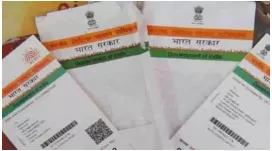
India is at risk of becoming a surveillance state, with faint resistance from libertarians, intellectuals, political parties, the media, or the Supreme Court. Very soon, almost everyone will have an Aadhaar number, seeded in hundreds of databases. Most of these databases will be accessible to the government without invoking any special powers. Permanent surveillance of all residents becomes a possibility. Only a simpleton (कमअक्ल) would expect this possibility to remain unused. With everyone on the radar, dissent is bound to be stifled (दबाना) . As it is, many people and institutions are anxious not to get on the wrong side of the government. NGOs are afraid that their registration might be cancelled if they antagonize (विरोधी बनाना/विरोध करना) the authorities. Vice-chancellors and principals are unable to stand up for their students’ right to hold public meetings on sensitive issues. Newspapers treat the government with kid gloves, especially on security matters. Investigative agencies target or spare Opposition leaders at the government’s bidding. Nationalism is confused with obedience to the state. With Aadhaar immensely reinforcing the government’s power to reward loyalty and marginalise dissenters, the embers of democracy are likely to be further smothered (दबाना) . How did we get there, without even noticing it? One answer is that we have been numbed (स्तब्ध हो जाना/सुन्न हो जाना) by a series of lies, myths and fictions about Aadhaar. The first lie was that Aadhaar is a voluntary facility. Today, we know that this was just doublespeak. Soon it will be virtually impossible to live in India without Aadhaar. And if you cannot live without Aadhaar, in what sense is it voluntary? As a columnist aptly put it, Aadhaar must be “the biggest bait (something intended to entice someone to do something.) -and-switch in history”. Another early fiction was that the purpose of Aadhaar is to help welfare schemes. The truth is closer to the reverse: Welfare schemes have been used to promote Aadhaar (by creating mass dependence on it), irrespective of the consequences. As it happens, the consequences so far have been disastrous. If the name of a worker employed under the National Rural Employment Guarantee Act is spelt differently in his job card and Aadhaar card, he is at risk of not being paid. If an old widow’s age happens to be understated on her Aadhaar card, she may be deprived of the pension that keeps her alive. For the public distribution system, Aadhaar is a calamity: In Jharkhand and Rajasthan, millions of people are deprived of their food rations every month due to technical problems related to Aadhaar-based biometric authentication (ABBA), according to the government’s own data. Third, Aadhaar was endowed with mythological powers as a weapon against corruption. Many people fell for the simplistic claim that Aadhaar would “ensure that the money goes to the right person”. In reality, Aadhaar can prevent only some types of corruption, mainly identity fraud. If a contractor fleeces (obtain a great deal of money from (someone), typically by overcharging or swindling them.) the government by over-invoicing, Aadhaar does not help. Nor does it help when a dealer gives people less than their due under the public distribution system. Sometimes, Aadhaar can make things worse, by disrupting fragile systems and creating confusion. For all we know, it may even create new varieties of identity fraud. Even if Aadhaar proves effective in curbing various forms of corruption, it is not the magic bullet that had been announced. Fourth came a series of bogus claims about Aadhaar-enabled “savings”. Most of the savings figures have no solid basis. Instead, they acquire an aura of plausibility by repetition. A common pattern is that an official press note mentions a savings figure, say, from a closed-door presentation at the Prime Minister’s Office, newspapers quote that figure without verification, sundry (विभिन्न) commentators repeat it, and it becomes part of the Aadhaar lore (विद्या/शिक्षा) . These dubious figures are then added up to produce an awesome grand total. Some of them are worse than gas — for instance, when Aadhaar-related glitches (खामियां) deprive people of their entitlements and the shortfall is counted as “savings”. Fifth, the technology was claimed to be flawless. Today, there is growing evidence that this is not the case. In ideal conditions, ABBA seems to work most of the time. But often the conditions are far from ideal, causing immense inconvenience. And even the ideal-condition success rates may not be good enough if ABBA is to serve as a common tool of identity verification. In a recent interview, Nandan Nilekani stated that “this is a system which works perfectly in 95 per cent of cases”. That does not sound reassuring: In many contexts, a 95 per cent success rate is far from adequate. Sixth, there is an ambiguity about the relation between Aadhaar and citizenship. Aadhaar, we are told, is for all residents, whether they are citizens or not. Sure, that is what the Aadhaar Act says. But then, why has enrolment been stalled in Assam? And why is Aadhaar enrolment in Assam being linked to the National Register of Citizens? Aadhaar deprivation could easily be used there as a weapon against illegal migrants, or communities branded as illegal migrants. Finally, the confidentiality of the identity information collected at the time of Aadhaar enrolment is a myth. The initial draft of the Aadhaar Act, known as the National Identity Authority of India (NIDAI) Bill, did protect that information. But the final version does not. On the contrary, it creates a framework that enables the government to share or sell that information, except for the core biometrics, with any “requesting entity”. A vast collection of lucrative Aadhaar applications is now being built on the back of this information sharing facility. This is almost as big a bait-and-switch as the claim that Aadhaar is voluntary. All this raises an interesting question: If the government misled the public to no end on this subject, can we trust it not to misuse the formidable powers of Aadhaar? The problem, however, is deeper. Even if it is not misused, the very existence of a huge infrastructure of surveillance is bound to stifle dissent. This ought to be a major concern for anyone committed to democratic rights and civil liberties.Simpleton (noun)
A foolish or gullible person. कमअक्ल
Synonyms: Fool, Nincompoop, Dunce, Dullard, Ignoramus
Example: His silly antics at office parties have earned him a reputation as a simpleton.
Stifle (verb)
Restrain (a reaction) or stop oneself acting on (an emotion). दबाना
Synonyms: Suppress, Smother, Restrain, Repress
Example: Too many regulations stifle innovation.
Antagonize (verb)
Cause (someone) to become hostile./ to incur or provoke the hostility of विरोधी बनाना/विरोध करना
Synonyms: Alienate, Disaffect, Work Against
Example: Religious Comments of politicians sometimes antagonize many people.
Smother (verb)
To suppress / to stop or prevent the growth or activity of. दबाना
Synonyms: Suppress, Quell, Stifle, Squelch
Example: The Roman general would not tolerate the uprising, and he sent his legions to smother it with force.
Numb (verb)
Unable to think, feel, or react normally because of something that shocks or upsets you स्तब्ध हो जाना/सुन्न हो जाना
Synonyms: Desensitize, Render Insensitive, Be Comatose
Example: My dentist administered a small dose of novocaine so that it would be numb on the right side of my mouth and not experience any pain.
Fleece (verb)
Obtain a great deal of money from (someone), typically by overcharging or swindling them. छलना/ठगना
Synonyms: Cheat, Fraud, Overcharge, Swindle
Example: Billy was arrested for fleecing after he was caught using fake checks.
Sundry (adjective)
A group of unrelated things/ of various kinds; several. विभिन्न
Synonyms: Various, Miscellaneous, Assorted, Diverse, Motley
Example: Because I was unsure of the San Francisco weather, I packed a sundry of clothing items to wear.
Glitch (noun)
A sudden, usually temporary malfunction or fault of equipment. खामी/कमी
Synonyms: Bug, Defect, Flaw, Malfunction
Example: A serious glitch at the ticket counter caused several customers to be inconvenienced while waiting for the airline system to be repaired.
Bait (noun)
Something intended to entice someone to do something. प्रलोभन
Synonyms: Enticement, Allurement, Temptation, Decoy, Lure
Example: A Television programme is essentially a bait to attract an audience for advertisements.
Lore (noun)
Information and wisdom gained through tradition विद्या/शिक्षा
Synonyms: Knowledge, Learning, Wisdom, Information
Example: Lore and tradition was always spread by word of mouth since during that time, the ancient people had no written language.

Bellwether in crisis
Aug 19, 2017
Remaking the board
Aug 19, 2017
Unsportsmanlike
Aug 13, 2017
Ties that bind
Aug 06, 2017
Defenders of varna
Aug 05, 2017
What the gods drank
Jul 30, 2017





Stay updated with The Hindu Editorial Vocab24 app, your definitive source for breaking news and comprehensive coverage from India and around the globe. Whether it's political developments, business updates, sports highlights, the latest technology trends, or current events, The Hindu brings live, accurate, and reliable news directly to your device.
Don’t fall for sensationalized or fake news shared online. Read and share accurate updates with friends and family through The Hindu Editorial Vocab24 app. Download it today!
News Coverage in The Hindu Editorial Vocab24 App
Breaking News: Receive instant notifications on breaking news stories as they unfold. Stay informed about major events and developments in India and around the world with live blogs, news in shorts videos, and concise articles.
Politics: Get the latest updates on Indian politics, including elections, policy changes, government decisions, and political events that shape the nation.
Business and Economy: Stay ahead in the economic landscape with detailed business news and market analysis. Learn about stock market trends, financial reports, corporate news, and economic developments to make informed investment decisions.
Current Events: Follow stories on social issues, policy changes, global events, and daily current affairs, tailored for UPSC and other competitive exam preparations.
Technology: Keep up with the latest gadgets, innovations, and tech trends. Read expert reviews and analyses in short, concise updates on cutting-edge technology from India and beyond.
Sports: Never miss a moment of your favorite sports. Get live scores, match reports, and expert analysis on cricket, football, tennis, and more.
International News: Stay informed about global events and geopolitical developments, including the Russia-Ukraine war, Israel-Palestine conflict, and other key international stories.
Local News: Stay connected to your community with the latest updates on city events, issues, and local news. Coverage includes hyperlocal updates from cities like Bangalore, Chennai, Delhi, Hyderabad, Mumbai, Kolkata, and more.
Trending Topics: Discover what's trending today with the most talked-about stories and hot topics across India and the world.
Experience journalism that values integrity, accuracy, and reliability. Download The Hindu Editorial Vocab24 app today and stay connected with the world.
Subscribe to our newsletter!







