

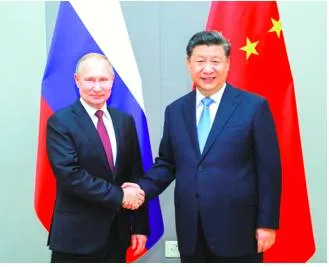
China’s ‘friendship’ must bother putin
In 1969, China gained quite a few islands on Siberia's Ussuri river. Now, it has already started claiming the entire Siberia as its territory.Late last month, Russia and China renewed their friendship treaty for a further five years. Comrade Putin appears to be making a dangerous mistake by ignoring the potential threat from China. He was only 17 when the Soviet Union fought a seven-month mini-war across the Ussuri river, which is located in Russia’s Siberia (Sleeping Land). How big was Beijing’s ambition one does not know, but the Soviets had to convey an implicit nuclear threat to the aggressor. To save face, Mao Zedong, through his Premier Zhou en Lai, threatened a “People’s War”, which meant that hundreds of thousands of Chinese soldiers would swarm Soviet tanks as they had done with the Americans in the Korean War in 1951-52. The Chinese leader’s belief of convenience was the superiority of man over machine. The People’s Liberation Army (PLA) did demonstrate its idea of warfare on one of the islands on the Ussuri by ambushing Soviet soldiers.
In the end, China gained quite a few islands on the river, which were a loss for the Soviet Union. Logically, more conflict lies ahead. China is a much bigger nuclear power than it was in 1969. Its ambitions have grown and, by current indications, it wishes to become a superpower. We have to remember that Siberia is over 13 million sq km with a sparse population, whereas China is bubbling with people but is short of arable land. Incidentally, the Yellow Giant gained several hundred islands in the midst of not only the Ussuri but also the Amur and Argun rivers. This gain by China and loss by the USSR were after decades of harrowing negotiations which ended in 2004.
With climate change and the earth getting warmer, Siberia can well become more hospitable. Today, the whole region is considered hostile due to its very low temperatures in winter. With global warming, Siberia is likely to become attractive for China to occupy. The region is rich in coal, natural gas, diamonds, iron ore, gold and aluminum. A possible scenario of China forcibly occupying Siberia can no longer be looked upon as hypothetical or imaginary. Patrick Prinston, a Western columnist, informs us that a Chinese portal Jinji Toutiao published an article, the author of which calls Siberia “Chinese land”. The Chinese media regularly praises Russian ruler Vladimir Putin and how cleverly he puts the West in its place. Simply, from the point of view of Beijing, Russia is not only a good friend but also has an excellent potential prize. “There are no countries around the world that are always friendly or, conversely, always hostile to each other. In the past, Siberia was conquered by the Mongols and, therefore, in fact, is Chinese territory.” This is increasingly becoming China’s refrain.
Joe Burgess in The New York Times column ‘Why China Reclaims Siberia’ lays out a starker scenario: A land without people for a people without land, Burgess says. The land is as resource-rich and people-poor as China is the opposite. The weight of that logic should scare the Kremlin. Like love, a border is real only if both sides believe in it. And on both sides of the Sino-Russian border, that belief is wavering. Siberia — the Asian part of Russia, east of the Ural Mountains — is immense. It takes up three-quarters of Russia’s land mass, the equivalent of the entire US and India put together.
The 1.35 billion Chinese people south of the border outnumber Russia’s 144 million almost 10 to 1. The discrepancy is even starker for Siberia on its own, home to barely 38 million people, and especially the border area, where only six million Russians face over 90 million Chinese. With intermarriage, trade and investment across that border, Siberians have realised that, for better or for worse, Beijing is a lot closer than Moscow. The land is already providing China “the factory of the world”, with much of its raw materials, especially oil, gas and timber. Increasingly, Chinese-owned factories in Siberia churn out finished goods as if the region already were a part of the Middle Kingdom’s economy. Beijing could use Russia’s own strategy: hand out passports to sympathisers in contested areas, and then move in militarily to “protect its citizens”. If Beijing chooses to take Siberia by force, the only way Moscow could stop it would be by using nuclear weapons.
In a meeting with the press on May 20 this year, Putin, using a bit of colourful language, threatened to “smash the teeth of anyone who tried to bite off even a piece of Siberia”. He surely could not have been thinking of the US or the West. Chinese dictator Xi Jinping only last year described Putin as his “best friend”.
But despite all the nice sounding rhetoric, the reality of the China-Russia relationship is a shallow one. The US and friendly countries have grown closer by a set of common values or structures like the Quad. There is nothing even remotely comparable in the case of Russia and China; in this partnership, which is purely transactional without any real political integration, Russia is very much the junior partner, with China eyeing its geographically vast, resource-rich but under-populated Eurasian neighbour.
Can quad restrain wayward china
May 29, 2022
Concerns over finland sweden joining nato
May 22, 2022
Sustainability road to a better future
May 16, 2022
Aap lays out its goal
May 11, 2022
Shanghai covid crisis a test for xi’s leadership
May 09, 2022
The idea of universal equality
May 06, 2022





Stay updated with The Hindu Editorial Vocab24 app, your definitive source for breaking news and comprehensive coverage from India and around the globe. Whether it's political developments, business updates, sports highlights, the latest technology trends, or current events, The Hindu brings live, accurate, and reliable news directly to your device.
Don’t fall for sensationalized or fake news shared online. Read and share accurate updates with friends and family through The Hindu Editorial Vocab24 app. Download it today!
News Coverage in The Hindu Editorial Vocab24 App
Breaking News: Receive instant notifications on breaking news stories as they unfold. Stay informed about major events and developments in India and around the world with live blogs, news in shorts videos, and concise articles.
Politics: Get the latest updates on Indian politics, including elections, policy changes, government decisions, and political events that shape the nation.
Business and Economy: Stay ahead in the economic landscape with detailed business news and market analysis. Learn about stock market trends, financial reports, corporate news, and economic developments to make informed investment decisions.
Current Events: Follow stories on social issues, policy changes, global events, and daily current affairs, tailored for UPSC and other competitive exam preparations.
Technology: Keep up with the latest gadgets, innovations, and tech trends. Read expert reviews and analyses in short, concise updates on cutting-edge technology from India and beyond.
Sports: Never miss a moment of your favorite sports. Get live scores, match reports, and expert analysis on cricket, football, tennis, and more.
International News: Stay informed about global events and geopolitical developments, including the Russia-Ukraine war, Israel-Palestine conflict, and other key international stories.
Local News: Stay connected to your community with the latest updates on city events, issues, and local news. Coverage includes hyperlocal updates from cities like Bangalore, Chennai, Delhi, Hyderabad, Mumbai, Kolkata, and more.
Trending Topics: Discover what's trending today with the most talked-about stories and hot topics across India and the world.
Experience journalism that values integrity, accuracy, and reliability. Download The Hindu Editorial Vocab24 app today and stay connected with the world.
Subscribe to our newsletter!







