

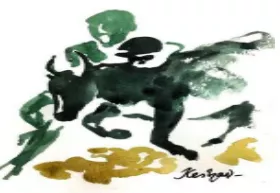
Catching a sport by its horns
Irrespective of the legislative, judicial or political outcome, there is no doubt that pro-jallikattu protesters have won the day. But this triumphal moment also calls for introspection (आत्मनिरीक्षण) . The Tamil word for ox and cattle, ‘maadu’, also means wealth. As the great book of wisdom, the Tirukkural, emphatically asserts, education is the real ‘maadu’. As the unprecedented mass uprising in Tamil Nadu unfolds, jallikattu, the sport of taming the bull, has now become a symbol of Tamil pride and identity. How did a sport with origins in a pastoral world capture the imagination of a vast and differentiated linguistic community and become its symbol? Since Sangam literature In the extraordinary body of poetry, termed as Sangam literature, is a text called Kalithokai . In five long poems, totalling over 300 breath-taking lines, it provides the first elaborate description of this ancient sport. Though there is evidence in ancient rock art of forms of this sport, it is only in modern Tamil literary prose writing that we find extended descriptions of jallikattu. The pioneer was B.R. Rajam Aiyar, the great vedantin and disciple (शिष्य/अनुयायी) of Swami Vivekananda. His Tamil novel, Kamalambal Charithiram (English translation:The Fatal Rumour , Oxford University Press), written in 1893, depicts the celebration accompanying the sport with men and women turning up in huge numbers. Rajam Aiyar also records technical terms associated with this sport. Kothamangalam Subbu (‘Kalaimani’) is now largely known for his novel Thillana Mohanambal, later made into the eponymous ((of a person) giving their name to something.) film starring Sivaji Ganesan and Padmini. Few know that his first foray into fiction, in the 1930s, was with a short story, ‘Manji Virattu’ (another form of jallikattu). Not satisfied with writing a short story on this theme, Subbu serialised a sprawling novel,Rao Bahadur Singaram , in the popular weekly, Ananda Vikatan . This story, centred on the romance between a young girl who raises a bull and a youth who sets out to tame it, was filmed (Vilaiyattu Pillai, 1970) by the same team that produced Thillana Mohanambal. But the locus classicus of jallikattu remains Ci.Su. Chellappa’s Vaadi Vaasal (English translation: The Arena, Oxford University Press). Conceiving it as a short story, Chellappa later expanded it into a novella. Out of print for a quarter of a century after its first publication in 1959, Vaadi Vaasal has over the last twenty years been reprinted more than a dozen times by Kalachuvadu Pathippagam — an indication of not only its literary merit but also the cultural importance accorded to it. Many of these books, in their later impressions, were embellished (अलंकृत करना/सजाना) with sketches and paintings by outstanding artistes such as K.M. Adhimoolam and Trotsky Marudhu. Meanwhile, articles by Panditamani M. Kathiresan Chettiar and other scholars provided an intellectual framework for the celebration of jallikattu as a Tamil sport. This history of the literary representation of jallikattu is testimony (प्रमाण) to its enduring allure (आकर्षण) . A close look at the content of these literary texts provides insights into the changes taking place within the sport and its dynamic interaction with society. The Kalithokai poems depicted the mood of riotous(अशांत/उपद्रवी) carnival where young men decked in colourful flowers ‘embraced the bull’ (‘eru thazhuvuthal’) and tamed it. Young women who watched this swore that they would not marry even in their next life a man who feared the bulls’ sharp horns. The focus of the poems is on the valour and the gore that accompanies this heroic feat. In A.K. Ramanujan’s inspired translation, a passage reads, “Look, the bull,/ raised horns and skin tawny/ as certain silkmoths,/ he skewers to death/ the cowherd who sprang/ heedless of the look in the animal’s eyes,/ carries the carcass high and shakes it/ on his horns.” According to poetic convention the young men and women of Kalithokai belonged to the community of shepherds now identified with idaiyar, konar and yadavar. Reflecting the power structure By the time of B.R. Rajam Aiyar, the description of the festival becomes naturalistic, written with the eye of an ethnographer (the scientific description of peoples and cultures with their customs, habits, and mutual differences.) . Unlike the Kalithokaipoems set in a stylised pastoral zone, the geographical location is now specified as (the erstwhile composite districts of) Madurai and Tirunelveli. The sport itself is imbricated (lying lapped over each other in regular order(manifest strengthening)) in the dynamics of rural power structure. By the time of Kothamangalam Subbu, the faultlines become clearer. ‘ Manji Virattu ’ is set in late 1920s Ramanathapuram district. The mood cannot be more festive, and Subbu records the practice of giving endearing names to the bulls. The crux (सार/निचोड़) of the story is the conflict between the always warring Agamudaiyar and Maravar castes, ending in violence and the suspension of the festival until it is restored by the advent (आगमन) of the Gandhian movement. For the first time we see the sport being celebrated as the valorous sport of Tamils. In Ci.Su. Chellappa’s hands the sport expands into an exploration of the conflicts between man and man, and man and animal, and their interweaving provides subtle insights into the human predicament (कठिन परिस्थिति/संकट) . Interestingly, all the authors mentioned above were Brahmins, giving the lie to the argument that the sport is the preserve of a few dominant castes. As a non-corporatised communitarian sport, though undoubtedly reflective of social inequities, especially caste, jallikattu incorporates the entire gamut (सारे पहलु/विस्तार) of the social order. Paralleling the literary depiction of jallikattu was its filmic representation. From the 1960s the taming of the bull by the rural hero became a recurring trope. The convention reached its apogee in Rajinikanth’s Murattu Kaalai (1980). State patronage fuelled it, and Alanganallur, a fixture in the tourist map, became a metaphor for the sport. Transformed by opposition By this time, at least in the popular imaginary, jallikattu transcended its regional and caste definition, and became emblematic of Tamil culture. But the credit for unambiguously and unequivocally turning jallikattu into a symbol of all that is Tamil must go to its adversaries, both perceived and real — of animal lovers, of ‘north India’, of an insensitive Central government, of Hindutva and of the impersonal forces of globalisation. Thanks to them, jallikattu now stands enshrined as the symbol of Tamil cultural pride. Irrespective of the legislative, judicial or political outcome, there is no doubt that the protestors have won the day. But this triumphal moment also calls for introspection. Jallikattu enthusiasts should ensure that the sport is regulated and animals are protected from harm. In a welcome sign, environmental groups, keen on preserving native breeds of bulls, are already in the fray. Hopefully they will take the lead in this matter. More importantly, the democratic character manifest in the upsurge (उन्नति/चढ़ाव) should be reflected in jallikattu itself by making it more inclusive with the participation of the high and the low, the dominant and the oppressed.Disciple (noun)
A follower or pupil of a teacher, leader, or philosopher. शिष्य/अनुयायी
Synonyms: Follower, Adherent, Believer, Devotee, Acolyte, Votary
Example: A true disciple not only spreads his own religion but also contributes to others too.
Embellish (verb)
To make something sound or look better or more acceptable than it is in reality/ to make more beautiful and attractive. अलंकृत करना/सजाना
Synonyms: Elaborate, Embroider, Decorate, Adorn, Ornament, Hone
Example: Dan doesn’t trust the news media because he believes that most reports embellish the facts.
Testimony (noun)
Evidence or proof of something. प्रमाण
Synonyms: Testament, Proof, Evidence, Avowal
Example: One of the witnesses in the murder trial later withdrew her testimony, saying that the police had pressured her into saying things that were not true.
Allure (noun)
The quality of being powerfully and mysteriously attractive or fascinating. आकर्षण
Synonyms: Attraction, Charisma, Charm, Temptation, Fascination
Example: Because I love the allure of the ocean waters, I enjoy spending time at the beach.
Riotous (adjective)
Marked by or involving public disorder. / characterized by wild and uncontrolled behavior. अशांत/उपद्रवी
Synonyms: Unruly, Disruptive, Uncontrollable, Turbulent, Uproarious, Tumultuous
Example: There was a riotous protest after the unfavorable policy implementation by the government in the state.
Crux (noun)
The decisive or most important point at issue. सार/निचोड़
Synonyms: Nub, Heart, Essence, Most Important Point, Central Point, Main Point, Essential Part, Kernel.
Example: If the scientist does not find the crux of the mutation, he will never be able to cure the disease.
Advent (noun)
The arrival of a notable person or thing. आगमन
Synonyms: Arrival, Appearance, Emergence, Occurrence, Dawn, Origin, Rise
Example: With the advent of the internet, working from home has become a real phenomenon.
Predicament (noun)
A difficult, unpleasant situation कठिन परिस्थिति/संकट
Synonyms: Difficult Situation, Mess, Difficulty, Problematic, Quandary, Trouble, Muddle
Example: Whenever I call my father, he always assumes I am in some type of predicament and in need of his help.
Gamut (noun)
The complete range or scope of something. सारे पहलु/विस्तार
Synonyms: Range, Spectrum, Span, Extent, Reach
Example: Since the arguments against the Metro project run the gamut from cost to conservation efforts, it will be a while before a final decision is made on the project.
Upsurge (noun)
An upward surge in the strength or quantity of something; an increase. उन्नति/चढ़ाव
Synonyms: Boom, Improvement, Upswing, Upturn, Advance, Rise
Example: After the new policies implementation, there was a immediate upsurge in the revenue.









Stay updated with The Hindu Editorial Vocab24 app, your definitive source for breaking news and comprehensive coverage from India and around the globe. Whether it's political developments, business updates, sports highlights, the latest technology trends, or current events, The Hindu brings live, accurate, and reliable news directly to your device.
Don’t fall for sensationalized or fake news shared online. Read and share accurate updates with friends and family through The Hindu Editorial Vocab24 app. Download it today!
News Coverage in The Hindu Editorial Vocab24 App
Breaking News: Receive instant notifications on breaking news stories as they unfold. Stay informed about major events and developments in India and around the world with live blogs, news in shorts videos, and concise articles.
Politics: Get the latest updates on Indian politics, including elections, policy changes, government decisions, and political events that shape the nation.
Business and Economy: Stay ahead in the economic landscape with detailed business news and market analysis. Learn about stock market trends, financial reports, corporate news, and economic developments to make informed investment decisions.
Current Events: Follow stories on social issues, policy changes, global events, and daily current affairs, tailored for UPSC and other competitive exam preparations.
Technology: Keep up with the latest gadgets, innovations, and tech trends. Read expert reviews and analyses in short, concise updates on cutting-edge technology from India and beyond.
Sports: Never miss a moment of your favorite sports. Get live scores, match reports, and expert analysis on cricket, football, tennis, and more.
International News: Stay informed about global events and geopolitical developments, including the Russia-Ukraine war, Israel-Palestine conflict, and other key international stories.
Local News: Stay connected to your community with the latest updates on city events, issues, and local news. Coverage includes hyperlocal updates from cities like Bangalore, Chennai, Delhi, Hyderabad, Mumbai, Kolkata, and more.
Trending Topics: Discover what's trending today with the most talked-about stories and hot topics across India and the world.
Experience journalism that values integrity, accuracy, and reliability. Download The Hindu Editorial Vocab24 app today and stay connected with the world.
Subscribe to our newsletter!







