

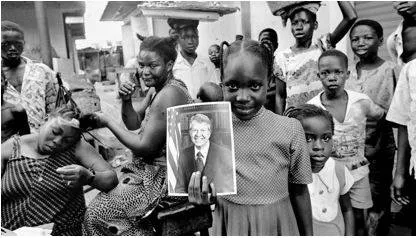
Carter made sure he did not ‘ignore’ africa like other american leaders
A think tank founded by the former U. S. President in 1982 played key role in monitoring elections and brokering ceasefires between warring forces on the continent; when he died at 100, his foundation’s work in rural Africa had nearly fulfilled his quest to eliminate a disease that afflicted millions.Jimmy Carter was the first U.S. President to make a state visit to sub-Saharan Africa. He once called helping with Zimbabwe’s transition from white rule to independence “our greatest single success.”
And when he died at 100, his foundation’s work in rural Africa had nearly fulfilled his quest to eliminate a disease that afflicted millions, for the first time since the eradication of smallpox.
The African continent, a booming region with a population rivaling China’s that is set to double by 2050, is where Carter’s legacy remains most evident. Until his presidency, U.S. leaders had shown little interest in Africa, even as independence movements swept the region in the 1960s and 1970s.
“I think the day of the so-called ugly American is over,” Carter said during his warm 1978 reception in Nigeria, Africa’s most populous country. He said the official state visit swept aside “past aloofness by the United States,” and he joked that he and then Nigerian President Olesegun Obasanjo would go into peanut farming together.
Cold War tensions drew Carter’s attention to the continent as the U.S. and Soviet Union competed for influence. But Carter also drew on the missionary traditions of his Baptist faith and the racial injustice he witnessed in his homeland in the U.S. South.
“For too long our country ignored Africa,” Carter told the Democratic National Committee in his first year as President.
African leaders soon received invitations to the White House, intrigued by the abrupt interest from the world’s most powerful nation and what it could mean for them.
Carter observed after his first Africa trip, “There is a common theme that runs through the advice to me of leaders of African nations: ‘We want to manage our own affairs. We want to be friends with both of the great superpowers and also with the nations of Europe. We do not want to choose up sides.’”
The theme echoes today as China also jostles with Russia and the U.S. for influence, and access to Africa’s raw materials. But neither superpower has had an emissary like Carter, who made human rights central to U.S. foreign policy and made 43 more trips to the continent after his presidency, promoting Carter Center projects that sought to empower Africans to determine their own futures.
As President, Carter focused on civil and political rights. He later broadened his efforts to include social and economic rights as the key to public health.
“They are the rights of the human by virtue of their humanity. And Carter is the single person in the world that has done the most for advancing this idea,” said Abdullahi Ahmed An-Naim, a Sudanese legal scholar.
Even as a presidential candidate, Carter mused about what he might accomplish, telling Playboy magazine in 1976, “it might be that now I should drop my campaign for President and start a crusade for black-majority rule in South Africa or Rhodesia (now Zimbabwe).”
Carter welcomed Zimbabwe’s independence just four years later, hosting new Prime Minister Robert Mugabe at the White House and quoting the Rev. Martin Luther King, Jr.: “Injustice anywhere is a threat to justice everywhere.”
Relations with Mugabe’s government soon soured amid deadly repression and by 1986 Carter led a walkout of diplomats in the capital. In 2008, Carter was barred from Zimbabwe, a first in his travels. He called the country “a basket case, an embarrassment to the region.”
“Whatever the Zimbabwean leadership may think of him now, Zimbabweans, at least those who were around in the 1970s and 1980s, will always regard him as an icon and a tenacious promoter of democracy,” said Eldred Masunungure, a Harare-based political analyst.
Carter also criticised South Africa’s government for its treatment of Black citizens under apartheid, at a time when South Africa was “trying to ingratiate itself with influential economies around the world,” current President Cyril Ramaphosa said on X after Carter’s death.
Fighting diseases
The think tank Jimmy and Rosalynn Carter founded in 1982 played a key role in monitoring African elections and brokering ceasefires between warring forces, but fighting disease was the third pillar of The Carter Center’s work.
“The first time I came here to Cape Town, I almost got in a fight with the president of South Africa, Thabo Mbeki, because he was refusing to let AIDS be treated,” Carter told a local newspaper. “That’s the closest I’ve come to getting into a fist fight with a head of state.”
Carter often said he was determined to outlive the last guinea worm infecting the human race. Once affecting millions of people, the parasitic disease has nearly been eliminated, with just 14 cases documented in 2023 in a handful of African countries.
Carter’s quest included arranging a four-month “guinea worm cease-fire” in Sudan in 1995 so that The Carter Center could reach almost 2,000 endemic villages.
“He taught us a lot about having faith,” said Makoy Samuel Yibi, who leads the guinea worm eradication programme for South Sudan’s Health Ministry and grew up with people who believed the disease was simply their fate. “Even the poor people call these people poor, you see. To have the leader of the free world pay attention and try to uplift them is a touching virtue.”
Such dedication impressed health officials in Africa over the years.
“President Carter worked for all humankind irrespective of race, religion, or status,” Ethiopia’s former Health Minister, Lia Tadesse, said in a statement. Ethiopia, the continent’s second most populous country with over 110 million people, had zero guinea worm cases in 2023.



Top court quashes FIRs against Gen Z protesters
Sep 04, 2026






Stay updated with The Hindu Editorial Vocab24 app, your definitive source for breaking news and comprehensive coverage from India and around the globe. Whether it's political developments, business updates, sports highlights, the latest technology trends, or current events, The Hindu brings live, accurate, and reliable news directly to your device.
Don’t fall for sensationalized or fake news shared online. Read and share accurate updates with friends and family through The Hindu Editorial Vocab24 app. Download it today!
News Coverage in The Hindu Editorial Vocab24 App
Breaking News: Receive instant notifications on breaking news stories as they unfold. Stay informed about major events and developments in India and around the world with live blogs, news in shorts videos, and concise articles.
Politics: Get the latest updates on Indian politics, including elections, policy changes, government decisions, and political events that shape the nation.
Business and Economy: Stay ahead in the economic landscape with detailed business news and market analysis. Learn about stock market trends, financial reports, corporate news, and economic developments to make informed investment decisions.
Current Events: Follow stories on social issues, policy changes, global events, and daily current affairs, tailored for UPSC and other competitive exam preparations.
Technology: Keep up with the latest gadgets, innovations, and tech trends. Read expert reviews and analyses in short, concise updates on cutting-edge technology from India and beyond.
Sports: Never miss a moment of your favorite sports. Get live scores, match reports, and expert analysis on cricket, football, tennis, and more.
International News: Stay informed about global events and geopolitical developments, including the Russia-Ukraine war, Israel-Palestine conflict, and other key international stories.
Local News: Stay connected to your community with the latest updates on city events, issues, and local news. Coverage includes hyperlocal updates from cities like Bangalore, Chennai, Delhi, Hyderabad, Mumbai, Kolkata, and more.
Trending Topics: Discover what's trending today with the most talked-about stories and hot topics across India and the world.
Experience journalism that values integrity, accuracy, and reliability. Download The Hindu Editorial Vocab24 app today and stay connected with the world.
Subscribe to our newsletter!







