

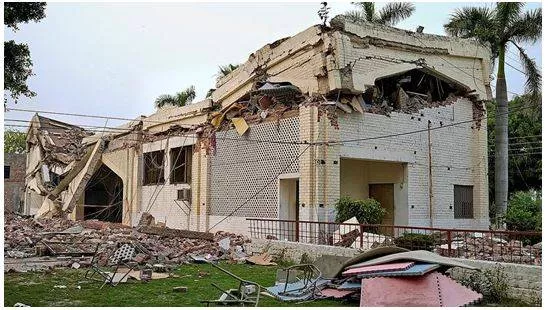
By attacking targets inside pakistan india seeks to establish a new normal
Until 2016, India’s strategy for dealing with terror attacks linked to Pakistan largely relied on three measures: diplomatic efforts to isolate Islamabad, economic penalties related to terror financing, and pressure on Islamabad to crack down on terror networks; this dynamic has begun to change.On September 22, 1965, during a speech at the UN Security Council, Zulfikar Ali Bhutto, who was then part of the Ayub Khan administration, declared that Pakistan “will wage a war for 1,000 years” against India. Years later, Gen. Zia-ul-Haq, who captured power in a 1977 coup by toppling Prime Minister Bhutto (who was later executed), turned Bhutto’s ‘1,000 years of war’ into a ‘Bleed India through a Thousand Cuts’ doctrine — use low-intensity and sub-conventional warfare with militancy and infiltration to continue to bleed India.
Pakistan suffered a humiliating defeat in the 1971 war, which saw the creation of Bangladesh. The Pakistani military, having failed in conventional warfare, turned to this indirect approach. The doctrine gained traction after the Soviet withdrawal from Afghanistan. Pakistan, with support from the U.S. and Saudi Arabia, had successfully applied the ‘Thousand Cuts’ tactic in Afghanistan against the country’s communist regime and its Soviet backers. Bled out by the Pakistan and U.S.-backed mujahideen’s thousand cuts, the mighty Soviet troops withdrew from Afghanistan in 1989.
The same year marked the beginning of a surge in militancy in the Kashmir Valley. By the early 2000s, terror was exported to other parts of the country. India’s Parliament was attacked in December 2001; and in 2008, Mumbai, the country’s commercial hub, suffered a major terrorist assault. By then, Jaish-e-Mohammed and Lashkar-e-Taiba, two anti-India terrorist outfits with close links to Pakistan’s security establishment, had built sprawling networks in Pakistan. The Pahalgam massacre of April 22, 2025, in which 26 people, mostly civilian tourists, were brutally gunned down by terrorists, was the latest sign that the ‘Thousand Cuts’ doctrine remains alive in Rawalpindi’s strategic thinking. The attack came days after Pakistan’s military chief Gen. Asim Munir said “Kashmir is our jugular vein”. The Resistance Front, which India believes is a front of Lashkar-e-Taiba, initially claimed responsibility for the attack, but later denied any role.
Until 2016, India’s strategy for dealing with terrorist attacks linked to Pakistan largely relied on three measures: diplomatic efforts to isolate Pakistan internationally, economic penalties related to terror financing, and pressure on Islamabad to crack down on terror networks. This approach saw limited success as Pakistan was briefly put on the ‘grey list’ of the Financial Action Task Force (FATF), an intergovernmental body established to combat money laundering and terror financing, and was compelled to take some face-saving actions against terrorist entities. But India stopped short of taking direct military retaliation, because it did not want an all-out war between the two nuclear powers. India’s diplomatic and economic responses did not stop attacks by Pakistan-based terrorists. Islamabad-Rawalpindi continued to wage the Thousand Cuts campaign with low cost and high immunity. Both would change soon.
Doctrinal change
India adopted a doctrinal shift in its response strategy following the Jaish-e-Mohammed attack at the Indian Army Brigade headquarters in Uri in Jammu and Kashmir on September 18, 2016, which killed 19 soldiers. Ten days later, the Indian commandos conducted a cross-border operation targeting terror launchpads and safe houses in Pakistan-occupied Kashmir, according to the military. This marked a significant departure from India’s earlier posture. In addition to the diplomatic and economic measures, India would also take direct military steps targeting terror infrastructure across the Line of Control in response to attacks.
This strategic shift did not immediately establish a strong deterrent. The Uri response did not prevent the deadly suicide bombing in Pulwama in February 2019. Similarly, the Balakot airstrike that followed Pulwama did not deter the attack on civilians in Pahalgam. Nevertheless, what is important is that by launching military operations inside Pakistan in response to terror attacks, New Delhi has effectively established a new normal in India-Pakistan relations.
Until recently, Pakistan’s nuclear deterrent had constrained India from pursuing conventional military responses to terror attacks. India also came under high international pressure to de-escalate every time tensions flared because of the same nuclear angle. This allowed Pakistan’s Generals to persist with the ‘Thousand Cuts’ doctrine with minimal cost. But that dynamic has begun to shift. With each flare-up, India has stepped up its response in both scope and scale. If the 2016 surgical strike was limited to Pakistan-occupied Kashmir, the 2019 Balakot strike was extended to Khyber Pakhtunkhwa. And this time, India struck nine locations, including Bahawalpur and Muridke in Punjab, Pakistan’s heartland, marking its largest aerial operation on Pakistani soil since 1971.
Risks of new normal
India’s evolving strategy carries significant risks. In 2019, following the Balakot strike, Pakistan scrambled its fighter jets, triggering an aerial dogfight in which an Indian aircraft was downed and its pilot captured (he was soon returned home, which helped de-escalate the crisis). After Operation Sindoor, as India’s military response to the Pahalgam massacre is called, Pakistan chose to escalate by targeting what India’s Ministry of Defence said “military stations at Jammu, Pathankot & Udhampur” with drones and missiles, which were “swiftly neutralised”. India launched its counterattacks “in the same domain and same intensity as Pakistan”, according to the Ministry. Pakistani media reported that India fired at least 77 drones in two days. In essence, the killings in Pahalgam by terrorists has brought India and Pakistan dangerously close to the brink of an all-out war.
Even if the current tensions subside, India-Pakistan relations have been fundamentally altered. India has established a new normal, one where it directly targets terrorist infrastructure within Pakistan in response to attacks. In turn, Islamabad-Rawalpindi’s retaliatory responses are aimed at raising the costs of this strategy for New Delhi (and thereby protecting its Thousand Cuts campaign). This is a long game that will test the strategic endurance of both nations.
The emerging status quo is undoubtedly riskier. Pakistan could provoke India in the future with more terror attacks. Future Indian governments will likely come under greater domestic pressure to take direct military actions each time. But the message from New Delhi is clear: the era of waging sub-conventional warfare against India under the protective cover of deterrence is over. India seems ready to play by the new rules it has set since 2016, even if doing so risks full-scale escalation. But can Pakistan — already grappling with Islamist militancy in its tribal regions, a separatist insurgency in Balochistan, a broken polity at home with the country’s most popular politician being in jail, and an economy sustained by an IMF bailout — afford to fight “a thousand years of war” against India?

Trump announces ceasefire between Lebanon and Israel
Apr 19, 2026


As trade row eases u s clears missile sale to india
Nov 23, 2025





Stay updated with The Hindu Editorial Vocab24 app, your definitive source for breaking news and comprehensive coverage from India and around the globe. Whether it's political developments, business updates, sports highlights, the latest technology trends, or current events, The Hindu brings live, accurate, and reliable news directly to your device.
Don’t fall for sensationalized or fake news shared online. Read and share accurate updates with friends and family through The Hindu Editorial Vocab24 app. Download it today!
News Coverage in The Hindu Editorial Vocab24 App
Breaking News: Receive instant notifications on breaking news stories as they unfold. Stay informed about major events and developments in India and around the world with live blogs, news in shorts videos, and concise articles.
Politics: Get the latest updates on Indian politics, including elections, policy changes, government decisions, and political events that shape the nation.
Business and Economy: Stay ahead in the economic landscape with detailed business news and market analysis. Learn about stock market trends, financial reports, corporate news, and economic developments to make informed investment decisions.
Current Events: Follow stories on social issues, policy changes, global events, and daily current affairs, tailored for UPSC and other competitive exam preparations.
Technology: Keep up with the latest gadgets, innovations, and tech trends. Read expert reviews and analyses in short, concise updates on cutting-edge technology from India and beyond.
Sports: Never miss a moment of your favorite sports. Get live scores, match reports, and expert analysis on cricket, football, tennis, and more.
International News: Stay informed about global events and geopolitical developments, including the Russia-Ukraine war, Israel-Palestine conflict, and other key international stories.
Local News: Stay connected to your community with the latest updates on city events, issues, and local news. Coverage includes hyperlocal updates from cities like Bangalore, Chennai, Delhi, Hyderabad, Mumbai, Kolkata, and more.
Trending Topics: Discover what's trending today with the most talked-about stories and hot topics across India and the world.
Experience journalism that values integrity, accuracy, and reliability. Download The Hindu Editorial Vocab24 app today and stay connected with the world.
Subscribe to our newsletter!







