

Break the stalemate
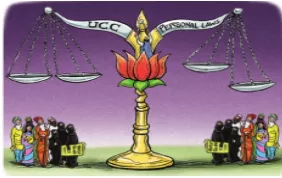
Here's how a Uniform Civil Code can be introduced without coercing minorities. Given the unequivocal (स्पष्ट/साफ़-जाहिर) stand of the Narendra Modi government in its submissions to the apex court, it is very likely that the Supreme Court will outlaw triple talaq. However, this will not bring BJP any closer to its manifesto promise of introducing the Uniform Civil Code (UCC). Most people rooting for enactment of UCC are under the mistaken impression that only Muslims and Christians follow their customary or religiously ordained (conferred holy orders on.) laws. There are countless examples to establish that customary practices have not vanished among Hindus, despite countless reforms introduced since the 1950s codification of laws. Hindus by and large continue following customary practices prevalent among their respective castes, sects and communities even though laws enacted by the state for the Hindu community have been totally secularised. For instance, most Hindu groups avoid intra-gotra marriage because they consider people belonging to the same gotra as sharing a brother-sister bond. Therefore, sagotra marriage is treated as bad as incest (the crime of having sexual intercourse with a parent, child, sibling, or grandchild.) even though there is no bar on sagotra marriages in the Hindu Marriage Act. It defies comprehension why the supposedly progressive Nehru government chose to institutionalise the practice of India's secular courts doling out justice as per religious laws of different communities, even though Article 44 of the Directive Principles of state policy in the Indian Constitution clearly mandates that “the state shall endeavor (प्रयत्न करना) to secure for all citizens a Uniform Civil Code throughout the territory of India.” It is equally puzzling that those who defend the divine sanctity (पवित्रता) of Muslim Personal Law have willingly submitted to adjudication by India's secular courts where non-Muslim judges unfamiliar with the intricacies (जटिलता/गूढ़ता) (details, especially of an involved or perplexing subject.) of Islamic law and zero knowledge of Arabic decide matters ostensibly (प्रकट रूप से) based on Sharia and Quran. It's as good as having IAS officers manage the affairs of mosques and deliver Friday sermons or lead Eid prayers. Today even raising this issue threatens to tear asunder (अलग) the Indian polity because all self-styled secular parties have tarred this constitutional promise as part of BJP's Hindutva project. Hence the virulent (bitterly hostile.) stalemate (गतिरोध) over UCC. But the solution to this contentious problem is actually quite simple. I present below a proposal I had offered in 1985 soon after the furore (सार्वजनिक क्रोध (जनता का)) that broke out with the Supreme Court judgment in Shah Bano case. It has the potential to break the stalemate on UCC without either coercing Muslims and Christians into reform or compromising the constitutional promise of equal citizenship rights to all. Its points can be summarised as follows: India's secular courts should stop adjudicating disputes on the basis of personal laws of any community ¬ be it Hindu, Muslim, Christian or Parsi. Instead, the state should confine itself to adjudicating cases only under the existing secular laws such as the Indian Marriage Act, Indian Divorce Act, Indian Succession Act, Indian Wards & Guardianship Act. These should be applicable to all citizens that choose to approach secular courts, irrespective of caste, creed, gender or religion. But these laws need to be carefully reviewed and improved in order to make them egalitarian (believing in or based on the principle that all people are equal and deserve equal rights and opportunities.) and gender just. Those who wish to continue with religio-customary practices of their community should be free to do so provided they don't expect India's secular law courts to be saddled with (saddle someone with something to give someone something that is difficult to deal with.) the burden of adjudication and enforcement. Let the onus (ज़िम्मेदारी) of ensuring compliance with customary laws rest with consensually accepted authority figures of that community ¬ be it the local imam or granthi, the family priest, caste panchayat or the spiritual gurus of the concerned sects. However, if even one party to the family dispute feels dissatisfied with the verdict of the authority adjudicating customary law, he/she should have the right to approach the secular courts where the dispute should be adjudicated only within the framework of secular laws applicable to all. Those who think this amounts to giving a free hand to retrogressive elements among Hindus, Muslims, Christians, Sikhs, Parsis would do well to remember that family laws enacted by the state, including provisions of the Indian Penal Code, come into play only when someone invokes their protection through the police and law courts. For example, the current law against bigamous marriages among Hindus works in favour of only those Hindu women who choose to sue their husbands in a court of law. A Muslim woman who accepts the second or third marriage of her husband or doesn't legally lodge a complaint after being arbitrarily abandoned is not going to benefit even if the arbitrary triple talaq is declared illegal. This is true not just for India but also for countries that give no legal recognition to Muslim or Hindu Personal Law as India does. There is now concrete evidence that when better options are available neither Muslim nor any other group of women hesitate from availing (use or take advantage of) of them. Today a growing number of Muslim women are filing cases under Dowry Prohibition Act as well as the laws against domestic violence, even though these laws don't draw legitimacy from the Holy Quran or the Shariat. Neither the All India Muslim Personal Law Board nor any mullah or maulvi has dared openly prohibit Muslim women from doing so. This is because these laws don't have the word “Hindu” attached to them. Though these community neutral laws have several flaws, they have had the salutary (हितकारी/लाभप्रद) effect of bringing Hindu, Muslim, Christian, Sikh, Buddhist, tribal and non-tribal women on a common platform to fight for what are common problems for women of all communities. Therefore, if we are serious about a UCC, let us do away with laws with a communal tag and let the two systems compete with each other on the basis of voluntary compliance.Unequivocal (adjective)
Unquestionably clear स्पष्ट/साफ़-जाहिर
Synonyms: Unambiguous, Unmistakable, Indisputable, Incontrovertible, Indubitable, Clear, Apparent.
Example: Since we raised over a million dollars for our charity, we considered the fundraiser to be an unequivocal success.
Ordain (verb)
Confer holy orders on/ to establish or order by appointment, decree, or law. आदेश करना
Synonyms: Decree, Rule, Order, Command
Example: John knows the ministry will never ordain him as a priest because of his evil acts done in past
Endeavor (verb)
Try hard to do or achieve something. प्रयत्न करना
Synonyms: Effort, Try, Attempt, Strive
Example: If you agree to chair the committee, we will endeavor to provide you with all the support you need.
Sanctity (noun)
The state or quality of being holy, sacred, or saintly. पवित्रता
Synonyms: Holiness, Godliness, Sacredness, Blessedness, Saintliness
Example: Your reckless driving jeopardizes the sanctity of life.
Intricacy (noun)
Details, especially of an involved or perplexing subject. जटिलता/गूढ़ता
Synonyms: Convolution, Difficulty, Complication, Complexity
Example: Sam hired a tutor to help him comprehend the intricacy of trigonometry.
Stalemate (noun)
A situation in which no progress can be made or no advancement is possible गतिरोध
Synonyms: Deadlock, Impasse, Standstill
Example: The judge dismissed the jury after the group failed to end their stalemate in two weeks.
Furore (noun)
An outbreak of public anger or excitement. (सार्वजनिक क्रोध (जनता का))
Synonyms: Ado, Bobbery, Commotion
Example: Riots took place in the streets following the innocent verdict of a murderer which the furore resonated down the street.
Salutary (adjective)
Producing good benefits हितकारी/लाभप्रद
Synonyms: Beneficial, Good, Advantageous, Profitable
Example: The board hopes the merger of the two companies will have salutary effects that will leave all the shareholders happy.
Onus (noun)
Something that is one's duty or responsibility. ज़िम्मेदारी
Synonyms: Vouchment, Responsibility, Liability, Obligation, Duty
Example: Being a leader is difficult because in this position one must bear the onus of making decisions for a group of people.
Virulent (adjective)
Bitterly hostile/ objectionably harsh or strong. संक्रामक/विषालु
Synonyms: Malevolent, Malicious, Malign, Nasty, Spiteful, Vicious
Example: The firemen had to wear masks that would protect them from the virulent fumes.
The conditional and the constitutional
Aug 13, 2017
No loo no i do
Aug 13, 2017
Stamp out stalking
Aug 09, 2017
False choice
Aug 03, 2017
Judicial overreach
Jul 27, 2017
Is the hindu a victim
Jul 20, 2017





Stay updated with The Hindu Editorial Vocab24 app, your definitive source for breaking news and comprehensive coverage from India and around the globe. Whether it's political developments, business updates, sports highlights, the latest technology trends, or current events, The Hindu brings live, accurate, and reliable news directly to your device.
Don’t fall for sensationalized or fake news shared online. Read and share accurate updates with friends and family through The Hindu Editorial Vocab24 app. Download it today!
News Coverage in The Hindu Editorial Vocab24 App
Breaking News: Receive instant notifications on breaking news stories as they unfold. Stay informed about major events and developments in India and around the world with live blogs, news in shorts videos, and concise articles.
Politics: Get the latest updates on Indian politics, including elections, policy changes, government decisions, and political events that shape the nation.
Business and Economy: Stay ahead in the economic landscape with detailed business news and market analysis. Learn about stock market trends, financial reports, corporate news, and economic developments to make informed investment decisions.
Current Events: Follow stories on social issues, policy changes, global events, and daily current affairs, tailored for UPSC and other competitive exam preparations.
Technology: Keep up with the latest gadgets, innovations, and tech trends. Read expert reviews and analyses in short, concise updates on cutting-edge technology from India and beyond.
Sports: Never miss a moment of your favorite sports. Get live scores, match reports, and expert analysis on cricket, football, tennis, and more.
International News: Stay informed about global events and geopolitical developments, including the Russia-Ukraine war, Israel-Palestine conflict, and other key international stories.
Local News: Stay connected to your community with the latest updates on city events, issues, and local news. Coverage includes hyperlocal updates from cities like Bangalore, Chennai, Delhi, Hyderabad, Mumbai, Kolkata, and more.
Trending Topics: Discover what's trending today with the most talked-about stories and hot topics across India and the world.
Experience journalism that values integrity, accuracy, and reliability. Download The Hindu Editorial Vocab24 app today and stay connected with the world.
Subscribe to our newsletter!







