

Birth pangs of a new federal polity
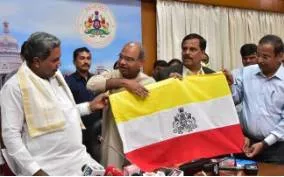
Siddaramaiah runs the risk of defeating his valid pitch for more powers to States by mixing it with electoral politics.A new flag for Karnataka has been ushered in by the Congress government of Chief Minister Siddaramaiah, who has urged the Centre to formally endorse it. Whether the Centre accepts his demand or rejects it, he is bound to reap electoral dividends at the cost of the Bharatiya Janata Party (BJP), the ruling party at the Centre. He appears to have used the same logic in granting separate religion status to Lingayats.
Brimming with symbolism
One must also not lose sight of the symbolism involved. If allowed to have a flag, Karnataka would become the second State after Jammu and Kashmir to have its own flag. It would be a terrifying prospect for those who regard India as a crumbling (disintegrate gradually over a period of time) edifice (a complex system of beliefs).
Interestingly, both the BJP and the Congress are united in viewing with suspicion every expression of sub-nationalism, cultural autonomy, or love for one’s language or way of life. A level-headed (having common sense and sound judgment; sensible) approach would be possible if one recognises India’s strength as a multicultural nation with parts having little in common but being proud to be its parts.
“Is the desire of the people of Karnataka to have a flag for their state, to give primacy to Kannada language and to have greater say in the running of their own lives,” Mr. Siddaramaiah asked ‘anchors in Delhi studios’ in a long Facebook post, “inconsistent with the objective of building a strong nation?” In fact, ‘anchors in Delhi studios’ appears to be a euphemism (a mild or pleasant word or phrase that is used instead of one that is unpleasant or offensive) for the Congress high command which expressed unhappiness last year over his move to have a flag for Karnataka.
The flag issue is being regarded as a part of electoral politics in Karnataka, but it also symbolises two broad trends in the country. One, there is a widespread disquiet among non-Hindi States at the increasing onslaught of conformity. Two, there is resentment at the skewed Centre-State relations wherein States find themselves as mere pillion-riders. This concern is shared by all States but those States where the ‘national’ parties are in power are gagged (to prevent from exercising freedom of speech or expression) by party discipline.
Being a protege (a young person who is taught and helped by someone who has a lot of knowledge and experience) of the late Ramakrishna Hegde, Mr. Siddaramaiah has managed to weave both issues into his poll plank. He may or may not be victorious at the hustings (a meeting at which candidates in an election address potential voters) , but he has already managed to mainstream the issues.
A pushback
It is but natural that a project to steamroll (to make sure something happens by using all your power) the entire nation into an abstract entity of one culture and one language should have produced a backlash. Identity politics is becoming front and centre not only in poll-bound Karnataka, but in non-Hindi States as diverse as Telangana and West Bengal, not to mention Tamil Nadu where sentiments of cultural autonomy are strongest.
Meghalaya Governor Ganga Prasad recently delivered his address to the State Assembly in Hindi and ended up inciting anti-Hindi comments from several MLAs. Mr. Prasad was oblivious (not aware of or not concerned about what is happening around one) of the thin line between his love for Hindi and the mindless expression of which offended legislators who could not understand him.
Consider the new State emblems of Telangana and West Bengal. While the former uses English, Telugu and Urdu, the latter has only Bengali and English. Both emblems retain ‘Satyameva Jayate’ in Devanagari more as a graphic, being part of the national symbol of the Lion Capital. This is a clear departure from the earlier practice of States using Hindi along with other language(s).
Similarly, the new flag of Karnataka (of yellow, white and red) contains the State’s emblem in the middle. Though the emblem originally has ‘Satyameva Jayate’ in Devanagari, it is not clear whether the script has been retained in the flag.
Hence the question: Why do non-Hindi States resist Hindi but have no qualms with English in State iconography/symbols?
As the nation is entering the poll season leading up to the general election in the summer of 2019, we run the risk of magnifying these mundane issues of identity and autonomy into matters that put a wedge between people and regions.
A generation ago, the non-BJP and non-Congress parties resorted to Mandal politics to stop the Hindutva juggernaut. Nitish Kumar at that time described the paradigm so evocatively (bringing strong images, memories, or feelings to mind) as Mandal versus Kamandal politics, though he moved effortlessly between these two poles.
The nation appears to be moving towards a more dangerous counter to Hindutva having, in addition to usual ingredients, sub-nationalism and north-south divide as the rallying cry.
Centre-State balance
Mr. Siddaramaiah’s Facebook post is not only a strong defence of States’ right to enjoy cultural autonomy (he is ‘a proud Kannadiga’ as well as ‘a proud Indian’), but a passionate appeal for India to become a federation of States. It may be recalled that his guru Hegde was instrumental in mounting a nation-wide critique of the misuse of Article 356, which resulted in the appointment of the Sarkaria Commission on Centre-State Relations in 1983.
Many issues that Mr. Siddaramaiah has now raised fall broadly into two groups. One group is the long-standing grievances of States such as the Centre’s mischievous practice of dictating to them (through the so-called Centrally Sponsored Schemes) how they must spend their share of Central tax revenue. This practice robs the States of their right to determine how best they can utilise their money as well as helps the Centre to take credit for the success of these schemes. The second group of issues pertains to the need to empower States to have a say in formulating the Centre’s economic and trade policies since they can adversely affect them.
Mr. Siddaramaiah’s push for a federation of States is perfectly in sync with the vision of our founding fathers. During the discussion in the Constituent Assembly on the draft Article 356, B.R. Ambedkar made it clear that: 1) India’s is a federal Constitution; 2) the Centre has no business in determining good governance in states; and 3) “the Provinces [States] are as sovereign in their field which is left to them by the Constitution, as the Centre is in the field which is assigned to it.”
Therefore, rebalancing Centre-State relations to be in tune with the 21st century needs will also amount to restoring the original scheme of the Constitution on the subject.
If Mr. Siddaramaiah is serious about phase two of moving towards a federal polity, he must keep the agenda above electoral politics. The least he can do to promote his cause is to refrain from his extreme partisanship displayed in his Facebook post: “Historically, the South has been subsidizing the north.” In addition to being offensive, this argument can be applied across regions and social groups. It would not be far-fetched for one to argue that thanks to Bengaluru south Karnataka subsidises north Karnataka. So on and so forth.



Top court quashes FIRs against Gen Z protesters
Sep 04, 2026






Stay updated with The Hindu Editorial Vocab24 app, your definitive source for breaking news and comprehensive coverage from India and around the globe. Whether it's political developments, business updates, sports highlights, the latest technology trends, or current events, The Hindu brings live, accurate, and reliable news directly to your device.
Don’t fall for sensationalized or fake news shared online. Read and share accurate updates with friends and family through The Hindu Editorial Vocab24 app. Download it today!
News Coverage in The Hindu Editorial Vocab24 App
Breaking News: Receive instant notifications on breaking news stories as they unfold. Stay informed about major events and developments in India and around the world with live blogs, news in shorts videos, and concise articles.
Politics: Get the latest updates on Indian politics, including elections, policy changes, government decisions, and political events that shape the nation.
Business and Economy: Stay ahead in the economic landscape with detailed business news and market analysis. Learn about stock market trends, financial reports, corporate news, and economic developments to make informed investment decisions.
Current Events: Follow stories on social issues, policy changes, global events, and daily current affairs, tailored for UPSC and other competitive exam preparations.
Technology: Keep up with the latest gadgets, innovations, and tech trends. Read expert reviews and analyses in short, concise updates on cutting-edge technology from India and beyond.
Sports: Never miss a moment of your favorite sports. Get live scores, match reports, and expert analysis on cricket, football, tennis, and more.
International News: Stay informed about global events and geopolitical developments, including the Russia-Ukraine war, Israel-Palestine conflict, and other key international stories.
Local News: Stay connected to your community with the latest updates on city events, issues, and local news. Coverage includes hyperlocal updates from cities like Bangalore, Chennai, Delhi, Hyderabad, Mumbai, Kolkata, and more.
Trending Topics: Discover what's trending today with the most talked-about stories and hot topics across India and the world.
Experience journalism that values integrity, accuracy, and reliability. Download The Hindu Editorial Vocab24 app today and stay connected with the world.
Subscribe to our newsletter!







