

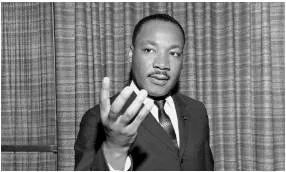
Big business is hijacking our radical past we must stop it
Ram Trucks distorted a Martin Luther King sermon to sell its cars. This is how the establishment whitewashes history.In 1966, shortly before Martin Luther King branded America “the greatest purveyor (to provide, furnish, or supply usually as a business or service) of violence in the world today” and insisted “capitalism forgets that life is social”, a Gallup poll showed two thirds of Americans viewed him unfavourably. In 1999, when Gallup asked Americans for the most admired figures of the 20th century, King came second to Mother Teresa. When his monument went up on the National Mall in Washington in 2011, 91% of Americans approved.
But when it comes to throwing its arms around a man it once loathed, American capitalism outdid itself last weekend, using a recording of a sermon King delivered about the value of service to sell Ram Trucks – “Built to Serve” – during the Superbowl.
Given that King was dead during the entire transition from being reviled to being revered, we should assume the journey owed less to what he did than to how others chose to remember him.
In the week when Britain celebrated the centenary of the act of parliament that granted the vote to some women, it is worth examining the manner in which radical history is misrepresented and radicals themselves are routinely coopted. With the militancy that made them both possible denied or distorted, their achievements are instead folded into the official narrative as though challenging the establishment was, in fact, the establishment’s idea all along. What was once considered dangerous and incendiary (a person who excites factions, quarrels, or sedition) is repackaged as obvious and inevitable.
Referring to America’s conversion to marriage equality, veteran gay rights campaigner Madeline Davis told me: “People forget that this did not erupt wholly from the head of Zeus … Those of us who did work hard all over the country put in many days and many hours going through rejection.” Movements are reduced to individuals – Rosa Parks’ momentary act of defiance (a daring or bold resistance to authority or to any opposing force) on the bus in Montgomery, Alabama is credited with forcing change, rather than the subsequent year-long transport boycott by the city’s black population.
Individuals, meanwhile, are elevated to icons: Parks is sold as a demure seamstress, ignoring a life of activism in which she insisted on the right to use violence in self-defence. Or they are condemned to invisibility: Claudette Colvin was ejected from a bus nine months before Parks after also refusing to give up her seat, but her cause was dropped after she became pregnant at 15. Until recently, she was left out of the story altogether.
The suffragettes were reviled (to use abusive or scornful language against (someone or something)) by the establishment. And for good reason. They smashed windows and started fires. They preferred jail to second-class citizenship. They went on hunger strikes. Some were communists. They did not just break the law – some flouted (to break or ignore (a law, rule, etc.) without hiding what you are doing or showing fear or shame) it ostentatiously. “To say I enjoyed making fires sounds rather awful,” said Lilian Lenton. “But it was really lovely to find that you’d been successful; that the thing really had burned down and you hadn’t got caught.”
Their challenge was not just against the political class, but the media that lent it legitimacy. In 1913 the Daily Express described suffragettes variously as “wild”, “fanatical”, “crazy” and “frenzied”. A year later the home secretary disparaged them as “foolish and mischievous”. Even those who supported suffrage would routinely condemn the means by which it was fought for. In 1905, when Christabel Pankhurst and Annie Kenney were forcibly removed from a Liberal party meeting for heckling (to harass and try to disconcert with questions, challenges, or gibes) in favour of female suffrage, the Guardian condemned their behaviour as being “such as one was accustomed to attribute to women from the slums”.
It would be churlish not to celebrate the fact that once controversial and radical ideas, such as women’s suffrage or racial and gay liberation, have shifted from the margins to the mainstream. Even if we are not where we would want to be in terms of equality we are, thankfully, not where we were. But we should be wary of how these celebrations are conducted – who is given the floor, to what end and with what message – for two main reasons.
First, because before radical history can be embraced by the establishment it must be washed clean of whatever ideology made it effective. Radical change is most likely to come from below, be fiercely resisted by entrenched interests from above and achieved through confrontation. “If those who have do not give, those who haven’t must take,” argued the late anti-racist intellectual Ambalavaner Sivanandan. This is not a message those in power are keen to promote, lest their own interests be challenged.
In the case of the Ram Trucks ad, this whitewashing couldn’t have been more blatant (completely obvious in a disagreeable way) . In another part of the sermon that was used, King literally tells the congregation not to be fooled into spending more money than necessary on cars by sharp advertisers. “These gentlemen of massive verbal persuasion,” he says, “have a way of saying things to you that kind of gets you into buying … In order to make your neighbours envious you must drive this type of car … And before you know it, you’re just buying that stuff.”
Second, because history does not stop because someone puts up a plaque. If we understand that what was radical yesterday could be accepted as common sense tomorrow, that might change how we act today. Knowing that some of our most cherished rights were won by often uncelebrated people facing great odds, unrelenting vilification (to utter slanderous and abusive statements against) and, at times, state repression, suggests that at least some of those being denigrated (to assault someone’s character or reputation) today will be celebrated one day. The means by which we might achieve progressive change may shift according to the context – but the need for it never goes away. And the stories we have been told about how things happened are intimately connected to the stories we tell ourselves.
“The belief that we have come from somewhere,” wrote the historian EH Carr, “is closely linked with the belief that we are going somewhere … our view of history reflects our view of society.”











Stay updated with The Hindu Editorial Vocab24 app, your definitive source for breaking news and comprehensive coverage from India and around the globe. Whether it's political developments, business updates, sports highlights, the latest technology trends, or current events, The Hindu brings live, accurate, and reliable news directly to your device.
Don’t fall for sensationalized or fake news shared online. Read and share accurate updates with friends and family through The Hindu Editorial Vocab24 app. Download it today!
News Coverage in The Hindu Editorial Vocab24 App
Breaking News: Receive instant notifications on breaking news stories as they unfold. Stay informed about major events and developments in India and around the world with live blogs, news in shorts videos, and concise articles.
Politics: Get the latest updates on Indian politics, including elections, policy changes, government decisions, and political events that shape the nation.
Business and Economy: Stay ahead in the economic landscape with detailed business news and market analysis. Learn about stock market trends, financial reports, corporate news, and economic developments to make informed investment decisions.
Current Events: Follow stories on social issues, policy changes, global events, and daily current affairs, tailored for UPSC and other competitive exam preparations.
Technology: Keep up with the latest gadgets, innovations, and tech trends. Read expert reviews and analyses in short, concise updates on cutting-edge technology from India and beyond.
Sports: Never miss a moment of your favorite sports. Get live scores, match reports, and expert analysis on cricket, football, tennis, and more.
International News: Stay informed about global events and geopolitical developments, including the Russia-Ukraine war, Israel-Palestine conflict, and other key international stories.
Local News: Stay connected to your community with the latest updates on city events, issues, and local news. Coverage includes hyperlocal updates from cities like Bangalore, Chennai, Delhi, Hyderabad, Mumbai, Kolkata, and more.
Trending Topics: Discover what's trending today with the most talked-about stories and hot topics across India and the world.
Experience journalism that values integrity, accuracy, and reliability. Download The Hindu Editorial Vocab24 app today and stay connected with the world.
Subscribe to our newsletter!







