

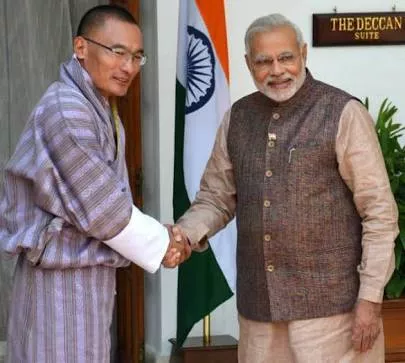
Bhutan twenty five years of energy cooperation with india
The tiny Himalayan Kingdom of Bhutan has completed 25 years of energy cooperation with India. The idea was/is for Bhutan to facilitate Indian funding for setting up hydro-power projects in the country.Its time we look through those ideas and find out there contemporary relevance.The tiny Himalayan Kingdom of Bhutan has completed 25 years of energy cooperation with India. The idea was/is for Bhutan to facilitate Indian funding for setting up hydro-power projects in the country, on a power-purchase agreement, thus generating additional power and job-creation in the use of the Himalayan nation as well.
Bilateral cooperation between India and Bhutan aims at installing hydro-power plants with a total capacity of 10,000 MW by 2020. To take it forward, an Inter-governmental Agreement on Development of Joint Venture Hydropower Projects has since been signed on 22 April 2014. The agreement has enabled implementation of four hydro-power projects, with a total capacity of 2120 MW in a joint venture model between public sector undertakings of the two countries.
The four new hydropower projects are: 600 MW Kholongchu, 180 MW Bunakha (with 230 MW downstream benefit from Tala, Chukha and Wangchu), 570 MW Wangchu and 770 MW Chamkarchu. Four Indian companies with a combined investment of Rs. 20,000 to 25,000 crores have been roped in by Thimphu for the JV with Bhutan’s state-owned companies. The four projects as part of the agreement signed are in addition to the already operational three hydro-electric projects totalling 1416 MW and three more projects totalling 2940 MW which are under construction and likely to be commissioned by 2018.
Energy cooperation
Need for energy drove India to start cooperating on energy with Bhutan and the first power plant to be commissioned as a joint venture project was the Chhukha hydroelectric plant in 1988. Since then so far it cooperation between the two countries has been a success.
The Tala hydro-electric plant with a capacity of 1020 MW in 1996 is the biggest power project so far in Bhutan and also India’s largest ever foreign investment.
The estimated potential of Bhutan’s hydro-electricity is 30,000 MW out of which about 23,000 MW is said to be economically viable. Presently, Thimphu exports about 1,000 MW surplus power to India from its three hydel projects. There are 10 more projects in the pipeline.
Initially, bilateral hydropower projects, which were on a 60:40 ratio of grant to loan, have now been changed to 70 percent loan at 10 percent and 30 percent grants. Though the loan component has gone up, Bhutan is set to make volumes from the projects.
A total cost of Rs 75,000 crores is said to be involved for completing the projects with a total installed capacity of 10,000 MW by 2020. On the other side, even the loan component is increasing for Bhutan.
However, both Bhutan and India are in a win-win situation, as Bhutan makes its ascendancy toward a self-sufficient economy powered by hydro-power exports, India investment in Bhutan’s hydropower has already proved economically viable.
Road ahead
The Indo-Bhutan energy cooperation has already become a model that Asian Development Bank is promoting for SAARC countries. With energy demands peaking in SAARC countries, the potential of hydropower surplus countries like Bhutan and Nepal has come into focus.
At a time when both countries are crediting the hydroelectric power cooperation as the defining factor in relations between India and Bhutan, the bilateral projects have their share of challenges. India is estimated to have doubled its demand by 2021 and would have to diversify its energy sources, Bhutan would have to face the increasing impact of climate change.
Energy demand in India is said to grow to a whopping 2,83,470 MW by 2021 more than double of where it stands today. India has a peak power shortage of around 12%. There are also concerns with project delays and hence escalation of construction costs.
The Druk Green Power Corporation of Bhutan has reported that water levels in rivers have been declining in recent years due to changes in monsoon patters, thus leading to less hydropower production. Presently power plants are running on Punatsangchhu, Wangchhu and Dragmechhu river basins, while projects would be commissioned on Amonchhu and Mangdecchhu river basins by 2030.
Bhutan economy is facing a severe credit crunch and a rupee crisis, which is said to be due to the construction costs of hydropower projects. Bhutan also faces climate change concerns.
Also, Bhutan realizes that its overreliance on hydropower exports is not in interest of the country’s healthy economy. The country needs to diversify its sources of revenue. However with no immediate substitute for revenue generation, Bhutan will continue to continue its cooperation with countries in the Indian Sub-continent.
Is wto relevant to india
Dec 28, 2017
Boosting export production
Dec 18, 2017
Trump’s asia visit leaves china stronger
Nov 19, 2017
Is india getting the kind of fdi it needs
Nov 13, 2017





Stay updated with The Hindu Editorial Vocab24 app, your definitive source for breaking news and comprehensive coverage from India and around the globe. Whether it's political developments, business updates, sports highlights, the latest technology trends, or current events, The Hindu brings live, accurate, and reliable news directly to your device.
Don’t fall for sensationalized or fake news shared online. Read and share accurate updates with friends and family through The Hindu Editorial Vocab24 app. Download it today!
News Coverage in The Hindu Editorial Vocab24 App
Breaking News: Receive instant notifications on breaking news stories as they unfold. Stay informed about major events and developments in India and around the world with live blogs, news in shorts videos, and concise articles.
Politics: Get the latest updates on Indian politics, including elections, policy changes, government decisions, and political events that shape the nation.
Business and Economy: Stay ahead in the economic landscape with detailed business news and market analysis. Learn about stock market trends, financial reports, corporate news, and economic developments to make informed investment decisions.
Current Events: Follow stories on social issues, policy changes, global events, and daily current affairs, tailored for UPSC and other competitive exam preparations.
Technology: Keep up with the latest gadgets, innovations, and tech trends. Read expert reviews and analyses in short, concise updates on cutting-edge technology from India and beyond.
Sports: Never miss a moment of your favorite sports. Get live scores, match reports, and expert analysis on cricket, football, tennis, and more.
International News: Stay informed about global events and geopolitical developments, including the Russia-Ukraine war, Israel-Palestine conflict, and other key international stories.
Local News: Stay connected to your community with the latest updates on city events, issues, and local news. Coverage includes hyperlocal updates from cities like Bangalore, Chennai, Delhi, Hyderabad, Mumbai, Kolkata, and more.
Trending Topics: Discover what's trending today with the most talked-about stories and hot topics across India and the world.
Experience journalism that values integrity, accuracy, and reliability. Download The Hindu Editorial Vocab24 app today and stay connected with the world.
Subscribe to our newsletter!







