

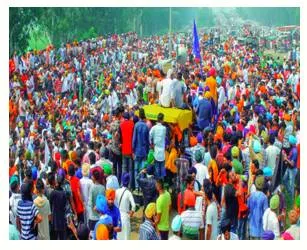
Bharat bandh making of farmers’ revolution
In the last 10 months, the agitation against the three farm laws has spread from being a ‘regional protest’ to a nationwide movement.It was September 27 and a Bharat bandh. And amidst a blooming cotton field and harvested bajra, I sat with Krishna Lal, a millet farmer on the Haryana-Rajasthan border, discussing the farmers’ revolution. From his field, we could see a long line of trucks and cars, police vehicles, discomfort and success of the farmers.
A group of 50 farmers had blocked the Shahjahanpur border to protest against the three farm laws. One naturally questioned, will these traffic jams, roadblocks or Bharat bandhs actually help the farmers? Is all this worth it? The police and truck drivers alike thought it was a show. But sometimes a show is needed to awaken others. Rising fuel prices, unemployment, long work hours and no pension affected police personnel and citizens alike. Having spent over six hours among them, I hitched a bike ride to Bawal and then a Haryana Roadways bus into Delhi. Contrary to news reports, our bus crossed into Delhi through Gurugram without traffic jams.
But others travelling near Ghazipur border, or in parts of Haryana and Punjab, were not so lucky. Traffic movement was affected in many parts of the country, much more than the last time farmers called for a Bharat bandh. Images from Bihar, Karnataka, Tamil Nadu and elsewhere confirmed that a lot more people were taking the Bharat bandh seriously. The Opposition parties also lent support.
So what did this bandh achieve? One, a nationwide strike. From a “handful of farmers” or “farmers from Haryana and Punjab”, the farm leaders proved that their message resonates across the country. The new pockets emerging, whether in Karnataka or Bihar, prove that the movement is spreading. The farmer leaders’ 10-month campaign has got new support and perhaps a new electoral constituency.
But this achievement was not possible without political maturity. Sir Chotu Ram’s talisman to farmers was “identify the enemy” and “learn to talk”; it’s clear that farmers have identified the enemy and learnt how to talk not only to the media, but are now evolving as a political class. They are organising general strikes or bandhs. And each time, their strength grows. If we compare the last few times farmers called for a general strike, September 27 has been the most successful in terms of numbers and multi-region participation. Apart from Opposition parties, trade and bank unions and others have joined their ranks. Slowly, these strikes are becoming a convergence point for dissent. Indians from all walks of life are embracing this call to protest against various shortcomings of the Government.
Looking inwards, keep in mind that 10 months have passed at Delhi’s borders; energy after the Muzaffarnagar Kisan Mahapanchayat and Karnal blockade has been low. As peaceful farmers blockade Delhi, their biggest enemy is not the Government but attrition and ennui, which are eating through their ranks. Getting fresh faces and keeping the morale high is a major challenge for farmer leaders. Hence they use the Bharat bandh to galvanise their supporters and motivate their cadre. The fight against the Modi Government is also a PR fight involving optics and chicanery. The farmer leaders constantly work to maintain media presence and remain in focus while disciplining their own. Since the Government has repeatedly tried to negate their message, the Bharat bandhs during the last 10 months are farmer leaders’ attempts to stay relevant in the nation’s attention.
Of course, it’s not all rosy. The farmers’ leadership also faces some challenges. The first comes from farmers’ camps at Shahjahanpur on the Rajasthan-Haryana border where both the crowds and morale seem to be dwindling. Three prominent factions — the BKU, Jai Kisan Andolan and the Left — are supposed to occupy this post but even 50 farmers weren’t present on the Bharat bandh day.
These camps around the city and at Shahjahanpur do cause discomfort to the locals, so more effort is required to bring the locals over to their side. By November 26, farmer leaders should aim at having heavier local presence at the borders.
Many years ago when Gandhi picked salt, he didn’t destroy the British monopoly but he did challenge immorality and tyranny. Similarly, the Bharat bandh didn’t bring the nation to a standstill but it has challenged the Government’s legitimacy. It has punctured holes in the official narrative and cast doubts in a trusting nation’s mind. Are the farm laws really that good? Ten months on, the resistance grows and another political movement evolves. Its success should be measured not by the number of cars blocked or Twitter hits, but by the resilience it has shown and hearts it has won fighting a well-oiled political giant. Finally, the biggest victory for farmer leaders is that within 10 months, they have converted a “regional protest” into a national revolution. They have successfully brought agrarian issues to the centre stage and unknowingly laid the foundation of a new politics in India.
Can quad restrain wayward china
May 29, 2022
Concerns over finland sweden joining nato
May 22, 2022
Sustainability road to a better future
May 16, 2022
Aap lays out its goal
May 11, 2022
Shanghai covid crisis a test for xi’s leadership
May 09, 2022
The idea of universal equality
May 06, 2022





Stay updated with The Hindu Editorial Vocab24 app, your definitive source for breaking news and comprehensive coverage from India and around the globe. Whether it's political developments, business updates, sports highlights, the latest technology trends, or current events, The Hindu brings live, accurate, and reliable news directly to your device.
Don’t fall for sensationalized or fake news shared online. Read and share accurate updates with friends and family through The Hindu Editorial Vocab24 app. Download it today!
News Coverage in The Hindu Editorial Vocab24 App
Breaking News: Receive instant notifications on breaking news stories as they unfold. Stay informed about major events and developments in India and around the world with live blogs, news in shorts videos, and concise articles.
Politics: Get the latest updates on Indian politics, including elections, policy changes, government decisions, and political events that shape the nation.
Business and Economy: Stay ahead in the economic landscape with detailed business news and market analysis. Learn about stock market trends, financial reports, corporate news, and economic developments to make informed investment decisions.
Current Events: Follow stories on social issues, policy changes, global events, and daily current affairs, tailored for UPSC and other competitive exam preparations.
Technology: Keep up with the latest gadgets, innovations, and tech trends. Read expert reviews and analyses in short, concise updates on cutting-edge technology from India and beyond.
Sports: Never miss a moment of your favorite sports. Get live scores, match reports, and expert analysis on cricket, football, tennis, and more.
International News: Stay informed about global events and geopolitical developments, including the Russia-Ukraine war, Israel-Palestine conflict, and other key international stories.
Local News: Stay connected to your community with the latest updates on city events, issues, and local news. Coverage includes hyperlocal updates from cities like Bangalore, Chennai, Delhi, Hyderabad, Mumbai, Kolkata, and more.
Trending Topics: Discover what's trending today with the most talked-about stories and hot topics across India and the world.
Experience journalism that values integrity, accuracy, and reliability. Download The Hindu Editorial Vocab24 app today and stay connected with the world.
Subscribe to our newsletter!







