

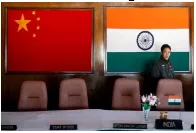
Beware of the wrong lessons from doklam
The standoff between China and India in Doklam was resolved not a day too soon. The Union government did well both in agreeing to a sequenced withdrawal and in refusing to comment on what, if any, understanding had been reached with China on its plans to build a road in the area. By contrast, much of the commentary in our media has been rather bullish, presenting the outcome as a testimony to the government’s ability to stare down the Chinese. It is further claimed that the Chinese backed down because their verbal threats failed to work, because they were in a weaker military position in the area and because of wider political considerations, especially the upcoming BRICS (Brazil, Russia, India, China, South Africa) summit in China. The confident conclusion is that a combination of resolve and tough-minded diplomacy can prevent military standoffs with China from escalating.This chain of reasoning is not just questionable, but also potentially problematic. For these “lessons” might well end up making future crises more difficult to resolve. The Doklam standoff needs to be seen for what it was: an indication of the steady deterioration in the ability of India and China to deal with such situations.
Consider the reasons trotted out to explain China’s willingness to seek a resolution. Was it because China’s threats failed to work? This is true inasmuch as India did not unilaterally pull its forces out of the area. But it is also a misleading claim inasmuch as the Chinese threats did force India to take the situation seriously and mount a sustained attempt at diplomatic resolution.
Threats are seldom held out with a view to receiving unconditional compliance. Rather they are an attempt to shape the adversary’s preferences and inject a sense of urgency in a crisis. This is an elementary point in the considerable body of research on crisis management.
Did India enjoy a local military advantage in this standoff? This may be true in a tactical sense. The Doka La post held by the Indian Army dominates the area below where the actual standoff took place. But to extrapolate from this and claim that India has stronger logistics in the area or even a military upper hand over the Chinese in the Chumbi Valley is to betray ignorance of the terrain and operational realities. Hopefully, the powers that be know better and the Indian Army isn’t drinking the Kool-Aid.
The point about Chinese concerns over Indian participation in the BRICS summit is stronger. If Prime Minister Narendra Modi had declined to attend, it would have been a serious embarrassment for the Chinese—both as the host and as the leading player in the grouping. Just how important a consideration this was we may never know.
Strikingly absent in Indian commentary on the denouement is any recognition of the most fundamental consideration from the Chinese standpoint. After all, the Chinese would have weighed the option of escalation against the interests at stake for them in building a road in Doklam. And the fact is that this is not an area of serious strategic interest for them. Certainly not important enough to have a military showdown with India and a consequent break with Bhutan. If anything, the Doklam area is of greater strategic importance for India, which is why India was so keen to forestall the Chinese move. In other words, the most salient aspect of the standoff was the balance of interests between the two sides—and it was tilted towards India. Innate interests apart, the Chinese had to consider the reputational consequences for them of allowing India to interpose itself in a dispute between China and Bhutan. Could Chinese acquiescence encourage other countries to behave similarly elsewhere, say in the South China Sea? Evidently, the Chinese concluded that reputational interests could be managed as long as they got Indian troops to pull out of the area first.
Beyond these questions lies the larger one of what the Doklam standoff portends. Does it really suggest that a combination of resoluteness and diplomacy can prevent escalation in future military standoffs with China? On the contrary, it shows that the existing mechanisms to unwind such situations have weakened. Compared to the standoffs in Ladakh in 2013 and 2014, the latest one took considerably longer to resolve. The key “lesson” of this episode is the urgent need for both sides to work towards an understanding on mutual restraint.
The assumption that we can pull off such things in future confrontations with China is deeply problematic. For one thing, the Chinese calculus of interest could be rather different in other parts of the disputed boundary. For another, drawing and internalizing such a conclusion could lead to avoidable overconfidence in the future. It is worth recalling that in the long run-up to the 1962 war, India and Chinese troops were engaged in several standoffs in which the Chinese desisted from using force despite issuing lurid warnings. This led India to believe that it could get away with running greater risks—an assumption that was badly belied in October 1962. Finally, there is no reason to assume—as some commentators have—that the nuclear context places an additional lid on escalation. After all, the Sino-Soviet boundary clashes of 1969 took place against the backdrop of nuclear weapons.
The government hopefully has a more sober reading of the implications of Doklam. The prime minister’s forthcoming visit to China would be a good opportunity to start putting in more stabilizers in the bilateral relationship.






Stay updated with The Hindu Editorial Vocab24 app, your definitive source for breaking news and comprehensive coverage from India and around the globe. Whether it's political developments, business updates, sports highlights, the latest technology trends, or current events, The Hindu brings live, accurate, and reliable news directly to your device.
Don’t fall for sensationalized or fake news shared online. Read and share accurate updates with friends and family through The Hindu Editorial Vocab24 app. Download it today!
News Coverage in The Hindu Editorial Vocab24 App
Breaking News: Receive instant notifications on breaking news stories as they unfold. Stay informed about major events and developments in India and around the world with live blogs, news in shorts videos, and concise articles.
Politics: Get the latest updates on Indian politics, including elections, policy changes, government decisions, and political events that shape the nation.
Business and Economy: Stay ahead in the economic landscape with detailed business news and market analysis. Learn about stock market trends, financial reports, corporate news, and economic developments to make informed investment decisions.
Current Events: Follow stories on social issues, policy changes, global events, and daily current affairs, tailored for UPSC and other competitive exam preparations.
Technology: Keep up with the latest gadgets, innovations, and tech trends. Read expert reviews and analyses in short, concise updates on cutting-edge technology from India and beyond.
Sports: Never miss a moment of your favorite sports. Get live scores, match reports, and expert analysis on cricket, football, tennis, and more.
International News: Stay informed about global events and geopolitical developments, including the Russia-Ukraine war, Israel-Palestine conflict, and other key international stories.
Local News: Stay connected to your community with the latest updates on city events, issues, and local news. Coverage includes hyperlocal updates from cities like Bangalore, Chennai, Delhi, Hyderabad, Mumbai, Kolkata, and more.
Trending Topics: Discover what's trending today with the most talked-about stories and hot topics across India and the world.
Experience journalism that values integrity, accuracy, and reliability. Download The Hindu Editorial Vocab24 app today and stay connected with the world.
Subscribe to our newsletter!







