

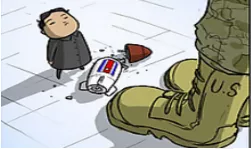
Being pragmatic with pyongyang
Rhetoric and political signalling is an accepted element of crisis management provided the messages are clearly understood by those for whom these are intended. If not, it becomes a source of misunderstanding and a recipe for unintended miscalculation and potential disaster. Nowhere is this more evident than in recent exchanges between the U.S. and the Democratic People’s Republic of Korea (DPRK) where events threaten to spin out of control. Trump’s mixed signals In an interview to Reuters last week, U.S. President Donald Trump, while describing it as his “biggest challenge”, cautioned: “There is a chance that we could end up having a major major conflict with North Korea. Absolutely.” Earlier in April, amid reports that North Korea might be planning another nuclear test to coincide with the 105th birth anniversary of long-time leader Kim Il Sung, Mr. Trump had announced that “an armada (a fleet of warships.) , very powerful” was headed towards the Korean peninsula. After a week it emerged that the USS Carl Vinson aircraft carrier was actually on its way to Western Australia, on account of a lack of clarity in communications. This now stands corrected. Meanwhile, a nuclear submarine, USS Michigan, has surfaced in Korean waters. In turn, the DPRK threatened a “super mighty pre-emptive strike”. After undertaking a live firing exercise off its east coast, it followed up with another test-firing of a ballistic missile on April 29 which fizzled (असफल रहना) , causing loss of face (मानहानि) . During the campaign, Mr. Trump had said that he would be willing to talk to North Korean leader Kim Jong-un, making it clear that Barack Obama’s policy focusing on tighter sanctions was a failure. After assuming office, he adopted a harder line, declaring that he would do “whatever is necessary” to prevent North Korea from developing a nuclear-capable missile that can reach the U.S. In the Reuters interview, however, he reflected unusual empathy when asked about Kim Jong-un: “He is 27 years old [in 2011 when he took over]. His father dies, took over a regime. So say what you want but that is not easy, especially at that age.” In an interview to NPR last week, U.S. Secretary of State Rex Tillerson said that while the North Korean leader may be ruthless (निर्मम/निर्दयी) , “he is not crazy”. He held out prospects of engaging in direct talks but was unwilling to engage in “negotiations about negotiations”. The U.S. has not held bilateral talks with North Korea since the Bill Clinton presidency. So clearly, there is no dearth of signalling but the question is, what is the 33-year-old Kim Jong-un expected to make of it? Need for policy consistency Regime acceptance and regime survival have been key priorities for Pyongyang since the collapse of the Soviet Union. A positive move in 1992 was the withdrawal of tactical nuclear weapons from the Korean peninsula and a suspension of Team Spirit, the joint U.S.-South Korean military exercises, leading to the Basic Agreement on Reconciliation, Non-Aggression, and Exchanges and Cooperation. When joint exercises were resumed in 1993, North Korea announced its decision to withdraw from the Nuclear Non-Proliferation Treaty (NPT). The ensuing crisis led to talks and a year later, an Agreed Framework was concluded under which North Korea suspended its decision to withdraw from the NPT, agreed to freeze its nuclear activities, and in return, the U.S. pledged to build two light water nuclear power reactors. Food aid and humanitarian assistance provided by the Clinton administration from 1995 till 2000 was close to $750 million. The Bush administration declared North Korea part of the ‘axis of evil’ in 2002, cancelled direct talks and annulled (रद्द करना) the 1994 agreement. North Korea responded by throwing out International Atomic Energy Agency inspectors and formally quit the NPT thereby provoking a fresh crisis. China and Russia initiated Six Party Talks in 2004 which led to the 2005 joint statement which expanded the scope to more than the nuclear issue. However, the talks collapsed when the U.S. imposed sanctions a few months later; North Korea responded with its first nuclear test in 2006. Since then, North Korea has made steady progress in its nuclear and missile programmes. An underground nuclear facility has been built at Mt. Musan. Nuclear tests were conducted in 2013 and twice last year, and it is estimated that North Korea has enough fissile (able to undergo nuclear fission.) material for 10 to 15 nuclear devices. By 2019, North Korea will be able to develop long-range missiles that can reach the U.S. mainland. Given Mr. Trump’s redline, Mr. Jong-un is convinced that nuclear capability is the ultimate security guarantee to protect his regime against U.S. intervention. U.S. policy has oscillated between sanctions in response to nuclear and missile tests, dilution of sanctions by China, talks about closer defence ties with Japan and South Korea, citing of additional threats by North Korea and more testing, thus repeating the cycle. U.S. expectations that sanctions would lead to regime collapse were misplaced because given China’s stakes, this will not happen. Will China nudge (coax or gently encourage (someone) to do something)? Recently China has registered a policy shift reflecting unhappiness about Mr. Jong-un’s behaviour, particularly the high-profile executions of those considered to be close to China. The most recent was the assassination of Kim Jong-nam, Mr. Jong-un’s half brother, in February, which prompted China to halting coal briquette imports from North Korea. Air China stopped direct flights to Pyongyang last month but these are now being reinstated (पुनः प्रतिष्ठित करना) . North Korea has accused China of “dancing to the tune of the U.S.”. However, China can neither permit a regime collapse which would create instability nor allow its communist ally to be subsumed into a unified Korea. Mr. Trump is trying to persuade China to exert greater leverage (प्रभाव) by praising its President, Xi Jinping, as “a good man” who is “trying hard”. After the latest missile test, Mr. Trump tweeted, “North Korea disrespected the wishes of China & its highly respected President when it launched, though unsuccessfully, a missile today. Bad!” Mr. Xi is unlikely to be persuaded. At the UN Security Council meeting on April 28, Foreign Minister Wang Yi reaffirmed support for a denuclearised Korean peninsula and previous Security Council resolutions but did not support additional punitive measures. Instead, he again suggested that the U.S. and South Korea could suspend their military exercises. More than North Korean tests, China is worried about the possibility of an unpredictable Trump initiating unilateral action which could create an escalatory spiral. Another concern is the U.S. decision to accelerate deployment of the THAAD (Terminal High Altitude Area Defence) system in South Korea though it is hopeful that a moderate President gets elected in the May 9 election in South Korea and reverses the THAAD decision. The way forward Mr. Xi’s objective is to persuade Mr. Trump that neither more sanctions nor military strikes are viable (व्यवहार्य) options; the only option is ‘dialogue’. Second, while denuclearisation of the Korean peninsula can be a long-term objective, for the foreseeable future, Mr. Jong-un is not going to give up North Korea’s nuclear and missile capabilities. At most, he can agree to a freeze on its programmes — no further tests, no exports or transfers and no threats. In return, the U.S. will need to provide assurances relating to regime acceptance and a gradual normalisation of relations. A moderate leader in Seoul will help the process of a sustained dialogue which also needs coordination with Japan. Mr. Jong-un’s stakes are existential and, having seen Western interventions in Iraq and Libya and Russian intervention in Ukraine, he is determined to retain his nuclear capabilities till the end of what will be a long and delicate (कमज़ोर/नाज़ुक) negotiating process, a process which could all too easily be derailed by confusing rhetoric and mixed signalling that has escalated tensions.Armada (noun)
A fleet of warships. लड़ाई के जहाजों का बेड़ा
Synonyms: Fleet, Flotilla, Squadron, (Task) Force
Example: During the war a country’s navy sent its armada to attack its enemy.
Fizzle (verb)
End or fail in a weak or disappointing way. असफल रहना
Synonyms: Fail, Flatine, Flop, Be A Fiasco, Come To Nothing, End In Defeat
Example: Government’s attempt to implement the policy was fizzled because of widespread protest against it.
Annul (verb)
Declare invalid (an official agreement, decision, or result). रद्द करना
Synonyms: Declare Invalid, Nullify, Invalidate, Negate, Cancel Out
Example: The newly elected president will work hard to annul policies that have had a negative effect on our organization.
Nudge (verb)
(coax or gently encourage (someone) to do something) समझाना
Synonyms: Prompt, Encourage, Coax, Stimulate, Prod
Example: The worried mom didn’t know what it would take to nudge her son’s interest in school and get him away from video games.
Leverage (noun)
The power to influence a person or situation. प्रभाव
Synonyms: Influence, Power, Authority, Control
Example: Because of the gasoline shortage, the fuel suppliers have a great deal of leverage in the pricing war.
Reinstate (verb)
Restore (someone or something) to their former position or state. पुनः प्रतिष्ठित करना
Synonyms: Restore, Reinstitute, Reinstall, Rehabilitate, Re-Establish
Example: Marc will reinstate his bookkeeper due to her stellar work history.
Ruthless (adjective)
Having or showing no pity or compassion for others. निर्मम/निर्दयी
Synonyms: Merciless, Pitiless, Cruel, Heartless, Callous
Example: A dictator is characterized by ruthlessness and can kill anyone who challenges his authority.
Viable (adjective)
Capable of working successfully/ having the possibility of being done. व्यवहार्य
Synonyms: Workable, Feasible, Practicable, Applicable, Manageable, Operable
Example: The two small bookstores see a merger as the only viable means of competing with online booksellers.
Delicate (adjective)
Not robust in health or constitution/ easily broken or damaged or destroyed. कमज़ोर/नाज़ुक
Synonyms: Fragile, Breakable, Easily Broken, Frail, Frangible
Example: The Bridge was declared to be too delicate for use after it was inspected by government officials, which is why it was demolished.
Loss of face (idiom)
The condition that occurs when one is made to feel embarrassed. मानहानि
Synonyms: Humiliation, Disgrace, Ignominy, Dishonor, Mortification
Example: Being a CEO of prestigious company, sudden reversal of policies can cause a loss of face for the growth of the organization.


U k budget increases child welfare allowance taxes
Nov 29, 2025
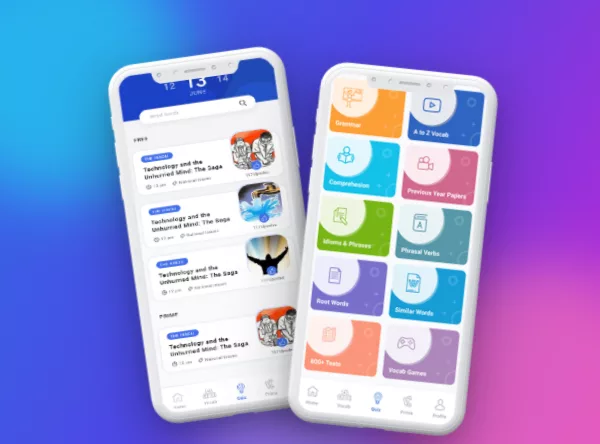





Stay updated with The Hindu Editorial Vocab24 app, your definitive source for breaking news and comprehensive coverage from India and around the globe. Whether it's political developments, business updates, sports highlights, the latest technology trends, or current events, The Hindu brings live, accurate, and reliable news directly to your device.
Don’t fall for sensationalized or fake news shared online. Read and share accurate updates with friends and family through The Hindu Editorial Vocab24 app. Download it today!
News Coverage in The Hindu Editorial Vocab24 App
Breaking News: Receive instant notifications on breaking news stories as they unfold. Stay informed about major events and developments in India and around the world with live blogs, news in shorts videos, and concise articles.
Politics: Get the latest updates on Indian politics, including elections, policy changes, government decisions, and political events that shape the nation.
Business and Economy: Stay ahead in the economic landscape with detailed business news and market analysis. Learn about stock market trends, financial reports, corporate news, and economic developments to make informed investment decisions.
Current Events: Follow stories on social issues, policy changes, global events, and daily current affairs, tailored for UPSC and other competitive exam preparations.
Technology: Keep up with the latest gadgets, innovations, and tech trends. Read expert reviews and analyses in short, concise updates on cutting-edge technology from India and beyond.
Sports: Never miss a moment of your favorite sports. Get live scores, match reports, and expert analysis on cricket, football, tennis, and more.
International News: Stay informed about global events and geopolitical developments, including the Russia-Ukraine war, Israel-Palestine conflict, and other key international stories.
Local News: Stay connected to your community with the latest updates on city events, issues, and local news. Coverage includes hyperlocal updates from cities like Bangalore, Chennai, Delhi, Hyderabad, Mumbai, Kolkata, and more.
Trending Topics: Discover what's trending today with the most talked-about stories and hot topics across India and the world.
Experience journalism that values integrity, accuracy, and reliability. Download The Hindu Editorial Vocab24 app today and stay connected with the world.
Subscribe to our newsletter!







