

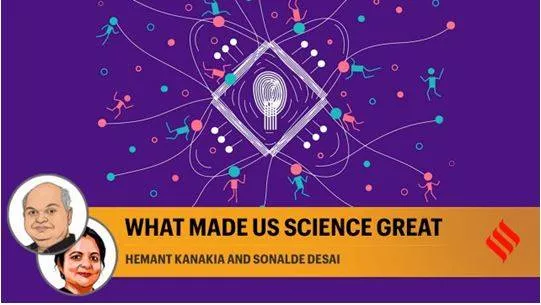
Attempts to make america great again seem to centre around destroying the institutions that made american science great it is a bad idea
What do lasers, the internet, Google’s search algorithm, the gene-editing tool CRISPR-9, Wireless MIMO (multiple-input multiple-output) technology, and Covid vaccines have in common? Key innovations underlying each originated in an American university, where government grants funded initial research and were later adapted for industrial research and development. Many great American multinational companies have emerged from these foundational research breakthroughs. However, if President Donald Trump has his way, America’s golden age of creativity would soon be a distant memory. While the world is focused on the economic disruption caused by Trump’s tariffs, his short-sightedness in killing the golden goose that made the American economy soar will have longer-lasting effects. Nevertheless, there are lessons for other countries, particularly India, as the American innovation system begins to unravel.Assaults on universities and the feeding of anti-migrant hysteria undermine the fundamental framework on which America’s technology-driven economy rests. The American innovation-industrial complex relies on three pillars: Stable support for research infrastructure within universities and non-profit institutions funded by the government, while allowing them to operate independently; an open and competitive ideas marketplace; and tapping into global talent. All three are currently under threat.
The Trump administration views universities as free riders exploiting government largesse by collecting 30 cents in overhead for each dollar going directly to support research. This is contrary to the post-war grand bargain created under the leadership of Vannevar Bush, the first presidential scientific adviser, whereby universities were supposed to nurture scientific talent through stable provision of jobs, laboratory space, research infrastructure, including libraries, and provide seed funding for new projects. The government would support this through overhead payments on grants. Curtailing overheads to 15 per cent jeopardises this equation.
The second pillar of this troika balanced creative freedom with accountability through professional oversight. An elaborate infrastructure was put in place in institutions like the National Institutes of Health to ensure that lack of fame or connections did not hold back young researchers, and peer review by other scientists was the only criterion that grant proposals needed to satisfy. The Center for Scientific Research at NIH was always conscious of the tendency of scientific orthodoxy to dominate and suffocate innovation. It looked for ways to ensure an even playing field. The latest balloon from the administration to downplay the role of scientific review and withholding funds from research powerhouses Harvard and Johns Hopkins to ensure political compliance risks destabilising this hard-won independence. If America forgets that, when ideology or cronyism trumps fair competition, it stifles a vibrant scientific culture. It only has to look at Russia. Russian scientists did not receive a single Nobel Prize for science between 2011 and 2022, during which 61 Americans became Nobel Laureates in scientific disciplines.
Beginning with a flight of Jewish scientists from Germany, American science has benefited tremendously from the influx of international scholars. Of the 314 laureates who won their Nobel Prize while working in the USA, 102 (or 30 per cent) were foreign-born. Compare that to Japan, which counts no foreign-born individuals among its nine Nobel laureates. We would be hard-pressed to find any scientific discipline whose leadership does not include people born outside of the United States. The anti-immigrant sentiment fuelled by the current administration will make America a less attractive place for international students and researchers. The administration claims not to be against international students, but they are welcome only if they hold no political views. This is reminiscent of Great Britain, which until 1829 was more than willing to extend democratic privileges to Irishmen as long as they did not profess Catholic beliefs.
Ironically, attempts to make America great again seem to think that destroying the institutions that made American science great is the best place to begin. These draconian measures have their roots in a belief that American universities are home to a woke culture that must be rooted out by any means. Ostensibly this is to prevent activism around Gaza to prevent antisemitism. However, using the cudgel of financial and administrative power to humble universities that have taken pride in self-governance and openness to diverse viewpoints does not simply curb political dissent it risks damming the fountain of their creativity. The only two-time unshared Nobel Prize winner, Linus Pauling’s life, offers an interesting example. Pauling received a prize in Chemistry as well as the Peace Prize for his crusade against nuclear weapons, a crusade that came under scrutiny from Senator McCarthy and led to tensions with his home institution, the California Institute of Technology. These tensions led to his leaving CalTech, and as historian of science Jeffrey Kovac notes, stunted the productivity of his later years. Unfortunately, the costs of the road not taken are rarely visible, except through the eyes of history.
There is a lesson and an opportunity for nations that seek to compete with America by enhancing their scientific infrastructure. The lesson lies in heightened appreciation of what made the American innovation economy function — institutional structures that provide support without stifling creativity and innovation, not using political ideologies to guide funding or regulations. Opportunity lies in a vacuum that is likely to be created and spaces that can be filled by less dogmatic nations in fields like climate science and vaccine technologies. As India seeks to enhance its innovation ecosystem, it is worthwhile to pay attention to opportunities and lessons from the self-inflicted wounds on American science.









Stay updated with The Hindu Editorial Vocab24 app, your definitive source for breaking news and comprehensive coverage from India and around the globe. Whether it's political developments, business updates, sports highlights, the latest technology trends, or current events, The Hindu brings live, accurate, and reliable news directly to your device.
Don’t fall for sensationalized or fake news shared online. Read and share accurate updates with friends and family through The Hindu Editorial Vocab24 app. Download it today!
News Coverage in The Hindu Editorial Vocab24 App
Breaking News: Receive instant notifications on breaking news stories as they unfold. Stay informed about major events and developments in India and around the world with live blogs, news in shorts videos, and concise articles.
Politics: Get the latest updates on Indian politics, including elections, policy changes, government decisions, and political events that shape the nation.
Business and Economy: Stay ahead in the economic landscape with detailed business news and market analysis. Learn about stock market trends, financial reports, corporate news, and economic developments to make informed investment decisions.
Current Events: Follow stories on social issues, policy changes, global events, and daily current affairs, tailored for UPSC and other competitive exam preparations.
Technology: Keep up with the latest gadgets, innovations, and tech trends. Read expert reviews and analyses in short, concise updates on cutting-edge technology from India and beyond.
Sports: Never miss a moment of your favorite sports. Get live scores, match reports, and expert analysis on cricket, football, tennis, and more.
International News: Stay informed about global events and geopolitical developments, including the Russia-Ukraine war, Israel-Palestine conflict, and other key international stories.
Local News: Stay connected to your community with the latest updates on city events, issues, and local news. Coverage includes hyperlocal updates from cities like Bangalore, Chennai, Delhi, Hyderabad, Mumbai, Kolkata, and more.
Trending Topics: Discover what's trending today with the most talked-about stories and hot topics across India and the world.
Experience journalism that values integrity, accuracy, and reliability. Download The Hindu Editorial Vocab24 app today and stay connected with the world.
Subscribe to our newsletter!







