

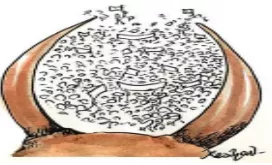
Ancient sport new age protests
Almost everybody appeared to miss the siren song of ‘unsynchronised awakenings’ of an ‘under class’ in the Jallikattu protests. It is these segments that are leading the global revolt against the so-called ‘elite’ The final months of 2016 witnessed high drama in Tamil Nadu, with millions across the State overcome by grief following the prolonged hospitalization and subsequent demise (देहान्त/निधन) of Chief Minister J. Jayalalithaa. The first few weeks of 2017 have since seen protests over the issue of Jallikattu convulse (हिला देना/हलचल मचाना) the State. To “outsiders”, viz. those not belonging to Tamil Nadu, it may appear extraordinary that so much frenzy should be on display over an issue that, elsewhere, would be merely equated with the sport of bullfighting. However, those guilty of simplistic assumptions of this kind would be unable to see the wood for the trees. Steeped in hoary (पुरानी) tradition, dating back to the fabled (प्रसिद्ध) Sangam era, Jallikattu holds a special place in the hearts and minds of ordinary Tamil folk. The decision of the Supreme Court, in May 2014, to uphold the Central government’s notification of 2011 (adding bulls to the list of animals whose training and exhibition is prohibited), in effect formalised the ban on bullfighting as a sport. However, it seemed to trigger concerns among sections in Tamil Nadu that it amounted to an assault on Tamil culture and Tamil pride. Such feelings had possibly lain dormant (शांत/निष्क्रिय) but seemed to come to life after the ban. Behind the cover of spontaneity It has been a field day for conspirators and conspiracies thereafter. Questions have been raised as to how and why a situation — that had merely been simmering (क्रोध की अवस्था में बने रहना) for some time — should all of a sudden turn explosive. Most ongoing rumours had little to do with Jallikattu as a sport; they related mainly to the turn of events following the demise of the former Tamil Nadu Chief Minister. Accusations relating to the “usurpation” of the mantle of Chief Minister by so-called “pretenders” added spice to these rumours. In the circumstances that prevail today in Tamil Nadu — presenting as it does a sorry spectacle of being adrift in choppy waters — the jallikattu agitation only provided an opportunity to stir up the proverbial witch’s brew. In this unedifying (अशोभनीय) situation, every rumour appeared to have an element of truth. The movement, at the outset at least, appeared spontaneous. It was perceived as a peaceful protest by Tamil youth against restrictions imposed on Jallikattu, which were portrayed as an assault on Tamil cultural traditions. In the early stages, few tended to question whether any movement could be truly spontaneous. Fewer still failed to look askance (संदेह से) at the fact that a principally rural sport (confined largely to pockets in the southern and western parts of Tamil Nadu) had suddenly become a major symbol of urban protest, and able to rally thousands of protesters. Still later, and even as it was beginning to turn into a mass movement, with the participation of large concentrations of urban people from different segments and across cities, mainly Chennai, no attempt seemed to have been made by those in authority to introspect about the true character of the movement. It is possible that the peaceful nature of the protests lulled the vast majority into missing the true character of the agitation. Almost everybody appeared to miss the siren song of “unsynchronised awakenings” of an “under class”. It is these segments in almost every country of the world today that are leading the revolt against the so-called “elite”. It has had major political repercussions (प्रतिक्रिया/प्रभाव) and compelled many a government to renegotiate the terms of governance. The digital highway has been the principal medium for initiating many of the radical and fundamental changes that have taken place lately and this should not be lost sight of by those in authority in India. An intellectual vacuum It is unfortunate that while such significant events were taking place, the public debate in Tamil Nadu over the jallikattu issue, and its aftermath, remained confined to old shopworn arguments and logic. The administration, under attack for the violence that occurred on the final day of the protests — even as an ordinance for the lifting of the ban on jallikattu was being promulgated (लागू करना/एलान करना) and a law was being enacted — had little more to say than to accuse “outsiders”. This label included a motley group of Tamil chauvinists (a person with a prejudiced belief in the superiority of his or her own kind), secessionist elements, pro-LTTE and Tamil Eelam cadres, and some other “invisible forces” it alleged of having infiltrated into the gathering at Marina beach in Chennai and of instigating the violence. The Opposition felt comfortable blaming both the government for allowing such a situation to develop and the police for provoking the protesters and employing indiscriminate force. It is quite obvious that the political class as a whole, and not only the administration, has little understanding of the undercurrents that exist today. For the Opposition, blaming the police for all that happened, while ignoring the provocations the latter had to contend with as also the Herculean efforts made by them during the previous days to maintain peace, is standard policy. It only highlights the nature of the intellectual vacuum that has prevailed in the State in the recent past. Politics of identity The reality is far graver than what the administration and the Opposition are making it out to be. A resurgence (पुनरुत्थान) of Tamil chauvinism is apparent. The reality also is that the politics of identity, far from receding, is very much alive. Beneath the surface calm, deep wells of unhappiness exist in the State over issues concerning so-called “Tamil pride”. Furthermore, sizeable segments in Tamil Nadu feel even more estranged from New Delhi than before due to the Centre’s policies over issues such as the Cauvery water dispute. It would be much more than mere political myopia if the State administration and other State politicians were to turn a blind eye to this reemergence of anti-national and anti-social forces in Tamil Nadu. The celebrated British physicist, Stephen Hawking, is credited with the remark that “the 21st century will be the century of complexity”. Hence, all governments need to accept that change is the order of things and that the nature of change itself changes. Logical thinking has been overtaken, or is being eclipsed (Obscured or blocked), by disruptive logic. In 1971, India dealt effectively with a problem of over a million refugees from East Bengal on its soil. Most of them returned home after the new state of Bangladesh came into being. Today, the refugee influx into Europe is threatening the very existence of Europe and is posing the most profound (अति गंभीर) challenge to the traditional concept of what states are, and their meaning. Time of ‘indeterminate complexity’ The metastasizing nature of the current wave of protests, here and elsewhere, contains a message which, if not heeded, could have dangerous consequences. Growing intolerance is a special feature across societies and populations today. As the spontaneous nature of protests begins to decline, they are increasingly taken over by vociferous (कोलाहलपूर्ण) and intolerant groups. These elements are thereafter able, in most cases, to hold the state to ransom. This is especially true in situations where the establishment is perceived to be weak. In Tamil Nadu, the perception of a “diffusion of power” gives the impression of it being a weak state. It heightens the danger of not being able to contain situations where sub-nationalism, chauvinism, caste prejudices and insular politics hold sway. The trend in “new wave” protests — which are occurring with greater frequency today — is towards creating a spectacle and mobilising large crowds to heighten the intensity of the initial cause. The cascading nature of public protests over the rape of a young woman in Delhi in December 2012, on the issue of safeguarding the dignity of women, is an instance in point. In Tamil Nadu today, the issue of Tamil pride could generate similar outcomes, with other grievances being added. Public opinion tends to be easily galvanised in a world which has gone from being “connected” to “hyper connected”. Hence, we need to recognise that the reality of “indeterminate complexity” is already upon us. Scientists and mathematicians are familiar with this phenomenon. Social scientists, politicians and administrators are less familiar with it. The underlying message is that authorities need to be more discerning (विवेकी/समझदार). There is also need for a great deal of careful thought and well-considered action in approaching such situations, and in calibrating responses.







Stay updated with The Hindu Editorial Vocab24 app, your definitive source for breaking news and comprehensive coverage from India and around the globe. Whether it's political developments, business updates, sports highlights, the latest technology trends, or current events, The Hindu brings live, accurate, and reliable news directly to your device.
Don’t fall for sensationalized or fake news shared online. Read and share accurate updates with friends and family through The Hindu Editorial Vocab24 app. Download it today!
News Coverage in The Hindu Editorial Vocab24 App
Breaking News: Receive instant notifications on breaking news stories as they unfold. Stay informed about major events and developments in India and around the world with live blogs, news in shorts videos, and concise articles.
Politics: Get the latest updates on Indian politics, including elections, policy changes, government decisions, and political events that shape the nation.
Business and Economy: Stay ahead in the economic landscape with detailed business news and market analysis. Learn about stock market trends, financial reports, corporate news, and economic developments to make informed investment decisions.
Current Events: Follow stories on social issues, policy changes, global events, and daily current affairs, tailored for UPSC and other competitive exam preparations.
Technology: Keep up with the latest gadgets, innovations, and tech trends. Read expert reviews and analyses in short, concise updates on cutting-edge technology from India and beyond.
Sports: Never miss a moment of your favorite sports. Get live scores, match reports, and expert analysis on cricket, football, tennis, and more.
International News: Stay informed about global events and geopolitical developments, including the Russia-Ukraine war, Israel-Palestine conflict, and other key international stories.
Local News: Stay connected to your community with the latest updates on city events, issues, and local news. Coverage includes hyperlocal updates from cities like Bangalore, Chennai, Delhi, Hyderabad, Mumbai, Kolkata, and more.
Trending Topics: Discover what's trending today with the most talked-about stories and hot topics across India and the world.
Experience journalism that values integrity, accuracy, and reliability. Download The Hindu Editorial Vocab24 app today and stay connected with the world.
Subscribe to our newsletter!







