

An improbable friendship
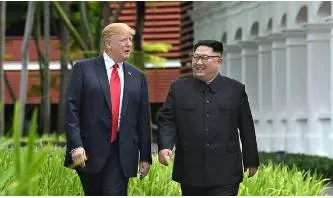
Donald Trump and Kim Jong-un have stunned the world. They may yet surprise us by pulling off a detente.“Truth is stranger than fiction, but it is because Fiction is obliged to stick to possibilities; Truth isn’t,” wrote Mark Twain. Nothing proves it better than the summit between U.S. President Donald Trump and North Korean Supreme Leader Kim Jong-un in Singapore on Tuesday. No reality TV show could have scripted an episode with greater suspense and drama than what the two leaders successfully imparted to their meeting.
Mr. Trump, the 72-year-old leader of one of the world’s oldest democracies, an $18 trillion economy with a 1.3 million strong military, of whom 28,500 troops are deployed in South Korea, and Chairman Kim, at 34 the third-generation leader of a totalitarian state with an impoverished economy estimated at less than $40 billion and a military force of 1.2 million with a newly acquired nuclear capability, make for an unusual couple. And yet, as Mr. Trump said, “From the beginning we got along.” Describing Mr. Kim as “very talented”, he recalled with a degree of empathy that the North Korean had faced a challenge when he took over his country at just 26 years.
Art of making friends
Less than a year ago, the heightened rhetoric on both sides had led to growing concerns about the possibility of a nuclear exchange as North Korea ramped up its nuclear and missile testing programmes. In September 2017, it conducted its sixth nuclear test, declaring it a thermonuclear device, a claim that has been disputed. However, with a yield of 100-300 kt (kiloton), it marked a significant improvement from earlier tests. Four of the six tests have been undertaken by Mr. Kim with a view to miniaturising the device to fit a missile warhead.
Simultaneously, he accelerated the missile programme conducting over 80 flight tests during the last seven years, compared to 16 undertaken by his father from 1994 to 2011. At least three new missiles have been successfully tested and inducted. These include the Musudan (around 3,500 km), Hwasong 12 (4,500 km) and Hwasong 14 (around 10,000 km). Last November, Hwasong 15 was tested with a range estimated at 13,000 km, making it clear that North Korea was close to developing the capability to target the U.S. mainland.
Mr. Trump warned North Korea with “fire and fury like the world has never seen”. North Korea responded by threatening to hit Guam “enveloping it in fire”. Mr. Trump announced that “military solutions are now fully in place, locked and loaded”. The UN Security Council met repeatedly, tightening economic sanctions on North Korea. Mr. Trump described Mr. Kim as a “rocket man on a suicide mission for himself and his regime” while North Korea vowed to “tame the mentally deranged U.S. dotard (An old person, especially one who has become weak or senile.) with fire”. Russia and China appealed for restraint, proposing a “freeze for freeze”, calling on the U.S. to stop military exercises with South Korea in return for North Korea halting its nuclear and missile testing.
Beginnings of a thaw
The situation began to change with Mr. Kim’s New Year’s address indicating that North Korea had achieved its nuclear deterrent capability and offering a new opening in relations with South Korea as it prepared to host the Winter Olympics in February. Things moved rapidly thereafter. The two Korean teams marched together at the opening ceremony and the presence of Mr. Kim’s sister, Kim Yo-jong, added a dash of bonhomie to the soft diplomacy.
Two senior South Korean officials visited Pyongyang in early March. Over a long dinner conversation, Mr. Kim indicated continued restraint on testing and willingness to discuss denuclearisation of the Korean peninsula if military threats to North Korea decreased and regime safety was guaranteed. The testing restraint was formally declared on April 21, a week before the summit between the two Korean leaders on April 27 in Panmunjom, which was acclaimed a success.
The U.S. was kept fully briefed by South Korean officials and in early March Mr. Trump indicated readiness to meet Mr. Kim, leading to heightened speculation about mismatched expectations all around. Even after two visits by Mike Pompeo (first as CIA chief and then as Secretary of State) and the release of three Americans sentenced for spying, there were hiccups when National Security Adviser John Bolton held up the “Libyan model” for North Korea’s disarmament (The reduction or withdrawal of military forces and weapons.) and the U.S. launched air combat exercises together with South Korea. North Korea responded angrily. The summit was put off, followed by an exchange of conciliatory letters between the two leaders amid mounting suspense, and on June 1 the summit was reinstated.
There have been previous attempts by the U.S. to address concerns regarding North Korea’s nuclear programme. The first was the 1994 Agreed Framework after North Korea threatened to withdraw from the Nuclear Non-Proliferation Treaty (NPT). This was annulled (To officially announce that something such as a law, agreement, or marriage no longer exists) by the Bush administration in 2002 with the ‘axis of evil’ speech. Consequently, North Korea withdrew from the NPT. The Six Party talks (second round) were initiated in 2004, resulting in a joint statement the following year reiterating commitment to denuclearisation, with a peace treaty and security guarantees to be concluded. The process collapsed when the U.S. imposed new sanctions, and in 2006 North Korea conducted its first nuclear test.
Changed situation
Since then, the situation has changed. The old process is dead; North Korean capabilities have grown dramatically, increasing anxiety especially in South Korea and Japan and Chinese worries about U.S. deployment of missile defence in South Korea. There are challenges too. The U.S. would ideally like complete, verifiable and irreversible disarmament as would Japan. North Korea seeks regime legitimacy and regime security together with sanctions relief while reducing its dependency on China. China would like to prolong the process to ensure its centrality. And South Korea would like to lower tensions while retaining the American presence. Reconciling these needs time and sustained dialogue.
The Joint Statement in Singapore is shy on detail but carries political promise. Instead of obsessing on the nuclear issue, it reflects clear recognition that a new beginning in U.S.-North Korea relations is possible only by replacing the 1953 Armistice Agreement with a permanent peace treaty and that regime security guarantee for North Korea is a prerequisite for denuclearisation. Mr. Trump has accepted that the denuclearisation process will take time, but he wants to take it to a point that makes it irreversible. The affirmation of the Panmunjom Declaration (signed between the two Korean leaders in April) means that bilateral normalisation between the two Koreas will move apace and a meeting involving the U.S. and possibly China to conclude a peace treaty can happen by end-2018.
Mr. Trump’s unilateral announcements at the press conference are equally promising. He announced suspension of joint military exercises with South Korea and indicated that North Korea would dismantle a major missile engine testing site. There is no sanctions relief yet but given the changing psychological backdrop, it is likely that there may be a loosening by China and Russia.
Summit diplomacy has a mixed record. In 1972, U.S. President Richard Nixon travelled to China for the first summit with Chairman Mao Zedong leading to a realignment of political forces whose impact is still reverberating. ((Of sound) to continue to be heard; to echo repeatedly) In 1986, U.S. President Ronald Reagan and Soviet leader Mikhail Gorbachev met in Reykjavik, coming close to agreement on abolition of all nuclear weapons till realpolitik eventually prevailed.
With Mr. Trump and Mr. Kim, it is difficult to predict how the process will unfold but it is a new opening. One can almost visualise Mr. Trump and Mr. Kim telling each other as they said their goodbyes in Singapore: “I think this is the beginning of a beautiful friendship.”




Top court quashes FIRs against Gen Z protesters
Sep 04, 2026






Stay updated with The Hindu Editorial Vocab24 app, your definitive source for breaking news and comprehensive coverage from India and around the globe. Whether it's political developments, business updates, sports highlights, the latest technology trends, or current events, The Hindu brings live, accurate, and reliable news directly to your device.
Don’t fall for sensationalized or fake news shared online. Read and share accurate updates with friends and family through The Hindu Editorial Vocab24 app. Download it today!
News Coverage in The Hindu Editorial Vocab24 App
Breaking News: Receive instant notifications on breaking news stories as they unfold. Stay informed about major events and developments in India and around the world with live blogs, news in shorts videos, and concise articles.
Politics: Get the latest updates on Indian politics, including elections, policy changes, government decisions, and political events that shape the nation.
Business and Economy: Stay ahead in the economic landscape with detailed business news and market analysis. Learn about stock market trends, financial reports, corporate news, and economic developments to make informed investment decisions.
Current Events: Follow stories on social issues, policy changes, global events, and daily current affairs, tailored for UPSC and other competitive exam preparations.
Technology: Keep up with the latest gadgets, innovations, and tech trends. Read expert reviews and analyses in short, concise updates on cutting-edge technology from India and beyond.
Sports: Never miss a moment of your favorite sports. Get live scores, match reports, and expert analysis on cricket, football, tennis, and more.
International News: Stay informed about global events and geopolitical developments, including the Russia-Ukraine war, Israel-Palestine conflict, and other key international stories.
Local News: Stay connected to your community with the latest updates on city events, issues, and local news. Coverage includes hyperlocal updates from cities like Bangalore, Chennai, Delhi, Hyderabad, Mumbai, Kolkata, and more.
Trending Topics: Discover what's trending today with the most talked-about stories and hot topics across India and the world.
Experience journalism that values integrity, accuracy, and reliability. Download The Hindu Editorial Vocab24 app today and stay connected with the world.
Subscribe to our newsletter!







