

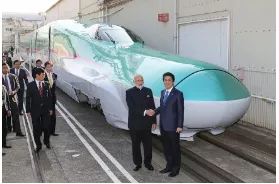
An alliance on track
When Japanese Prime Minister Shinzo Abe meets Prime Minister Narendra Modi in Ahmedabad this week, the bilateral agenda will range from issues of maritime security to nuclear energy and trade. But at the centrepiece of their summitry (the practice of conducting international negotiations by summit conferences) will be the inauguration of India’s first high-speed rail corridor from Mumbai to Ahmedabad, to be developed using Japanese technology and financing.The image of the platypus-snouted blue and white Shinkansen streaking past a snow-topped Mount Fuji has become as synonymous with Japan as sushi. Since October 1964, when the first bullet trains collapsed the time it took to cover the 552 km between Tokyo and the commercial centre of Osaka to four hours (today it is down to 2 hours, 22 minutes), the Shinkansen has emerged as the symbol of Japan’s post-World War II ascent to economic superpowerdom. It encapsulates the archipelago’s engineering might and almost preternatural (beyond what is normal or ordinary) standards of safety and punctuality. Japan’s Shinkansen have carried over 10 billion passengers to date, without a single accident or casualty and an average delay of less than one minute.
Yet, despite this admirable track record, Japan has struggled to export its bullet train know-how (practical knowledge or skill), even as Mr. Abe has made selling the technology abroad a cornerstone of his game plan to revitalise the stagnant Japanese economy. Before signing on India, Taiwan had been Japan’s only successful sale. But Taiwan is hardly a poster child for the system, given that its high-speed line has suffered heavy losses since opening in 2007.
Profitability is a notoriously hard ask for high-speed train networks. Most lines across Europe, for example, are in the red. In Japan, some routes, notably Tokyo-Osaka, are profitable, but to achieve this requires high volumes of passengers and highly priced tickets. It costs around $130 for a one-way Shinkansen ticket from Tokyo to Osaka. And over 350 trains operate on this line daily, ferrying about 163 million passengers a year. The region served is demographically dense, home to over half of Japan’s population. These conditions are not easy to replicate and other high-speed lines in Japan have struggled.
Chinese competition
The latest challenge to Japan’s ambitions is the emergence of China as the new emperor of the superfast train. Over the last decade China has developed a 22,000 km high-speed rail network. It boasts the ‘world’s fastest train’, the Shanghai Maglev that hits speeds of 430 km. Its technology is also cheaper, making it an attractive proposition for the cost-conscious developing and middle-income countries of Asia.
In 2015, China pipped Japan to the post at the last minute by securing a high-speed rail project in Indonesia that had been considered by Tokyo to be in the bag. One reason Beijing unexpectedly won out was because China offered to finance the line without any recourse (a source of help in a difficult situation.) to Indonesia’s government coffers (a strongbox or small chest for holding valuables.). In the years since, the project has stalled following land acquisition problems. Nonetheless, China has also beaten Tokyo to becoming Thailand’s partner of choice for its first high-speed rail line, permissions for which were finally granted after a two-year delay.
The battle to export bullet trains is clearly reflective of the broader rivalry between China and Japan for influence in Asia. Consequently, the India deal is not only a business coup (an instance of successfully achieving something difficult.) for Japan but also a geostrategic one. Former Ambassador of Japan to India and President of the Japan-India Association, Hiroshi Hirabayashi, acknowledged as much. “India is not Indonesia or Thailand. It is a great nation, totally autonomous. And it’s not as likely to submit to Chinese pressure,” he said of India’s decision to go with Tokyo.
Ironing out the niggles (a trivial criticism, discomfort, or annoyance.)
For Japan, the Mumbai-Ahmedabad contract has been hard-won. It entails a loan worth $12 billion, at 0.1% interest, to be paid back over 50 years, taking care of over 80% of the project’s estimated costs. Japan will also supplement the financing with a generous package of technical assistance and training.
Yet in India, concerns related to costs, safety and misplaced priorities persist. Tomoyuki Nakano, the Director for International Engineering Affairs of Japan’s Railway Bureau, remained confident of ironing these out with some tweaks (a fine improvement) to the Japanese technology taking into account climatic differences, the possibility of electrical blackouts, as well as dust and other environmental conditions in India. He also pointed out that when Japan developed its first Shinkansen lines in the 1960s, it was a poor country as well that had required loans from the World Bank.
But what about the enormous software or cultural differences between Japan and India? Mr. Nakano was sanguine (optimistic or positive, especially in an apparently bad or difficult situation.). “When we had Indians coming here (to Tokyo) for training, I noticed some of them were quite late. But after two weeks in Japan they became very punctual,” he concluded.
Understanding the chinese mind
Sep 02, 2017
And the war goes on on trump’s south asia policy
Aug 24, 2017
Rebooting india nepal ties
Aug 23, 2017
Mr modi in israel he reaffirms special ties
Jul 07, 2017
Sheikh hasina india visit transformative visit
Apr 11, 2017





Stay updated with The Hindu Editorial Vocab24 app, your definitive source for breaking news and comprehensive coverage from India and around the globe. Whether it's political developments, business updates, sports highlights, the latest technology trends, or current events, The Hindu brings live, accurate, and reliable news directly to your device.
Don’t fall for sensationalized or fake news shared online. Read and share accurate updates with friends and family through The Hindu Editorial Vocab24 app. Download it today!
News Coverage in The Hindu Editorial Vocab24 App
Breaking News: Receive instant notifications on breaking news stories as they unfold. Stay informed about major events and developments in India and around the world with live blogs, news in shorts videos, and concise articles.
Politics: Get the latest updates on Indian politics, including elections, policy changes, government decisions, and political events that shape the nation.
Business and Economy: Stay ahead in the economic landscape with detailed business news and market analysis. Learn about stock market trends, financial reports, corporate news, and economic developments to make informed investment decisions.
Current Events: Follow stories on social issues, policy changes, global events, and daily current affairs, tailored for UPSC and other competitive exam preparations.
Technology: Keep up with the latest gadgets, innovations, and tech trends. Read expert reviews and analyses in short, concise updates on cutting-edge technology from India and beyond.
Sports: Never miss a moment of your favorite sports. Get live scores, match reports, and expert analysis on cricket, football, tennis, and more.
International News: Stay informed about global events and geopolitical developments, including the Russia-Ukraine war, Israel-Palestine conflict, and other key international stories.
Local News: Stay connected to your community with the latest updates on city events, issues, and local news. Coverage includes hyperlocal updates from cities like Bangalore, Chennai, Delhi, Hyderabad, Mumbai, Kolkata, and more.
Trending Topics: Discover what's trending today with the most talked-about stories and hot topics across India and the world.
Experience journalism that values integrity, accuracy, and reliability. Download The Hindu Editorial Vocab24 app today and stay connected with the world.
Subscribe to our newsletter!







