

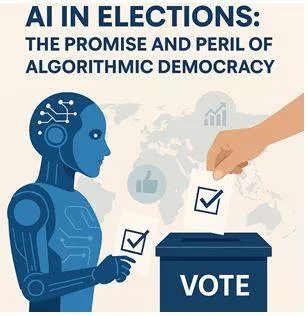
Ai in elections the promise and peril of algorithmic democracy
IntroductionIn an era of accelerating technological change, Artificial Intelligence (AI) has found its way into nearly every domain of human life—from healthcare and transportation to education and entertainment. One of the most sensitive and impactful areas where AI is now emerging is the democratic process, particularly elections. As nations around the globe grapple with increasing voter apathy, misinformation campaigns, and complex logistical challenges, the potential role of AI in improving electoral integrity and efficiency is both promising and deeply controversial.
The 2024 general elections in several democracies, including the United States and India’s upcoming 2026 state elections, have already begun to witness the subtle influence of AI—from personalized political ads and sentiment analysis to deepfakes and voter targeting. This essay explores the benefits and risks of integrating AI into electoral processes, and whether such intervention strengthens or undermines democratic ideals.
________________________________________ The Emergence of AI in Elections
Artificial Intelligence is not a single technology but an umbrella term for a collection of machine learning, natural language processing (NLP), computer vision, and data analytics techniques that mimic human cognition. In elections, AI tools are already being used to:
• Analyze public sentiment via social media data
• Micro-target voters with personalized content
• Predict voter turnout and manage resources accordingly
• Detect misinformation and bot-generated content
• Automate administrative processes, such as voter registration or district mapping
Companies like Cambridge Analytica, during the 2016 U.S. elections, were early players in leveraging psychometric data to target voters through AI-driven analysis. While the fallout from such practices was severe, it marked the beginning of an AI revolution in electoral politics.
________________________________________ The Promises of AI in Electoral Democracy
1. Efficiency in Election Management
Election commissions in India, the US, and Europe have started experimenting with AI to improve voter roll accuracy, reduce human error, and automate logistical planning. AI algorithms can help optimize polling booth placement based on population density, access to roads, and previous turnout patterns. In countries with vast rural electorates like India, this can greatly enhance voter participation.
2. Combatting Fake News
AI-powered tools can scan and verify facts across millions of websites, flagging false content before it spreads. Platforms like Facebook, Twitter, and YouTube increasingly rely on machine learning models to identify deepfakes, hate speech, and misinformation. AI-driven moderation, while imperfect, is a crucial line of defense in the digital battlefield of modern elections.
3. Inclusivity and Accessibility
Natural Language Processing (NLP) has made it easier to provide multi-lingual content, allowing citizens to understand policies and manifestos in their own languages. AI can also assist voters with disabilities by enabling voice-assisted voting systems or facial recognition for those unable to use traditional biometric methods.
4. Better Policy Analysis
AI can simulate the impact of proposed policies on different socioeconomic groups, enabling voters to make more informed decisions. Some civic tech startups are using AI to analyze political speeches, bills, and voting records to highlight contradictions, policy gaps, and ideological shifts.
________________________________________ The Dangers and Pitfalls
1. Data Manipulation and Privacy Concerns
The flip side of data-driven campaigning is the ethical concern about how that data is collected and used. AI requires massive datasets to function, often drawn from social media platforms, search histories, and even financial records—sometimes without informed consent. The potential for manipulation through psychographic profiling, as seen in the Cambridge Analytica scandal, is enormous.
2. Spread of Deepfakes
Generative AI tools like deepfake video creators and AI voice mimics pose a severe threat to electoral integrity. A doctored video of a candidate making controversial remarks could go viral days before the vote and change public perception irreversibly. With AI-generated content becoming nearly indistinguishable from authentic media, the line between truth and fabrication is increasingly blurred.
3. Algorithmic Bias
AI systems are only as good as the data they are trained on. If historical data includes racial, gender, or socioeconomic biases, the AI will replicate them. For instance, predictive models used to identify likely voters may underrepresent marginalized communities, leading to their under-engagement or exclusion in campaign outreach.
4. Erosion of Public Trust
Perhaps the gravest danger of AI in elections is its potential to erode public trust. When voters believe that algorithms, not people, determine electoral outcomes—whether through manipulation, bias, or opacity—they may lose faith in democratic institutions. Transparency in how AI tools are deployed is essential, yet often lacking.
________________________________________ Global Perspectives and Policy Responses
Several countries have started to address these challenges through regulation. The European Union’s AI Act proposes a framework to classify AI systems by risk levels, with strict oversight on “high-risk” uses like biometric surveillance and electoral manipulation.
India, which will soon become the world’s largest digital democracy, is also revisiting its Data Protection Bill to include AI-based interventions. The Election Commission of India has indicated interest in using AI for improving voter outreach but has so far treaded cautiously to avoid backlash.
Meanwhile, civil society organizations globally have called for:
• Mandatory algorithmic transparency
• Restrictions on AI-driven microtargeting
• Ethical frameworks for AI use in political campaigns
• Public awareness programs to promote digital literacy
________________________________________ Future Outlook: Toward a Responsible AI Democracy
The future of elections is undeniably intertwined with AI. As with any tool, its impact will depend on the values and frameworks guiding its use. A proactive and democratic approach to AI integration can make elections more participatory, transparent, and efficient. However, if left unchecked, the same technology could subvert the very foundation of free will in a democracy.
The ideal path forward lies in human-centric AI—where machine intelligence supports, rather than replaces, civic engagement. This includes public disclosure of AI usage in campaigns, opt-out mechanisms for voter profiling, and continuous monitoring by independent watchdogs.
________________________________________ Conclusion
AI’s growing role in elections is not a matter of if but how. As democracies globally stand at a crossroads, the choice is not between technology and tradition, but between accountability and automation. Artificial Intelligence has the potential to become the silent architect of a more inclusive, informed, and accessible electoral process. But it also bears the risk of becoming an invisible manipulator of public will. Only through conscious regulation, public discourse, and ethical innovation can we ensure that AI strengthens rather than undermines the spirit of democracy.






Stay updated with The Hindu Editorial Vocab24 app, your definitive source for breaking news and comprehensive coverage from India and around the globe. Whether it's political developments, business updates, sports highlights, the latest technology trends, or current events, The Hindu brings live, accurate, and reliable news directly to your device.
Don’t fall for sensationalized or fake news shared online. Read and share accurate updates with friends and family through The Hindu Editorial Vocab24 app. Download it today!
News Coverage in The Hindu Editorial Vocab24 App
Breaking News: Receive instant notifications on breaking news stories as they unfold. Stay informed about major events and developments in India and around the world with live blogs, news in shorts videos, and concise articles.
Politics: Get the latest updates on Indian politics, including elections, policy changes, government decisions, and political events that shape the nation.
Business and Economy: Stay ahead in the economic landscape with detailed business news and market analysis. Learn about stock market trends, financial reports, corporate news, and economic developments to make informed investment decisions.
Current Events: Follow stories on social issues, policy changes, global events, and daily current affairs, tailored for UPSC and other competitive exam preparations.
Technology: Keep up with the latest gadgets, innovations, and tech trends. Read expert reviews and analyses in short, concise updates on cutting-edge technology from India and beyond.
Sports: Never miss a moment of your favorite sports. Get live scores, match reports, and expert analysis on cricket, football, tennis, and more.
International News: Stay informed about global events and geopolitical developments, including the Russia-Ukraine war, Israel-Palestine conflict, and other key international stories.
Local News: Stay connected to your community with the latest updates on city events, issues, and local news. Coverage includes hyperlocal updates from cities like Bangalore, Chennai, Delhi, Hyderabad, Mumbai, Kolkata, and more.
Trending Topics: Discover what's trending today with the most talked-about stories and hot topics across India and the world.
Experience journalism that values integrity, accuracy, and reliability. Download The Hindu Editorial Vocab24 app today and stay connected with the world.
Subscribe to our newsletter!







