

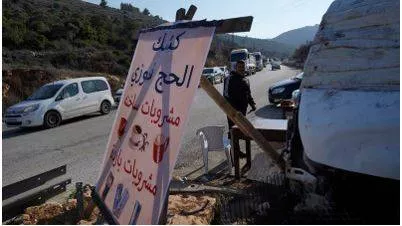
After the ceasefire in gaza west bank palestinians face more israeli barriers
After the January 19 truce, Israeli forces, using drones and attack helicopters, targeted Jenin and increased checkpoints across the West Bank, disrupting the lives of hundreds of thousands of people; Israel says these measures are to prevent Hamas from opening a new front in the region.Abdullah Fauzi, a banker from the northern West Bank city of Nablus, leaves home at 4 a.m. to reach his job by eight, and he’s often late.
His commute used to take an hour — until Hamas’s attack on Israel on October 7, 2023, after which Israel launched its offensive in the Gaza Strip.
The Israeli military also ramped up raids against Palestinian militants in the northern West Bank, and diverted its residents through seven new checkpoints, doubling Mr. Fauzi’s time on the road.
Now it’s gotten worse.
Since the ceasefire in Gaza between Israel and Hamas took effect, Mr. Fauzi’s drive to the West Bank’s business and administrative hub, Ramallah, has become a convoluted, at least four-hour wiggle through steep lanes and farm roads as Israel further tightens the noose around Palestinian cities in measures it considers essential to guard against militant attacks.
“You can fly to Paris while we’re not reaching our homes,” the 42-year-old said from the Atara checkpoint outside Ramallah last week.
“Whatever this is, they’ve planned it well,” he said. “It’s well-designed to make our life hell.”
As the truce between Israel and Hamas took hold on January 19, radical Israeli settlers — incensed over an apparent end to the war and the release of Palestinian prisoners in exchange for Israeli hostages — rampaged through West Bank towns, torching cars and homes.
More checkpoints
Two days later, Israeli forces with drones and attack helicopters descended on the northern West Bank city of Jenin, long a centre of militant activity.
More checkpoints started going up between Palestinian cities, slicing up the occupied West Bank and creating choke points the Israeli army can shut off on a whim. Crossings that had been open 24/7 started closing during morning and evening rush hours, upturning the lives of hundreds of thousands of people.
New barriers — earthen mounds, iron gates — multiplied, pushing Palestinian cars off well-paved roads and onto rutted paths through open fields. What was once a soldier’s glance and head tilt became international border-like inspections.
Israel says the measures are to prevent Hamas from opening a new front in the West Bank. But many experts suspect the crackdown has more to do with assuaging settler leaders like Bezalel Smotrich, the Finance Minister and an important ally of Prime Minister Benjamin Netanyahu, who has threatened to topple the government if Israel does not restart the war in Gaza.
“Israel now has a free hand to pursue what it has wanted to in the West Bank for a long time: settlement expansion, annexation,” said Tahani Mustafa, a senior analyst at the International Crisis Group. “It was considered a potential trade-off.”
Asked why Israel launched the crackdown during the ceasefire, the Israeli military said politicians gave the order in part over concerns that the release of Palestinian prisoners — in swaps for Israeli hostages held by Hamas — could raise tensions in the West Bank.
The checkpoints all over the West Bank, it said, were “to ensure safe movement and expand inspections.”
Top fight against terror
“Checkpoints are a tool we use in the fight against terror, enabling civilian movement while providing a layer of screening to prevent terrorists from escaping,” said Lt. Col. Nadav Shoshani, an Israeli military spokesman.
To spend rush hour at an Israeli checkpoint is to hear of the problems it has brought — Palestinian families divided, money lost, trade disrupted, sick people kept from doctors.
Ahmed Jibril said not even his position as manager of emergency services for the Palestinian Red Crescent protects him.
“We’re treated like any other private car,” he said, describing dozens of cases in which Israeli soldiers forced ambulances to wait for inspection.
In one case, the Palestinian Health Ministry reported that a 46-year-old woman who had suffered a heart attack in the southern city of Hebron died while waiting to cross a checkpoint.
The Israeli military said it was not aware of that specific incident. But citing Hamas’s use of civilian infrastructure like hospitals to conceal fighters, the army acknowledged subjecting medical teams to security checks “while trying to reduce the delay as much as possible in order to mitigate harm.”
The U.N. humanitarian agency, or OCHA, reported that, as of last November 28, Israel had 793 checkpoints and roadblocks in the West Bank, 228 more than before the war in Gaza.
With its upscale restaurants and yoga studios, Ramallah gained a reputation in past conflicts for being something of a well-to-do bubble where cafe-hopping residents can feel immune to the harsh realities of the occupation. Now its residents, struck in numbingly long lines to run simple errands, feel under siege.
Palestinian trucks, packed with perishable food and construction materials, are not spared the scrutiny. Soldiers often ask truckers to pull over and unload their cargo for inspection. Fruit rots. Textiles and electronics get damaged.
The delays raise prices, further choking a Palestinian economy that shrank 28% last year as a result of punitive Israeli policies imposed after Hamas’s attack, said Palestinian Economy Minister Mohammad Alamour.


U k budget increases child welfare allowance taxes
Nov 29, 2025









Stay updated with The Hindu Editorial Vocab24 app, your definitive source for breaking news and comprehensive coverage from India and around the globe. Whether it's political developments, business updates, sports highlights, the latest technology trends, or current events, The Hindu brings live, accurate, and reliable news directly to your device.
Don’t fall for sensationalized or fake news shared online. Read and share accurate updates with friends and family through The Hindu Editorial Vocab24 app. Download it today!
News Coverage in The Hindu Editorial Vocab24 App
Breaking News: Receive instant notifications on breaking news stories as they unfold. Stay informed about major events and developments in India and around the world with live blogs, news in shorts videos, and concise articles.
Politics: Get the latest updates on Indian politics, including elections, policy changes, government decisions, and political events that shape the nation.
Business and Economy: Stay ahead in the economic landscape with detailed business news and market analysis. Learn about stock market trends, financial reports, corporate news, and economic developments to make informed investment decisions.
Current Events: Follow stories on social issues, policy changes, global events, and daily current affairs, tailored for UPSC and other competitive exam preparations.
Technology: Keep up with the latest gadgets, innovations, and tech trends. Read expert reviews and analyses in short, concise updates on cutting-edge technology from India and beyond.
Sports: Never miss a moment of your favorite sports. Get live scores, match reports, and expert analysis on cricket, football, tennis, and more.
International News: Stay informed about global events and geopolitical developments, including the Russia-Ukraine war, Israel-Palestine conflict, and other key international stories.
Local News: Stay connected to your community with the latest updates on city events, issues, and local news. Coverage includes hyperlocal updates from cities like Bangalore, Chennai, Delhi, Hyderabad, Mumbai, Kolkata, and more.
Trending Topics: Discover what's trending today with the most talked-about stories and hot topics across India and the world.
Experience journalism that values integrity, accuracy, and reliability. Download The Hindu Editorial Vocab24 app today and stay connected with the world.
Subscribe to our newsletter!







