

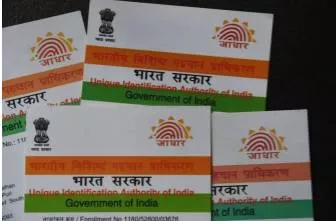
Aadhaar survives
The Supreme Court finds a pragmatic middle path between the Aadhaar scheme’s excesses and its benefits to the marginalised.The Aadhaar project has survived a fierce legal challenge. Ever since a nine-judge Bench ruled unanimously last year that privacy is a fundamental right, opinion began to gain ground that the unique identification programme was vulnerable in the face of judicial scrutiny. It was projected by sceptics, detractors and activists as an intrusion on citizens’ privacy, a byword for a purported surveillance system, a grand project to harvest personal data for commercial exploitation by private parties and profiling by the state. But the government has staved off the challenge by successfully arguing that it is essentially a transformative scheme primarily aimed at reaching benefits and subsidies to the poor and the marginalised. Four of the five judges on a Constitution Bench ruled that the law enabling the implementation of the programme does not violate the right to privacy of citizens; instead, the project empowers marginalised sections and procures dignity for them along with services, benefits and subsidies by leveraging the power of technology.
In upholding the constitutional validity of Aadhaar and clarifying areas in which it cannot be made mandatory, the Supreme Court has restored the original intent of the programme: to plug leakages in subsidy schemes and to have better targeting of welfare benefits. Over the years, Aadhaar came to mean much more than this in the lives of ordinary people, acquiring the shape of a basic identity document that was required to access more and more services, such as birth and death certificates, SIM cards, school admissions, property registrations and vehicle purchases. A unique identity number, that could be availed on a voluntary basis and was conceived to eliminate the rampant fraud in the distribution of benefits, had threatened to morph — with the Centre’s tacit acceptance — into something that was mandatory for various aspects of life. The judgment narrows the scope of Aadhaar but provides a framework within which it can work. The majority opinion has sought to limit the import of the scheme to aspects directly related to welfare benefits, subsidies and money spent from the Consolidated Fund of India. Thus, controversial circulars and rules making it mandatory to link mobile phone numbers and bank accounts to Aadhaar numbers have been declared unconstitutional. Section 57 of the Aadhaar (Targeted Delivery Of Financial And Other Subsidies, Benefits And Services) Act, 2016, has been struck down to the extent that it authorised body corporates and individuals to use the Aadhaar number to establish someone’s identity. Schools have been barred from making the submission of the Aadhaar number mandatory to enrol children. A few other provisions have been read down or clarified.
In upholding Aadhaar, the majority opinion was not oblivious to the impact of disbanding a project that has already completed much ground. For instance, relying on official statistics, the majority favoured the scheme’s continuance for the sake of the 99.76% of people included under it, rather than fret over the 0.24% who were excluded because of authentication failure. “The remedy is to plug the loopholes rather than axe the project,” the Bench said. With enrolment saturation reaching 1.2 billion people, the programme had acquired a scale and momentum that was irreversible. It was perhaps this pragmatic imperative that led the majority to conclude that the government was justified in the passage of the Aadhaar Act as a ‘money bill’, even though under a strict interpretation this is a difficult position to defend, the Centre’s objective being to bypass the Rajya Sabha, where it did not have a majority. The Court has addressed this issue by accepting the government’s argument that Section 7, which enables the use of Aadhaar to avail of any government subsidy, benefit or service for which expenditure is incurred out of the Consolidated Fund of India, is the core provision in the law, and that this makes it a ‘money bill’. It has chosen to accept the technical arguments on the safety of the Aadhaar architecture and the end-to-end encryption that underlies the transmission of captured biometric data to the Unique Identification Authority of India. The majority opinion has looked at the larger picture beyond the merits or demerits of the Aadhaar programme and the arguments for and against it. It held that the Aadhaar Act passes the “triple test” laid down in the ‘Privacy’ judgment under which there ought to be a law, a legitimate state interest and an element of proportionality in any law that seeks to abridge the right of privacy.
In his dissent, Justice D.Y. Chandrachud argued that the Rajya Sabha’s authority has been superseded and that this “constitutes a fraud on the Constitution” — a position that is impossible to fault if one adopts a strict interpretation of what a money bill is. As a result of this “debasement of a democratic institution”, he held the Aadhaar Act unconstitutional. He also expressed his displeasure at the government passing a series of orders making Aadhaar compulsory for various reasons, in defiance of interim orders from the Supreme Court. He highlighted the biometric authentication failures that have led to denial of rights and legal entitlements, and located the reason for such failures in the project’s inability to account for and remedy flaws in its network and design. He ruled that denial of benefits arising out of any social security rights is “violative of human dignity and impermissible under our constitutional scheme”. Few would disagree with him in that “dignity and rights of individuals cannot be made to depend on algorithms and probabilities”. Finally, it was the arguments in favour of benefits to the poor and the practical consequences of abandoning the scheme that won the day. Aadhaar possibly was simply too big to fail.




Top court quashes FIRs against Gen Z protesters
Sep 04, 2026







Stay updated with The Hindu Editorial Vocab24 app, your definitive source for breaking news and comprehensive coverage from India and around the globe. Whether it's political developments, business updates, sports highlights, the latest technology trends, or current events, The Hindu brings live, accurate, and reliable news directly to your device.
Don’t fall for sensationalized or fake news shared online. Read and share accurate updates with friends and family through The Hindu Editorial Vocab24 app. Download it today!
News Coverage in The Hindu Editorial Vocab24 App
Breaking News: Receive instant notifications on breaking news stories as they unfold. Stay informed about major events and developments in India and around the world with live blogs, news in shorts videos, and concise articles.
Politics: Get the latest updates on Indian politics, including elections, policy changes, government decisions, and political events that shape the nation.
Business and Economy: Stay ahead in the economic landscape with detailed business news and market analysis. Learn about stock market trends, financial reports, corporate news, and economic developments to make informed investment decisions.
Current Events: Follow stories on social issues, policy changes, global events, and daily current affairs, tailored for UPSC and other competitive exam preparations.
Technology: Keep up with the latest gadgets, innovations, and tech trends. Read expert reviews and analyses in short, concise updates on cutting-edge technology from India and beyond.
Sports: Never miss a moment of your favorite sports. Get live scores, match reports, and expert analysis on cricket, football, tennis, and more.
International News: Stay informed about global events and geopolitical developments, including the Russia-Ukraine war, Israel-Palestine conflict, and other key international stories.
Local News: Stay connected to your community with the latest updates on city events, issues, and local news. Coverage includes hyperlocal updates from cities like Bangalore, Chennai, Delhi, Hyderabad, Mumbai, Kolkata, and more.
Trending Topics: Discover what's trending today with the most talked-about stories and hot topics across India and the world.
Experience journalism that values integrity, accuracy, and reliability. Download The Hindu Editorial Vocab24 app today and stay connected with the world.
Subscribe to our newsletter!







