

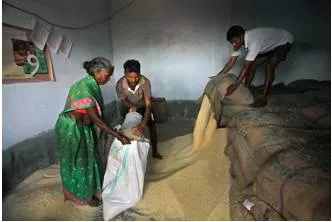
Aadhaar no standout performer in welfare delivery
Aadhaar-based biometric authentication did not reduce PDS leakages, finds Jharkhand-based empirical study.“Aadhaar has curtailed leakages of government subsidies... Through Aadhaar, savings worth ₹90,000 crore have accrued to the government,” said Ajay Bhushan Pandey, then CEO of the Unique Identification Authority of India (UIDAI) and current Revenue Secretary, in UIDAI’s 2017-18 annual report.
But not so fast, say Professors Karthik Muralidharan, Paul Niehaus and Sandip Sukthankar. They have just published a new working paper in the prestigious National Bureau of Economic Research, which details findings from an extensive empirical study of the impact of Aadhaar in reducing leakages and accruing fiscal savings.
When Aadhaar was conceived a decade ago, the rationale postulated was: India spends nearly three trillion rupees a year across several core welfare programmes such as Public Distribution System (PDS), LPG, Mahatma Gandhi National Rural Employment Guarantee Act etc; roughly 30-40% of this is lost in leakages; leakages are largely due to ‘ghost’ and ‘duplicate’ beneficiaries using fake identities to avail these benefits; a unique identity biometric scheme can eliminate these leakages and vastly improve efficiency in welfare delivery. In fact, the former Union Minister, Arun Jaitley, even renamed the Aadhaar Bill to ‘Targeted Delivery of Financial and other Subsidies, Benefits and Services’ Bill, making it amply clear that Aadhaar’s primary, if not sole purpose, was to improve welfare delivery efficiency. The Bill’s renaming was also a clever by half attempt to legislate it as a money bill, thereby avoiding debate and scrutiny in the Upper House.
This new research paper, the first comprehensive field study of Aadhaar, offers a sobering counter to all of us, “Aadhaarphiles”, who truly believed that Aadhaar was the panacea for India’s leaky welfare regime.
The study concluded that Aadhaar-based biometric authentication had no measurable benefit. Aadhaar-based biometric authentication did not reduce leakages due to elimination of ghosts and duplicates, as widely perceived. On the other hand, they found that Aadhaar-based biometric authentication increased transaction costs for beneficiaries. That is, to claim ration worth ₹40, beneficiaries in the Aadhaar system incurred an additional ₹7 of costs than those in the old system, because of multiple trips to authenticate themselves and the opportunity cost of time spent. This is a whopping 17% extra cost burden of the value of the benefit they were entitled to receive.
To make matters worse, Aadhaar-based biometric authentication also introduced what empirical scientists call Type I error of exclusion. In simple terms, Aadhaar authentication falsely rejected genuine PDS beneficiaries who were then denied their ration supplies. The study finds that nearly 10% of legitimate beneficiaries were denied their ration either because they did not have their Aadhaar linked to their ration card or due to an exclusion error.
In summary, the study states that there was no direct impact of Aadhaar in reducing leakages but it denied ration to 10% of genuine beneficiaries and increased costs by 17% to those that were forced to get their ration using Aadhaar. They conclude that Aadhaar authentication for PDS in Jharkhand caused “some pain with no gain”. Put simply, Mr. Pandey’s boast of ₹90,000 crore savings solely due to Aadhaar is hollow.
No testing
There was widespread belief among the policy elite that ghosts and duplicates were the scourge of India’s welfare delivery and that Aadhaar would eliminate this. But this belief was never empirically tested. It was deemed to be true simply because the intellectual elite said so. Based on this belief, an entire story was concocted about improving welfare efficiency through eliminating ghosts and duplicates with Aadhaar and a whole new law was enacted to this effect.
Many studies now establish that ghosts and duplicates are not the significant cause of leakages. Would it not have been better to have undertaken a robust pilot project of scale to test the belief about ghosts and duplicates, before embarking on it nationwide?
The findings
Professor Muralidharan and the rest of the team tell us that Aadhaar by itself has no impact in reducing leakages significantly. They conducted a scientifically designed study of the PDS system in Jharkhand covering 15 million beneficiaries using the technique of randomised control trials (RCT). The study was set up in a manner where one set of beneficiaries went through the Aadhaar-based biometric authentication while the other group used the old system of procuring their ration. The results were then compared to see if Aadhaar-based biometric authentication had any impact in reducing leakages.
GST parallel
This is much like the boisterous claim of policy economists for over a decade that a multitude of State taxes are a drag on inter-State commerce and hence a nationwide Goods and Services Tax (GST) by stripping States of their fiscal autonomy is badly needed. There was no empirical evidence to back this claim. Three years after GST, the promise of vastly improved inter-State trade and a two percentage point boost to GDP seem distant while States are hurting badly with sole dependence on the Centre for their taxes.
The other fault line in policy making that this new study exposes is the engineer’s way of measuring policy outcomes only through the prism of numerical efficiency. In an engineer’s world, if say, nine people are denied welfare due to a system error while nine million are benefited through greater efficiency, then it is considered a net benefit for society and the policy is given a thumbs up. But in a sociologist’s world and in a liberal society, a policy that could run the risk of denying welfare to just a few people, putting their lives at risk, is not worth implementing regardless of how many millions it benefits. Aadhaar was held hostage to the engineer’s worldview of policy efficacy.



Top court quashes FIRs against Gen Z protesters
Sep 04, 2026







Stay updated with The Hindu Editorial Vocab24 app, your definitive source for breaking news and comprehensive coverage from India and around the globe. Whether it's political developments, business updates, sports highlights, the latest technology trends, or current events, The Hindu brings live, accurate, and reliable news directly to your device.
Don’t fall for sensationalized or fake news shared online. Read and share accurate updates with friends and family through The Hindu Editorial Vocab24 app. Download it today!
News Coverage in The Hindu Editorial Vocab24 App
Breaking News: Receive instant notifications on breaking news stories as they unfold. Stay informed about major events and developments in India and around the world with live blogs, news in shorts videos, and concise articles.
Politics: Get the latest updates on Indian politics, including elections, policy changes, government decisions, and political events that shape the nation.
Business and Economy: Stay ahead in the economic landscape with detailed business news and market analysis. Learn about stock market trends, financial reports, corporate news, and economic developments to make informed investment decisions.
Current Events: Follow stories on social issues, policy changes, global events, and daily current affairs, tailored for UPSC and other competitive exam preparations.
Technology: Keep up with the latest gadgets, innovations, and tech trends. Read expert reviews and analyses in short, concise updates on cutting-edge technology from India and beyond.
Sports: Never miss a moment of your favorite sports. Get live scores, match reports, and expert analysis on cricket, football, tennis, and more.
International News: Stay informed about global events and geopolitical developments, including the Russia-Ukraine war, Israel-Palestine conflict, and other key international stories.
Local News: Stay connected to your community with the latest updates on city events, issues, and local news. Coverage includes hyperlocal updates from cities like Bangalore, Chennai, Delhi, Hyderabad, Mumbai, Kolkata, and more.
Trending Topics: Discover what's trending today with the most talked-about stories and hot topics across India and the world.
Experience journalism that values integrity, accuracy, and reliability. Download The Hindu Editorial Vocab24 app today and stay connected with the world.
Subscribe to our newsletter!







