

A volatile border
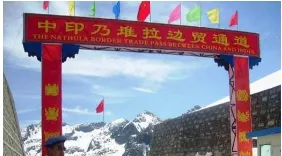
One cannot be too sure as to how long the sabre-rattling (the display or threat of military force.) over different perceptions of the Indo-Chinese border will persist. However, the nub of the matter must be that one historical wrong, once made, cannot be unmade. Reacting to Defence Minister Arun Jaitley’s remarks, the Chinese foreign ministry spokesman Geng Shuang invoked the 1890 Sino-British Treaty and its sacrosanct (अलंघनीय) nature in demarcating the border between the two nations in the Sikkim sector, currently the subject of a rather longish stand-off (गतिरोध) . “I would like the Indian side to respect the 1890 treaty immediately and pull back the border troops which have crossed into Chinese territory back to the Indian side of the boundary,” Geng said. And if that is fair enough, one wonders why China is so unwilling to accept the McMahon Line as a fair demarcation. In its reckoning it is another imperial baggage like the Simla Convention of 1914 on which rests India’s claim on Arunachal Pradesh. Geng has accused India of using Bhutan as a “cover up” for the “illegal entry” into the Doklam area over which Bhutan has subsequently lodged a protest with the Chinese government. It is legitimate to ask China, so cautious about international treaties, how it can justify its acts of transgressions (अतिक्रमण) into India’s territory with the help of Pakistan, even to the extent of mobilising an economic corridor and subsuming vast tracts of Indian land and increased PLA incursions (आकस्मिक हमला/आक्रमण) across the LAC. Pakistan arbitrarily signed away, according to Prime Minister Nehru’s statement in the Lok Sabha on March 5, 1963, 3.000 square miles of Indian territory to China. As for the Doklam stand-off, the Indian Army, as per reports, is showing aggressiveness. It has been cautioned that an aggressive Indian policy towards China or for that matter a “New Forward Policy” might aggravate border disputes and push China to use force. After the ‘slight’ friction with China in 1959, the Indian army implemented aggressive action known as its Forward Policy following which the Chinese Army made a limited but successful ‘counter-attack’ in 1962. If China establishes control over Doklam plateau, it will have the wherewithal to challenge India as that region lies immediately east of Indian defences in Sikkim and thus make India vulnerable. Lest we forget, it was Mao Zedong who once termed Tibet as the ‘palm’ of a hand with its five fingers as Ladakh, Sikkim, Nepal, Bhutan, and what has so long been referred to as NEFA. It pertains to our north-eastern states, specifically territories that Mao claimed needed to be ‘liberated’. Mao took the hard line that there was nothing in the ‘historical’ India-China friendship and that Nehru was a ‘bourgeoisie (the middle class, typically with reference to its perceived materialistic values or conventional attitudes.)’ leader. The pacifist and placatory (शांत करने वाला) Indian leadership remained impervious (अगम्य/अप्रभावित) to Communist China’s repeated claims on Tibet and a large swathe of Indian territory. It continued to concede areas under duress (अवरोध/दबाव/प्रतिबन्ध) that Tibet is a part of China, that China poses no military threat, that it is entitled to a seat in the Security Council, and that its dismal record of human rights is an internal matter, without being able to chart out a durable roadmap for Kashmir, its feet of clay. On 8 August 1949, India and Bhutan signed a Treaty of Friendship calling for peace and non-interference in each other’s internal affairs. The relationship gathered momentum when Jawaharlal Nehru visited Bhutan in 1958. While abiding by the principle of non-interference, the relationship involved considerable Indian assistance in exchange for Bhutanese deference to India’s foreign policy and defence concerns, especially relating to China. Under Indian guidance, Bhutan developed a model of diplomatic engagement with the “middle powers”, but with none of the Permanent Five (P-5) members of the UN Security Council and thus, most significantly, not with China. China has been persuading Bhutan to let it open formal diplomatic links and an embassy in the capital of Thimpu, which would have none of it, barring a few like Bangladesh, Finland and Switzerland which have embassies and consulates (दूतावास) . China’s ulterior (छिपा हुआ/अप्रत्यक्ष) motive is to extend its territory in the Chumbi Valley, a strategically important ‘V’ shaped area of Tibet between the Indian state of Sikkim to the west and Bhutan to the east. This is extremely sensitive for India because the 3,000 m (9,500 ft) high valley juts down towards a strip of Indian territory called the Siliguri Corridor, which is the only land route ~ known as the ‘chicken’s neck’ ~ from the broad mass of India to the North-east and Nepal. Therefore, India’s sensitivities are perfectly rational. Chumbi Valley is of geostrategic importance to China because of its shared borders with Tibet and Sikkim. DS Rajan, Distinguished Fellow, Chennai Centre for China Studies, in a 2015 paper noted that if China establishes control over Doklam plateau, it can challenge India as that region lies immediately east of Indian defences in Sikkim. “This piece of dominating ground not only has a commanding view of the Chumbi Valley but also overlooks the Siliguri Corridor further to the east.” China has been seeking a quid pro quo (a favor) with Bhutan, urging its government to cede to it the area close to Chumbi Valley, a tri-junction of Bhutan, Tibet and Sikkim in lieu of which Beijing would give up its claim over Bhutan’s central areas. And China has been at this game for a fairly long time. When China built a 1200 km-long road in 1956 across Aksai Chin, of which some 180 km was claimed by India, to carve a route for Sianking, its westernmost province, into Tibet, India was caught napping. It learnt about the road only in the following year by reading about this “remarkable” piece of engineering in Chinese newspapers. Years later it went ahead with its China-Pakistan Economic Corridor that passes through PoK with the same brutish disregard for Indian sovereignty claims, a nationalist India looking as feckless (शक्तिहीन/लापरवाह) as ever, never being able to raise a howler with the same fever pitch as China does. To the question as to why China still refuses to formally accept the McMahon Line, observers like Srinath Raghavan think that if China does so, it would be tantamount (के तुल्य) to accepting that Tibet had enjoyed de facto (actually, in fact) independence at the time of the Simla conference, weakening its claim that Tibet was an ‘inalienable’ part of China. But such ‘historical’ intransigence apart, China’s tough talk is ably sustained by its military modernisation and incremental upgrading of its military posture in Tibet to enable rapid force deployment, backed by logistics capability and communications infrastructure and strategically interspersed (बिखरा हुआ) by repeated incursions by the PLA across the Line of Actual Control (LAC). This includes the settled or undisputed areas like Sikkim in northeastern India. Besides Chinese forays into Tibet and the Indian Ocean region (IOR), it keeps on leveraging economic and military relationships with India’s neighbours to establish a containment policy towards India. Massive Chinese infrastructure buildup in the Tibet Autonomous Region (TAR) in terms of rail, road, airfield, and telecommunications infrastructure is very much under way. Sadly, if India is being ‘aggressive’ today, it is a case of too little, too late. It devolves (transfer or delegate (power) to a lower level) on India to maintain the status quo at all costs.Stand-off (noun)
A deadlock between two equally matched opponents in a dispute or conflict. गतिरोध
Synonyms: Deadlock, Stalemate, Impasse, Standstill, Dead End
Example: The standoff between the countries was ended with the peace treaty.
Transgression (noun)
An act that goes against a law, rule, or code of conduct अतिक्रमण
Synonyms: Lapse, Infringement, Contravention, Encroachment
Example: When the banker stole funds from the vault, he made a huge transgression.
Placatory (adjective)
Intended to make someone less angry or hostile शांत करने वाला
Synonyms: Appeasing, Assuaging, Conciliatory, Pacific
Example: India has always shown a placatory hand in all war like situations.
Impervious (adjective)
Unable to be affected by/ not allowing fluid to pass through. अगम्य/अप्रभावित
Synonyms: Impermeable, Impenetrable, Impregnable, Unaffected
Example: Since the bank installed an impervious safe, it has not been robbed.
Duress (noun)
Threats, violence, constraints, or other action used to coerce someone into doing something against their will or better judgment. अवरोध/दबाव/प्रतिबन्ध
Synonyms: Coercion, Compulsion, Force, Intimidation, Threats, Constraint
Example: The judge overturned the case because the defendant’s attorney proved that his client’s confession had been given under duress.
Ulterior (adjective)
Existing beyond what is obvious or admitted; intentionally hidden. छिपा हुआ/अप्रत्यक्ष
Synonyms: Underlying, Undisclosed, Undivulged, Unexpressed, Unapparent, Under Wraps, Unrevealed
Example: Politicians often use religion as a tool to get people to believe them despite their ulterior motives.
Feckless (adjective)
Lacking initiative or strength of character शक्तिहीन/लापरवाह
Synonyms: Incompetent, Inefficient, Inept, Ineffectual
Example: Phil is probably the most feckless worker at the company, but he’s so charming and lovable he’s somehow managed to work here for fifteen years.
De facto (adverb)
In fact, whether by right or not. दर असल
Synonyms: In Practice, Veritably
Example: Although Jim and Sarah have never married, they consider their thirty-year relationship to be a de facto marriage.
Tantamount (adjective)
Equivalent in seriousness to; virtually the same as. के तुल्य
Synonyms: Equal, Equivalent, Parallel, Same as, On a par with
Example: For some environmentalists, cutting down trees is tantamount to destroying ecosystem.
Intersperse (verb)
Scatter among or between other things; place here and there. बिखरा हुआ
Synonyms: Scatter, Disperse, Spread, Strew, Sprinkle
Example: The interspersed thoughts led him to confusion.






Stay updated with The Hindu Editorial Vocab24 app, your definitive source for breaking news and comprehensive coverage from India and around the globe. Whether it's political developments, business updates, sports highlights, the latest technology trends, or current events, The Hindu brings live, accurate, and reliable news directly to your device.
Don’t fall for sensationalized or fake news shared online. Read and share accurate updates with friends and family through The Hindu Editorial Vocab24 app. Download it today!
News Coverage in The Hindu Editorial Vocab24 App
Breaking News: Receive instant notifications on breaking news stories as they unfold. Stay informed about major events and developments in India and around the world with live blogs, news in shorts videos, and concise articles.
Politics: Get the latest updates on Indian politics, including elections, policy changes, government decisions, and political events that shape the nation.
Business and Economy: Stay ahead in the economic landscape with detailed business news and market analysis. Learn about stock market trends, financial reports, corporate news, and economic developments to make informed investment decisions.
Current Events: Follow stories on social issues, policy changes, global events, and daily current affairs, tailored for UPSC and other competitive exam preparations.
Technology: Keep up with the latest gadgets, innovations, and tech trends. Read expert reviews and analyses in short, concise updates on cutting-edge technology from India and beyond.
Sports: Never miss a moment of your favorite sports. Get live scores, match reports, and expert analysis on cricket, football, tennis, and more.
International News: Stay informed about global events and geopolitical developments, including the Russia-Ukraine war, Israel-Palestine conflict, and other key international stories.
Local News: Stay connected to your community with the latest updates on city events, issues, and local news. Coverage includes hyperlocal updates from cities like Bangalore, Chennai, Delhi, Hyderabad, Mumbai, Kolkata, and more.
Trending Topics: Discover what's trending today with the most talked-about stories and hot topics across India and the world.
Experience journalism that values integrity, accuracy, and reliability. Download The Hindu Editorial Vocab24 app today and stay connected with the world.
Subscribe to our newsletter!







