

A time of strategic partnerships
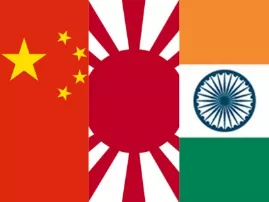
India pulled out all the stops last week to welcome Japanese Prime Minister Shinzo Abe on the occasion of his fourth annual summit with Prime Minister Narendra Modi. The India-Japan “Special Strategic and Global Partnership” — a designation and status New Delhi accords to no other partner — has reached new heights under the stewardship (the job of supervising or taking care of something, such as an organization or property.) of the two leaders.The rise of China and questions about America’s commitment in Asia have drawn them into a deepening security-cum-economic relationship. How deep is it? As Mr. Abe wrapped up his visit last Thursday, speculation arose on the possibility of an evolving “alliance” between the two countries given just how much their interests converge (tend to meet at a point.). Such analyses, though pointing in the right direction, may not capture the true nature of the India-Japan “strategic partnership.”
The India-Japan synergy (the interaction or cooperation of two or more organizations) has two key elements. Japan is investing heavily in strengthening its critical infrastructure to enhance its economic and potential defence capabilities. Simultaneously, the two countries have begun working on a joint infrastructure development and connectivity drive traversing (travel across or through.) the Indian Ocean, from Myanmar to Sri Lanka to Iran and encompassing the Asia-Africa Growth Corridor. On defence matters, Japan and India have agreed to establish regular consultations in the “2+2” format of their defence and foreign ministries. Their navies exercise regularly together with the U.S. Navy. And negotiations on arms sales — notably, the ShinMaywa US-2i amphibious aircraft — are on. Japanese investment in the strategically placed Andaman and Nicobar Islands is likely to help New Delhi establish a major security sentinel in the eastern Indian Ocean.
Strategic partnerships
But this is not an alliance in the making. Alliances are passe (no longer fashionable; out of date.) and only a few continue gingerly (in a careful or cautious manner.) from the Cold War era. We live in a world today driven by “strategic partnerships”. States find themselves in an interdependent system where the traditional power politics of yesteryear doesn’t quite fit. After all, every major relationship characterised by strategic tension such as U.S.-China, Japan-China, India-China is simultaneously one of economic gain. The U.S. and China are each other’s chief trading partners, while China ranks at the top for Japan and India. Besides, India might confront China at Doklam but it also wants Chinese investment.
Strategic partnerships carry certain characteristic features falling short of alliances. First, unlike alliances, they do not demand commitments to a partner’s disputes with other countries. New Delhi does not take a strong position on Japan’s territorial disputes with China and Russia. Likewise, Tokyo does not openly side with India in its quarrels with China and Pakistan. For instance, Japan’s reaction to the Doklam stand-off, though critical of China implicitly, did not go beyond saying that “all parties involved should not resort (turn to and adopt (a course of action, especially an extreme or undesirable one) so as to resolve a difficult situation.) to unilateral attempts to change the status quo by force.” India’s reaction to the verdict of the arbitral tribunal on the South China Sea last year, urging “all parties to show utmost respect for the UNCLOS”, reflected a similar dispensation despite Japan’s push for a stronger statement. There was also no explicit mention of the South China Sea in the latest joint statement.
Strategic partnership means, first, that both retain the flexibility to continue political engagement and economic cooperation with their common adversary. Second, they avoid “entrapment”, or being dragged into a partner’s disputes and potentially into conflict, which happened in the First World War. Third, regular high-level political and military interactions facilitate a collaborative (produced by or involving two or more parties working together.) approach to strategic policies over a range of economic and military activities. India and Japan, for instance, are not only moving forward on economic and defence cooperation but are also cooperating on other important issues such as civil nuclear energy and Security Council reform.
Given that resort to war is undesirable owing to economic interdependence as well as the presence of nuclear weapons, the aim of major strategic partnerships is to strengthen defences against marginal conflict, convey a determination to stand up to a strategic adversary and, overall, generate a persuasive environment that discourages potential intimidation. Occasionally, as between India and China, a “strategic partnership” is a way of opening a channel of communication and minimal cooperation intended to stabilise and develop the potential for a detente (the easing of hostility or strained relations, especially between countries.) and conceivably something warmer. In this particular case, not much has been accomplished thus far, but it remains a low-cost option for expanding cooperation in the event the political fundamentals of the relationship show an upward swing.
Looking ahead
India’s two main strategic partnerships, with the U.S. and Japan, are dovetailing (fit or cause to fit together easily and conveniently.) nicely. For New Delhi, the U.S. will remain its chief backer both to enhance India’s conventional defence capabilities and to draw political support in global political institutions, for example in components of the nuclear non-proliferation regime. Japan, in the meantime, is becoming its primary collaborator in developing its economic sinews (the parts of a structure, system, or organization that give it strength or bind it together.) and for building a geostrategic network that offers Indian Ocean states an alternative to dependence on China. Together, the emerging structure of triangular cooperation should give Beijing pause to think.




Top court quashes FIRs against Gen Z protesters
Sep 04, 2026







Stay updated with The Hindu Editorial Vocab24 app, your definitive source for breaking news and comprehensive coverage from India and around the globe. Whether it's political developments, business updates, sports highlights, the latest technology trends, or current events, The Hindu brings live, accurate, and reliable news directly to your device.
Don’t fall for sensationalized or fake news shared online. Read and share accurate updates with friends and family through The Hindu Editorial Vocab24 app. Download it today!
News Coverage in The Hindu Editorial Vocab24 App
Breaking News: Receive instant notifications on breaking news stories as they unfold. Stay informed about major events and developments in India and around the world with live blogs, news in shorts videos, and concise articles.
Politics: Get the latest updates on Indian politics, including elections, policy changes, government decisions, and political events that shape the nation.
Business and Economy: Stay ahead in the economic landscape with detailed business news and market analysis. Learn about stock market trends, financial reports, corporate news, and economic developments to make informed investment decisions.
Current Events: Follow stories on social issues, policy changes, global events, and daily current affairs, tailored for UPSC and other competitive exam preparations.
Technology: Keep up with the latest gadgets, innovations, and tech trends. Read expert reviews and analyses in short, concise updates on cutting-edge technology from India and beyond.
Sports: Never miss a moment of your favorite sports. Get live scores, match reports, and expert analysis on cricket, football, tennis, and more.
International News: Stay informed about global events and geopolitical developments, including the Russia-Ukraine war, Israel-Palestine conflict, and other key international stories.
Local News: Stay connected to your community with the latest updates on city events, issues, and local news. Coverage includes hyperlocal updates from cities like Bangalore, Chennai, Delhi, Hyderabad, Mumbai, Kolkata, and more.
Trending Topics: Discover what's trending today with the most talked-about stories and hot topics across India and the world.
Experience journalism that values integrity, accuracy, and reliability. Download The Hindu Editorial Vocab24 app today and stay connected with the world.
Subscribe to our newsletter!







