

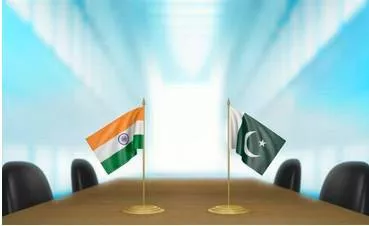
A straightforward lesson on resolution
By not sorting out conflicts between themselves, India and Pakistan are effectively outsourcing the role to third parties.U.S. President Donald Trump’s claim last Monday that Prime Minister Narendra Modi had asked him at the G-20 summit in June in Japan to mediate between India and Pakistan on the Kashmir question may, for the moment, have been deftly handled by the two foreign policy establishments, but this is not a question that is likely to go away all too easily. Given that Mr. Trump made this rather out-of-the-blue statement during Pakistan Prime Minister Imran Khan’s visit to the United States, it has fuelled further speculation about what it implies.
A mixed bag
To be fair to the Indian establishment’s traditional logic, third party mediation in Jammu and Kashmir might not be a useful idea simply because third parties typically come with their own agenda. Second, it might do more harm than good in an age of hypernationalism and frenzied media attention on anything to do with Kashmir. In a milieu where bilateral diplomacy on Jammu and Kashmir itself comes under intense scrutiny from domestic political forces, third party mediation is almost impossible to even consider. More so, past instances of third party mediation have had mixed results.
And yet, Kashmir is likely to be on the great power radar and will continue to attract international attention for a variety of reasons, not least because New Delhi refuses to invest in bilateral diplomatic measures to resolve Jammu and Kashmir.
Shimla and after
Historically, New Delhi has had a love-hate relationship with third party mediation in Jammu and Kashmir in 1948. However, much of this overt third-party intervention in Kashmir ended with the Shimla agreement of 1972 which stated, at New Delhi’s insistence, that Kashmir will be a bilateral issue thereby ending the United Nations Military Observer Group in India and Pakistan’s (UNMOGIP’s) peacekeeping work in Kashmir, de facto, if not de jure. The current UNMOGIP involvement in Kashmir is neither encouraged nor recognised by India, something Pakistan continues to do. New Delhi believes that its UN experience vis-à-vis Kashmir has been an unsavoury one which partly explains the current distaste in India for any third-party mediation. Then there is India’s status-linked indifference to external opinion that comes with being a major economy and military power whose deep pockets and growing markets are of significance to those potentially desirous of talking about Kashmir. So theoretically, New Delhi has consistently, and successfully, blocked all third party mediation in Kashmir, except when it wants to let others play a role. And if anyone indeed makes a reference to Kashmir which New Delhi disagrees with, it either ignores it or strongly disapproves of it.
That is, in practice, there has historically been a great deal of third party attention on the larger Kashmir question some of which has been encouraged by India.
In order to understand this argument better, let us make a conceptual distinction between conflict resolution and crisis management. While both involve some amount of mediation, the former is focussed on a specific issue — Kashmir in this case — and seeks to address and resolve the root causes of the conflict. The latter involves mediation during an ongoing crisis with a potential for escalation. Crisis mediation unlike conflict resolution does not seek to resolve the political or root causes of a conflict.
Management and resolution
New Delhi has traditionally been averse to mediation in the form of conflict resolution while accepting more than once third party mediation during crisis events. Kargil is an example when India accepted third party mediation by the Clinton Administration in the U.S. This was also evident during the post-Pulwama military stand-off in February this year. While both Kargil and the February stand-off were directly linked to Kashmir, mediation by the third party did not seek to address anything beyond the immediate diffusion of tensions. Then there are other instances where third party crisis mediation took place even though they had no direct links to Kashmir such as the post-26/11 terror attacks.
For sure, crisis management is different from conflict resolution. And yet even when the focus is on crisis management, the larger conflict, which has given rise to the crisis comes into focus and become part of the conversations between the mediator and the conflicting parties. This is precisely what seems to underlie the current American interest vis-à-vis Kashmir. So even though New Delhi accepts crisis management, and not conflict resolution in the context of Kashmir, it is not easy to separate the two either during a crisis or when the conflict is crisis prone.
Put differently, given that crisis, at least in this context, is the function of a pre-existing conflict, crisis management by third parties and the attendant focus on the broader conflict is not easy to avoid.
More so, while New Delhi is loathe to having third party discussions on Kashmir, especially on the human rights situation, it actively seeks third party attention on terror emanating from Pakistan as well as the latter’s sponsorship of violence in the Valley. While this might be a desirable distinction to New Delhi’s mind, it is not easy to get a third party to focus on one part of the problem and ignore the other. In other words, New Delhi’s efforts at getting other countries to condemn Pakistan’s sponsorship of terrorism in Kashmir while at the same time disparaging the reports of the Office of the United Nations High Commissioner for Human Rights (OHCHR) on the human rights situation in Kashmir is a difficult balance to maintain.
Impact of regional geopolitics
The unfolding developments in regional geopolitics could also have implications for third party interest in Kashmir. The U.S.’s desire for a deal with the Taliban in Afghanistan, in which Pakistan is key, is already beginning to have an impact on the frosty relationship between Washington and Islamabad. Besides Washington, Beijing, and Moscow, the European capitals will also eventually start courting Pakistan. This will invariably increase, albeit marginally, the global focus on Kashmir either at Pakistan’s insistence or because third parties might see a link between Kashmir and regional instability. As a matter of fact, several people have in the past made a direct link between instability in Afghanistan and the Kashmir conflict. Such voices could potentially become sharper now. More so, if the rising concerns about the Islamic State’s influence in Kashmir turn about to be not-so-misplaced, the heat on Kashmir is only going to increase.
What further ensures third party involvement in Kashmir is the lack of a conflict resolution process between India and Pakistan. The less the two sides talk on Kashmir, the more there is are likely to be crisis situations between them which would invariably lead to more third party involvement in the whole Kashmir quagmire. In other words, by not resolving conflicts between themselves, India and Pakistan are effectively outsourcing crisis management, and thereby conflict resolution, albeit in a limited manner, to third parties. The lesson then is a straightforward one: if you do not engage in a dialogue with Pakistan to resolve the Kashmir issue, third parties will continue to meddle.



Top court quashes FIRs against Gen Z protesters
Sep 04, 2026






Stay updated with The Hindu Editorial Vocab24 app, your definitive source for breaking news and comprehensive coverage from India and around the globe. Whether it's political developments, business updates, sports highlights, the latest technology trends, or current events, The Hindu brings live, accurate, and reliable news directly to your device.
Don’t fall for sensationalized or fake news shared online. Read and share accurate updates with friends and family through The Hindu Editorial Vocab24 app. Download it today!
News Coverage in The Hindu Editorial Vocab24 App
Breaking News: Receive instant notifications on breaking news stories as they unfold. Stay informed about major events and developments in India and around the world with live blogs, news in shorts videos, and concise articles.
Politics: Get the latest updates on Indian politics, including elections, policy changes, government decisions, and political events that shape the nation.
Business and Economy: Stay ahead in the economic landscape with detailed business news and market analysis. Learn about stock market trends, financial reports, corporate news, and economic developments to make informed investment decisions.
Current Events: Follow stories on social issues, policy changes, global events, and daily current affairs, tailored for UPSC and other competitive exam preparations.
Technology: Keep up with the latest gadgets, innovations, and tech trends. Read expert reviews and analyses in short, concise updates on cutting-edge technology from India and beyond.
Sports: Never miss a moment of your favorite sports. Get live scores, match reports, and expert analysis on cricket, football, tennis, and more.
International News: Stay informed about global events and geopolitical developments, including the Russia-Ukraine war, Israel-Palestine conflict, and other key international stories.
Local News: Stay connected to your community with the latest updates on city events, issues, and local news. Coverage includes hyperlocal updates from cities like Bangalore, Chennai, Delhi, Hyderabad, Mumbai, Kolkata, and more.
Trending Topics: Discover what's trending today with the most talked-about stories and hot topics across India and the world.
Experience journalism that values integrity, accuracy, and reliability. Download The Hindu Editorial Vocab24 app today and stay connected with the world.
Subscribe to our newsletter!







