

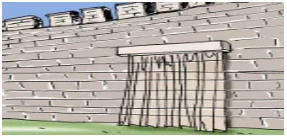
A season to repair relations
It’s time for a comprehensive (विस्तृत/व्यापक), open dialogue between India and China to promote communication and connectivity in diverse spheres and preserve the peace on our shared borders. The Chinese Ambassador to India, Luo Zhaohui, recently put forward some suggestions for improvement of bilateral ties between China and India. The suggestions are timely since relations between the two Asian giants have looked tired and worn in recent months. The voices from the gallery have been worrisome. China’s obduracy (ज़िद/हठ) on India’s Nuclear Suppliers Group (NSG) bid, its incomprehensible stand on the listing of known terrorist-progenitor (अग्रगामी/जनक) Masood Azhar under the U.N. Security Council’s 1267 Committee, the deployment of Chinese military and engineering assets in Pakistan-occupied Kashmir and the development of the China-Pakistan Economic Corridor (CPEC) are all pointers to a complex and tension-riddled relationship. Absence of trust On the CPEC, the Prime Minister himself, speaking at the Raisina Dialogue in New Delhi, implicitly criticised the Chinese actions saying, “Connectivity in itself cannot override or undermine the sovereignty (प्रधानता) of other nations.” While the border areas between the two countries have remained conflict-free, the Line of Actual Control continues to be subject to conflicting interpretations by both India and China and the scene of intermittent transgression. Commentators have suggested that India’s Tibet policy is also being recalibrated, drawing conclusions from the Dalai Lama’s projected visit to Arunachal Pradesh and his being “seen at Rashtrapati Bhavan, sitting beside President Pranab Mukherjee”. As expected, the nationalist Chinese media condemned it. What did Mr. Luo say? The remarks were obviously prepared as the Chinese do not speak off-the-cuff in public spaces. He suggested a ‘friendship and cooperation treaty’ and a free trade agreement (FTA) to boost bilateral relations and joining of hands on China’s One Belt, One Road (OBOR) initiative, and added that the time is ripe for both countries to reap some ‘early harvest’ outcomes (based on negotiations held so far) on the unresolved boundary question. That the Ambassador chose to make these remarks at the newly-established Ji Xianlin Centre for India-China Studies at the University of Mumbai campus lent some symbolism to the occasion. Ji Xianlin was one of China’s foremost modern Indologists and a protagonist (अग्रणी/मुख्य व्यक्ति/समर्थक) of friendship and civilisational understanding between India and China. Could the Ambassador's statement be part of an effort within the Chinese establishment to review relations with neighbours like India, given the strategic uncertainties generated by the advent (आगमन) of Donald Trump’s administration in the U.S. and his unabashed negativity towards China? Mr. Trump’s phone call with the Taiwanese President, Tsai Ing-wen, before he took office; his proclaimed intention to impose punitive (दण्डात्मक) tariffs on Chinese goods; and the new U.S. Secretary of State, Rex Tillerson’s thinly disguised threats against China’s building of artificial islands in the disputed areas in the South China Sea have all generated concern in Beijing. It is not known whether these ideas articulated in Mumbai by the Chinese envoy have been discussed at the government-to-government level previously. It is possible that some of them, particularly the ‘early harvest’ concept relating to the boundary, may have been broached in some form or other by the Chinese side. Sectors of the boundary, like Sikkim and the middle sector (Uttarakhand/Himachal Pradesh), are by and large free of the disputes that one sees in the western (Jammu and Kashmir) and eastern (Arunachal Pradesh) sectors. But ‘solutions’ that segment the border instead of ensuring an overall comprehensive settlement of the boundary may be difficult to accept, especially for India. Devil in the detail A treaty of friendship and cooperation between the two countries recalls the 1954 “Panchsheel” Agreement which essentially tied up the status of Tibet but also outlined the Five Principles of Peaceful Coexistence — principles that became empty words over the ensuing years as the relationship slid into conflict and then took years to revive. The 1993 and 1996 agreements on peace and tranquility and confidence-building in the India-China border areas reiterated the five principles and also spoke of the non-use of force and the concept of mutual and equal security. While India need not spurn the latest Chinese overture (प्रस्ताव) made by Mr. Luo, and would do well to explore what the proposal entails, the devil is always in the detail. Given the state of bilateral relations, and the extent of unresolved political and security issues that bedevil the relationship, not to mention the disparity (असमता/असमानता) in economic strength, a treaty of friendship and cooperation may only be an inventory of good intentions but not a transformative document. As for trade and economic relations, Mr. Luo’s idea of an FTA is no doubt forward-looking. Trade between India and China has grown to an annual volume of $70 billion (2015-16). India has made a strong pitch for Chinese investments under Make in India in infrastructure development, solar energy and smart cities. Recent reports, however, also suggest security hurdles faced by Chinese firms seeking to invest in India. An FTA that is goods-centred will obviously not benefit India given the huge trade in goods imbalance that favours China. An FTA that is comprehensive, covering goods and services, cross-border investment, R&D, standards and dispute resolution would be worth exploring. As some Indian scholars have observed, “An FTA with China may have benefits that escape quantification and transcend economics.” Connectivity builds the sinews (मजबूत करना) of successful diplomacy today. Our own region of South Asia with its poor inter-country connectivity only buttresses the poor state of diplomatic cooperation in much of the subcontinent. The rigour (सख्ती /कड़ापन) of borders and sovereignties has triumphed over any consensus-building on connectivity and cooperation beyond borders. India’s own reaction to China’s OBOR has been hedging (प्रतिरक्षा) and tentative (अनिश्चित), mainly because of the CPEC through Pakistan-occupied Kashmir. At the same time, India is a part of the frontline membership of the Asian Infrastructure Investment Bank (AIIB) that is bolstering (सहारा देना/सँभालना) OBOR. The Chinese have today chosen to disregard the sovereignty issues surrounding the dispute between India and Pakistan over the State of J&K, despite the provisions of the 1963 China-Pakistan Boundary Agreement which conceded the disputed nature of the territory (in what Pakistan now calls Gilgit-Baltistan but what India claims as part of Jammu and Kashmir) covered under the agreement. This is a crucial reason for India’s reservations about OBOR. The Chinese are seen by India to have acted in disregard of Indian sensitivities on this matter, which is a cause for legitimate concern. Connectivity, connectivity, connectivity The question however is, whether despite this, India should as a test of the Chinese approach, and with reference to OBOR, explore the development of connectivity between Tibet and India, especially through the Sikkim sector into Bengal. The old route between Lhasa and Kolkata via Nathu La was the most easily traversed route — and may still be, despite the road networks constructed by the Chinese in Tibet — between Tibet and mainland China, via land and sea, up until the mid-20th century. This is a road that provided for the transport of goods and services between Tibet and the outside world through India. The case for its revival requires a serious examination and should not be dismissed cursorily. Nathu La is already the crossing point for border trade between India and the Tibet Autonomous Region. A true indicator of Chinese positivity would also be approval for India to open a Trade Office in Lhasa in place of the old Consulate General that operated there until 1962. An opening of ties between India and the Xinjiang region of China is also worth examining. Providing for air connectivity between Urumqi, the capital of Xinjiang province, and New Delhi as one of the OBOR linkages, for instance, would help the promotion of people-to-people ties and trade and commercial contact and could also help open a new chapter in counter-terrorism cooperation between India and China. The two countries have a common interest in curbing religious radicalism and terrorism. Kashmir and Xinjiang, both contiguous (सटा हुआ/समीपस्थ) neighbours, have similar challenges posed by terrorism and separatist movements. New thinking necessary India-China relations can definitely do with some new thinking and new ideas, and from that point of view, the Chinese Ambassador has done well to articulate his outlook, however modest, on how more bilateral cooperation can be promoted. The long peace between the two countries, stretching from the 1970s to the present day, deserves preservation and not disturbance. It is entirely in the self-interest of each country to ensure this. Competitive coexistence, with a clear delineation (चित्रांकन/आकार) of areas of difference and how to manage them, the promotion of business and people-centred connectivity, and mutual confidence-building with tension-reduction measures cannot do any harm. The border problem, by virtue of its complexity and size, will take its time to resolve. Maturity of approach, and strategic patience while each country is preoccupied with the demands of internal and external equilibrium and balancing, offers a constructive way forward. The modus Vivendi (an arrangement or agreement allowing conflicting parties to coexist peacefully, either indefinitely or until a final settlement is reached.) of the last few decades are easily disturbed as recent events have shown. China as the larger neighbour must take the initiative to ensure that this trend is halted. Its approach on NSG, Masood Azhar, the activities in PoK, to name a few, have cast long shadows on the relationship. China cannot expect India not to pursue her legitimate interests in ensuring the security of its periphery, and to promote ties with countries like the U.S. and Japan and ASEAN partners in the Indo-Asia Pacific. All these countries have extensively evolved and developed relationships with China. Likewise, our cooperation with them need not hinder (बाधा पहुंचाना) a productive, comprehensive, open and frank dialogue between India and China that is aimed at preserving and promoting good contact, communication and connectivity in diverse spheres as also the peace on our shared borders of the last few decades.Comprehensive (adjective)
Including or dealing with all or nearly all elements or aspects of something. व्यापक/विस्तृत
Synonyms: Broad, Extensive, Complete, Thorough, All-Inclusive
Example: After travelling in southern India for years, he finally put his experiences and knowledge to good use by writing a comprehensive guide to life in the region.
Obduracy (noun)
The quality or state of being obdurate (stubbornly refusing to change one's opinion or course of action.) ज़िद/हठ
Synonyms: Adamancy, Firmness, Determination, Intransigence, Pertinacity
Example: Despite the defendant’s apology, the judge was obdurate and gave him a thirty-year sentence.
Progenitor (noun)
A person who originates a cultural or intellectual movement. अग्रगामी/जनक
Synonyms: Originator, Founder, Instigator, Source
Example: Some scientists suggest that because we share similar DNA, the human’s closest progenitor is chimpanzee.
Sovereignty (noun)
Supreme power or authority. प्रधानता
Synonyms: Dominance, Preeminence, Primacy, Supremacy
Example: Once I reach legal age, I will be a sovereign individual and will have control over my own life.
Protagonist (noun)
An advocate of a particular cause or idea./ the leading character of something that is considered as important. अग्रणी/मुख्य व्यक्ति/समर्थक
Synonyms: Exponent, Advocate, Lead, Hero, Mainstay
Example: In the short story, the protagonist must finally stand up to the bullies who torment him.
Advent (noun)
The arrival of a notable person or thing. आगमन
Synonyms: Arrival, Appearance, Emergence, Occurrence, Dawn, Origin, Rise
Example: The advent of drones is set to usher in a whole new era for photography.
Punitive (adjective)
Inflicting or intended as punishment. दण्डात्मक
Synonyms: Punishing, Penal
Example: The University is taking punitive actions against the football player who failed his drug test.
Overture (noun)
An introduction to something more substantial. प्रस्ताव
Synonyms: Preliminary, Prelude, Introduction, Precursor, Forerunner, Herald
Example: Wanting to add a new song to their repertoire, the violinist studied an overture.
Disparity (noun)
The quality or state of being different. असमता/असमानता
Synonyms: Discrepancy, Imbalance, Inequality, Unevenness, Dissimilarity
Example: An enormous disparity in the lives of the rich and the poor in India can easily be seen.
Sinew (verb)
To strengthen. मजबूत करना
Synonyms: Bolster, Invigorate, Sustain, Toughen
Example: Recent scientific studies have identified natural extracts which can help sinew the body's immune system.
Tentative (adjective)
Not certain or fixed; provisional. अनिश्चित
Synonyms: Provisional, Unconfirmed, Unsettled, Indefinite
Example: The employees were not happy when they learned their pay raises were tentative and could be cancelled at any moment.
Bolster (verb)
Support or strengthen for bettering something. सहारा देना/सँभालना
Synonyms: Strengthen, Support, Reinforce, Make Stronger, Boost, Fortify
Example: Free tickets were given away to bolster attendance at the game.
Contiguous (adjective)
Sharing a common border; touching. सटा हुआ/समीपस्थ
Synonyms: Adjacent, Neighbouring, Adjoining, Bordering
Example: The escaped prisoner found it easy to cross the border of the two contiguous states.
Delineation (noun)
The action of describing or portraying something precisely/ the action of indicating the exact position of a border or boundary. चित्रांकन/आकार
Synonyms: Portrayal, Description, Depiction, Representation, Picture, Portrait
Example: Using an electron microscope, a scientist can clearly delineate the parts of a plant cell.
Hinder (verb)
Make it difficult for (someone) to do something or for (something) to happen/ to make difficult to accomplish. बाधा पहुंचाना
Synonyms: Obstruct, Impede, Inhibit, Retard, Thwart
Example: Tight, restrictive clothing will work to hinder your athletic performance.

Trump announces ceasefire between Lebanon and Israel
Apr 19, 2026


As trade row eases u s clears missile sale to india
Nov 23, 2025





Stay updated with The Hindu Editorial Vocab24 app, your definitive source for breaking news and comprehensive coverage from India and around the globe. Whether it's political developments, business updates, sports highlights, the latest technology trends, or current events, The Hindu brings live, accurate, and reliable news directly to your device.
Don’t fall for sensationalized or fake news shared online. Read and share accurate updates with friends and family through The Hindu Editorial Vocab24 app. Download it today!
News Coverage in The Hindu Editorial Vocab24 App
Breaking News: Receive instant notifications on breaking news stories as they unfold. Stay informed about major events and developments in India and around the world with live blogs, news in shorts videos, and concise articles.
Politics: Get the latest updates on Indian politics, including elections, policy changes, government decisions, and political events that shape the nation.
Business and Economy: Stay ahead in the economic landscape with detailed business news and market analysis. Learn about stock market trends, financial reports, corporate news, and economic developments to make informed investment decisions.
Current Events: Follow stories on social issues, policy changes, global events, and daily current affairs, tailored for UPSC and other competitive exam preparations.
Technology: Keep up with the latest gadgets, innovations, and tech trends. Read expert reviews and analyses in short, concise updates on cutting-edge technology from India and beyond.
Sports: Never miss a moment of your favorite sports. Get live scores, match reports, and expert analysis on cricket, football, tennis, and more.
International News: Stay informed about global events and geopolitical developments, including the Russia-Ukraine war, Israel-Palestine conflict, and other key international stories.
Local News: Stay connected to your community with the latest updates on city events, issues, and local news. Coverage includes hyperlocal updates from cities like Bangalore, Chennai, Delhi, Hyderabad, Mumbai, Kolkata, and more.
Trending Topics: Discover what's trending today with the most talked-about stories and hot topics across India and the world.
Experience journalism that values integrity, accuracy, and reliability. Download The Hindu Editorial Vocab24 app today and stay connected with the world.
Subscribe to our newsletter!







