

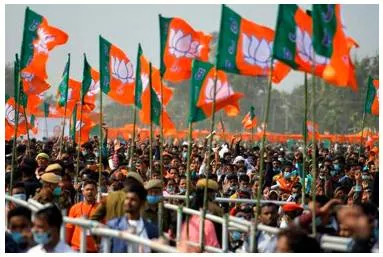
A one party juggernaut and its feeble challengers
With no glue still to bond the Opposition, the non-party movements of resistance could offer hope for change.The political Opposition in its entirety appears to have decided this — that each party would rather contest and lose to a smaller local adversary than challenge the one bigger, common and more ominous adversary. And win (or lose) the forthcoming Assembly elections, and more importantly, the crucial general election of 2024 together. The writing has been on the wall ever since 2019, reaffirming the urgency of the good old saying, “united we stand/win, divided we fall”.
Some stirrings
Only one leader with credible bona fides — the inimitable fighter and West Bengal Chief Minister Mamata Banerjee — appears to have recognised this and is striving to forge a united front to challenge the Bharatiya Janata Party (BJP). Indeed, she had sounded out the Opposition on this even before 2019, but it was ignored then as it is being ignored now. Nationalist Congress Party leader Sharad Pawar, the veteran, is also one leader sensitive to the nuances of the present scenario and did take some initial steps towards forging a common front to take on the strong adversary. It ended with an online conversation, with a prepared sermon by Indian National Congress chief Sonia Gandhi on how India must be saved. Period. The writing on the wall remains unread. Meanwhile, every party is busy finalising its list of candidates for the forthcoming Assembly elections and issuing statements to the press asserting its own invincibility in the forthcoming battle. The year 2024 is still too far on the horizon to exercise one’s mind. Never mind the link between the two.
A contrast lies in strategy
It is hard for an outsider to ignore the distinct modes of election management, one that the BJP has introduced especially over the past decade and that of the other established parties. The BJP prepares for an election at the ground level at least two years ahead by activating its cadres, especially cadres from the Rashtriya Swayamsevak Sangh, in establishing personal contacts with potential voters, collecting information about the local issues that might motivate voters to its side, the caste/subcaste/community profile of each constituency to cohere with grandiose calls for Vikas, and Hindu Rashtra from the top-level leadership, not to forget the ever active BJP IT cell forging and spreading questionable material every day on social media.
In other words, the BJP is forever preparing for an election. This is in contrast to the Opposition parties which get into action a month or two before election dates are announced, their chief concern being to usually nominate candidates with their own resources for winning. The leaders contribute their mite to the process by making speeches at election meetings. The BJP also learns quickly from its defeats and victories and does take immediate remedial action. The recent quick change of governments in several BJP- ruled States is a good example. The party also changes its tactics keeping in mind the lessons learnt. The contrast, of the energy of the BJP and the lethargy on the other side, is striking.
The BJP and the Opposition rely largely on attacking each other. This suits the BJP more because the Opposition earns credibility only if it posits an alternative economic, political and social programme to the electorate that carries conviction, for which it has to be formulated long before the elections are seen on the horizon. Before 2019, the Congress did posit an attractive economic alternative by promising ₹6,000 per month to poor farmers, but it was formulated a few weeks before the elections, announced from electoral daises by Congress leader Rahul Gandhi with no groundwork to prepare the audiences for it, and thus, carried no conviction. Since then, no Opposition party has challenged the Government by positing an attractive alternative slogan.
As of now, the reluctance of the Opposition parties to come together for the decisive fights ahead, and the absence of any evidence of serious preparations, do seem to indicate a willing walkover to the ruling party.
The Congress’s problem
It is easy to pin the responsibility for this denouement on the Indian National Congress. As the country’s second largest party in the Seventeenth Lok Sabha, with footprints around the country (besides being the oldest and the most experienced political party), the responsibility devolves upon it squarely to forge a vision and a programme which would accommodate most if not all the others into a single conglomerate (though preferably not a single unit), for the battles ahead.
But it is this status it has that fills it with an arrogance to claim the unshared leadership of any possible combination of parties, expressed in the following formula: come and support us and we shall fight together. There is no need for discussion, for discussion involves sharing. Just listen to either Ms. Sonia Gandhi or second best, Rahul Gandhi, and do as they say and demand. This is contrary to what its high status should imply: openness, liberalism, generosity and a vision for India beyond a vision for the present party leadership.
Its exclusive concern looks like retaining the three Gandhis (Ms. Gandhi, Rahul Gandhi and Priyanka Vadra) at the top even if the bottom keeps floundering and withering away. It is not only the pleas from leaders of a much higher stature such as Mr. Sharad Pawar but also pleas for the reinvigoration of the party from its own seniormost and most committed leaders (the G23, or 23 of them) that are perceived as a threat to Gandhis and thus sidelined.
There has been nil “introspection” within the party after each stunning political defeat. There is no sign of the party being a living organism capable, or at least willing, to rectify its errors and move on. This is in contrast to its chief rival. The grimness of the situation is highlighted by the sterling fact that the Opposition cannot go forward without the Congress either. What more could make the BJP happier?
A new brigade
Paradoxically, the only avenue of political change through the elections that lies open, if at all, is in the non-political movements of resistance such as the farmers’ agitation. The farmers, who have withstood the indifference and the assaults of the Government show no sign of backing off. They have kept almost all political parties away while also shouting from the rooftops that their mission is to defeat the BJP in the elections by mobilising farmers around the country. That they do have the capacity to mobilise themselves has been demonstrated repeatedly, most recently in Muzaffarnagar (Uttar Pradesh) and Karnal (Haryana). The mahapanchayat at Muzaffarnagar has also cautioned farmers against the BJP’s use of the so-far successful strategy of divide and rule along communal lines, and the Uttar Pradesh Chief Minister has already announced his intention to go the whole hog along this path. A major communal conflagration may also be in the offing. The results of these elections will decide the future of India to a large extent.



Top court quashes FIRs against Gen Z protesters
Sep 04, 2026






Stay updated with The Hindu Editorial Vocab24 app, your definitive source for breaking news and comprehensive coverage from India and around the globe. Whether it's political developments, business updates, sports highlights, the latest technology trends, or current events, The Hindu brings live, accurate, and reliable news directly to your device.
Don’t fall for sensationalized or fake news shared online. Read and share accurate updates with friends and family through The Hindu Editorial Vocab24 app. Download it today!
News Coverage in The Hindu Editorial Vocab24 App
Breaking News: Receive instant notifications on breaking news stories as they unfold. Stay informed about major events and developments in India and around the world with live blogs, news in shorts videos, and concise articles.
Politics: Get the latest updates on Indian politics, including elections, policy changes, government decisions, and political events that shape the nation.
Business and Economy: Stay ahead in the economic landscape with detailed business news and market analysis. Learn about stock market trends, financial reports, corporate news, and economic developments to make informed investment decisions.
Current Events: Follow stories on social issues, policy changes, global events, and daily current affairs, tailored for UPSC and other competitive exam preparations.
Technology: Keep up with the latest gadgets, innovations, and tech trends. Read expert reviews and analyses in short, concise updates on cutting-edge technology from India and beyond.
Sports: Never miss a moment of your favorite sports. Get live scores, match reports, and expert analysis on cricket, football, tennis, and more.
International News: Stay informed about global events and geopolitical developments, including the Russia-Ukraine war, Israel-Palestine conflict, and other key international stories.
Local News: Stay connected to your community with the latest updates on city events, issues, and local news. Coverage includes hyperlocal updates from cities like Bangalore, Chennai, Delhi, Hyderabad, Mumbai, Kolkata, and more.
Trending Topics: Discover what's trending today with the most talked-about stories and hot topics across India and the world.
Experience journalism that values integrity, accuracy, and reliability. Download The Hindu Editorial Vocab24 app today and stay connected with the world.
Subscribe to our newsletter!







