

A new job for dna
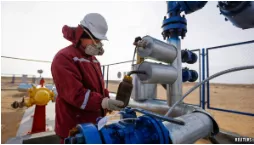
WHAT lies beneath? It is a pressing question for those prospecting for oil, planning shale-fracturing or seeking geothermal-energy sites. Underground reservoirs of water, oil and gas are connected in extensive, circuitous networks that can change with time or with drilling. Knowing those networks’ particulars can make a big difference to beliefs about how much can safely be extracted from them. To acquire such knowledge, drillers often use tracers. These are materials that can be injected into the ground in small amounts at one point and then detected reliably if they turn up in other places—thus showing that those places have subterranean links to the point of injection. The supply of decent tracers, however, is limited. About 100, mostly dyes or mildly radioactive materials, are in routine use. This constrains the number of possible injection points in a particular area, and thus the amount of tracking that can actually be done. Yet in many cases—for example, a long well that runs horizontally through a particular rocky stratum—more than 100 injection points might ideally be required. The numerical constraint on tracers extends, moreover, into time, as well as space, for injecting one poisons the well, as it were, thus confusing future attempts to employ the same agent. The problem would go away, though, if a tracer could be found that was essentially the same with every use, and would thus behave in a predictable way, but was different in detail on each occasion, so that both the time and the place of its injection could be known reliably when it turned up elsewhere. And such a substance exists. It is called DNA. The four types of chemical “letter” of which this molecule is composed can be written in any order you like, giving infinite variety to individual batches of the stuff. Unfortunately, DNA is a delicate molecule, ill-equipped to survive the extreme temperatures and stresses found inside boreholes. Attempts in the 1990s, by Statoil, Norway’s state-owned fossil-fuel company, to use it as a tracer failed. But technology has moved on, and others are now trying again. One such is BaseTrace, in North Carolina. This firm’s engineers exploit the fact that some DNA sequences are more stable than others. Such relative stability comes from the various ways that different DNA molecules fold up—their so-called secondary structures. But any given secondary structure can have numerous underlying sequences, so there is plenty of room for multiple tracer molecules that have the same properties of stability. BaseTrace has used this to develop algorithms which work out what sequences are best for the stresses a given application presents. It has recently moved from courting the oil industry to nuclear energy, where conditions of wastewater are at their most extreme. Another approach to protecting tracer DNA is encapsulation. Well Genetics, a Norwegian firm, wraps the molecules in polymer coatings. The company has been testing these tiny capsules, in collaboration with oil- and gas-production companies drilling in a North Sea oilfield and in a shale-gas field in Texas. Tracesa, a British company, is also developing polymer-coated DNA. And Haelixa, a firm spun out from the Swiss Federal Institute of Technology, in Zurich, is encapsulating DNA using a different material: glass. Haelixa is not, however, always aiming for perfect protection. The company’s researchers have shown that the amount of damage DNA undergoes, if held in glass particles that have had holes etched in them, is a precise measure of the temperature that those particles have encountered in their underground journey. They have also gone on to show that such particles can measure acidity, too. These results have caused interest in the oil and gas industries, which currently lack means of taking readings of this sort beyond the limits of their boreholes, and among geothermal-energy types, the success of whose ventures depends on exploiting the varying temperatures at a given site. Last month, in partnership with Clariant Oil Services, another Swiss firm, Haelixa started testing its technology in an American oilfield. Haelixa’s inventive approach—turning tracers into sensors—opens a new avenue of research. Mapping what is going on underground has always been hard. Yet underground is where most natural resources lie. A better understanding of the subterranean will help those resources to be extracted more cheaply and cleanly.





Stay updated with The Hindu Editorial Vocab24 app, your definitive source for breaking news and comprehensive coverage from India and around the globe. Whether it's political developments, business updates, sports highlights, the latest technology trends, or current events, The Hindu brings live, accurate, and reliable news directly to your device.
Don’t fall for sensationalized or fake news shared online. Read and share accurate updates with friends and family through The Hindu Editorial Vocab24 app. Download it today!
News Coverage in The Hindu Editorial Vocab24 App
Breaking News: Receive instant notifications on breaking news stories as they unfold. Stay informed about major events and developments in India and around the world with live blogs, news in shorts videos, and concise articles.
Politics: Get the latest updates on Indian politics, including elections, policy changes, government decisions, and political events that shape the nation.
Business and Economy: Stay ahead in the economic landscape with detailed business news and market analysis. Learn about stock market trends, financial reports, corporate news, and economic developments to make informed investment decisions.
Current Events: Follow stories on social issues, policy changes, global events, and daily current affairs, tailored for UPSC and other competitive exam preparations.
Technology: Keep up with the latest gadgets, innovations, and tech trends. Read expert reviews and analyses in short, concise updates on cutting-edge technology from India and beyond.
Sports: Never miss a moment of your favorite sports. Get live scores, match reports, and expert analysis on cricket, football, tennis, and more.
International News: Stay informed about global events and geopolitical developments, including the Russia-Ukraine war, Israel-Palestine conflict, and other key international stories.
Local News: Stay connected to your community with the latest updates on city events, issues, and local news. Coverage includes hyperlocal updates from cities like Bangalore, Chennai, Delhi, Hyderabad, Mumbai, Kolkata, and more.
Trending Topics: Discover what's trending today with the most talked-about stories and hot topics across India and the world.
Experience journalism that values integrity, accuracy, and reliability. Download The Hindu Editorial Vocab24 app today and stay connected with the world.
Subscribe to our newsletter!







