

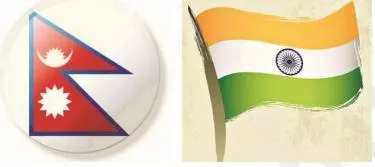
A nepal india win win
The new Prime Minister in Kathmandu needs a hands-off New Delhi to ensure mutually beneficial stability and growth.Without doubt, like every nation-state, India seeks its own advantage in international relationships, including within the South Asian region. But the repeated experience is that of New Delhi generating animosities, with attitudes and actions that go against its own interests. This forces one to ask from nearby Kathmandu, is there a structural issue with India’s foreign affairs oversight — or is this question itself taboo?
Take the case of Nepal, a country where friendship with India comes naturally even more than being a necessity, due to cultural, social and economic linkages over the open border. But, perhaps because of global preoccupations, New Delhi seems to constantly under-estimate Kathmandu’s fierce sense of self. The stratagem (A trick or plan for deceiving an enemy or for achieving a goal) over the decades has been to try to influence Kathmandu’s politicos, forgetting that they too survive within the milieu (the physical or social setting in which people live or in which something happens or develops) of Nepali politics.
The legacy of ‘big brother’ started with Jawaharlal Nehru — Nepal’s statesman B.P. Koirala in his memoir has pinpointed the precise moment in 1950 during a meeting at Teen Murti Bhavan when he realised that the fellow-revolutionary was now transformed as Prime Minister of India, inheriting the geopolitical inclinations of the departed colonialist.
The big stick
More recently, India became progressively interventionist as Nepal got mired in internal crisis during and after the Maoist ‘people’s war’, and as the hill-plain polarisation escalated during the constitution-writing. India has tended to speak loudly while wielding (to exert one's authority by means of) a big stick, based on a sense of entitlement and exceptionalism. But evidently, Indian nationalism for all its vigour cannot suppress nationalism across the frontier.
While there are of course numerous domestic factors, a key reason for political instability in Nepal has been India’s overt and covert intercessions (the action of intervening on behalf of another). This involvement explains in part why Nepal has not had a Prime Minister in office for more than a year-and-a-half over two decades now. Meanwhile, Indian analysts fail to appreciate how political stability in Nepal can deliver economic bounty to the bordering Indian States on its three sides. And economists should study the Pew Research Center figures showing Nepal as one of the larger sources of remittances to India, that too to the poorest regions such as north Bihar, east Uttar Pradesh and Odisha.
India is understandably apprehensive as the Chinese geoeconomic juggernaut infiltrates the Subcontinental countries, including Nepal. Rather than imperious warnings against consorting with Beijing, however, better to leave each society to develop its own method on dealing with China. In the case of Nepal, the arrival of the Qinghai-Tibet Railway at the northern border point in 2020 will be a game-changer, and the Indian market too is set to benefit.
With Khadga Prasad Sharma Oli sworn in as Prime Minister on February 15, there is now opportunity to start afresh on India-Nepal. It is true that India has never had as adversarial a Prime Minister in Kathmandu as Mr. Oli, but this is mainly the result of New Delhi’s own short-sightedness.
Mr. Oli has been a moderate (if loquacious (liking to talk and talking smoothly and easily)) politician who does not bend easily to populist pressures, but it fell on him during his previous term to stand up to the devastating Great Blockade of 2015.
It became his job to rally a populace under humanitarian distress and seek connectivity northward through a set of 10 agreements with Chinese President Xi Jinping in Beijing.
Tagging Mr. Oli as ‘anti-Indian’ is not sensible, for being ‘pro-Nepal’ does not ipso facto mean animosity towards India. And New Delhi may be surprised to find Mr. Oli more than willing to reciprocate its overtures, providing reassurance that Kathmandu will never act against India’s security interests, while insisting that in all areas Nepal will take its own decisions. Nepal’s politicians are masters at realpolitik, and the art of balancing India vis-à-vis China is not outside of Mr. Oli’s personal skill-set.
Desire for harmony
Thankfully, it does look like India is seeking a recalibration, and no one is asking for a public apology. The desire for rapprochement (((especially in international affairs) an establishment or resumption of harmonious relations) is seen in the three phone conversations Prime Minister Narendra Modi has had with Mr. Oli since December, and the dispatch of Foreign Minister Sushma Swaraj to Kathmandu before the new government was even formed.
Nepal’s topmost politicos, who never seem to retire, have got so used to revolving-door leadership that they are finding it hard to stomach the five-year term that the new government will probably get. On the other hand, the people’s expectation is that the longevity will ipso facto make for better governance.
Mr. Oli’s ascendance to prime-ministership marks the final turn of the key in implementing the Constitution of Nepal (2015), which was adopted despite India’s fervent (having or showing great warmth or intensity of spirit, feeling, enthusiasm) lobbying. The promulgation marks an end to the extended derailment of the last two decades, with numerous tragedies from the Maoists ‘people’s war’ to the Great Blockade.
Nepal is now a federal and secular republic, experimenting with three levels of fully empowered government — central, provincial and local. But there is confusion on the division of powers between the tiers, and foot-dragging by the national bureaucracy and many powerful politicians, besides an untested Constitutional Bench of the Supreme Court.
Ensuring inclusion
Mr. Oli inherits the share-the-spoils bhagbanda politics of the transitional years, which has left the police, bureaucracy and judiciary politicised. The decay in each sphere cries out for reform, from the private sector cartels that control the economy to corruption that has seeped (to become diffused or spread) to the village terraces.
The central socio-political task is to ensure inclusion in governance, giving the Janjati ethnicities as well as the Madhesi plains people and others a feeling of ownership of the state. While seeking to restore Nepal’s position internationally, Mr. Oli has to implement the connectivity agreements he signed with Beijing in 2015, while lifting the relationship with India above the patron-supplicant status. He will have his hands full trying to raise employment through tourism, industry, agroforestry and agriculture, ensuring energy self-sufficiency through hydro projects and rescuing the post-earthquake reconstruction effort, which has been a scandal. With international assistance in decline, investors have to be attracted by the promise of the rule of law and due process if Nepal is not to remain the playground of carpetbaggers.
Speaking of the rule of law, the human rights community is worried that the ongoing truth and reconciliation process might be used as a sham exercise to pardon wartime atrocities. With Nepal recently elected to the UN Human Rights Council, there is opportunity to raise Nepal’s international profile while finally putting the ‘people’s war’ behind us all.
Mr. Oli is fortunate that the new Constitution ensures extended tenure, by not allowing a no-confidence vote for the first two years. Besides, he rides a strong public mandate, having led the Left Alliance in its sweep of the local, provincial and national elections and forming governments at each tier. The field is also clear because the parties representing the Hindutva ideology and the deposed king, Gyanendra, were roundly defeated at all levels.
Reaching out
Mr. Oli’s primary preoccupation will be managing the government’s relationship with the opposition. The atmospherics between his Communist Party of Nepal (UML) and the Nepali Congress (NC) are at their worst, the latter sullen (bad tempered and gloomy) and vulnerable after the trouncing at the polls. He must reach out to build a working relationship with the NC and the Madhesbaadi plains-based parties, also because hundreds of new laws need to be urgently drafted under the Constitution.
The Prime Minister’s immediate challenge, however, has to do with Pushpa Kamal Dahal (‘Prachanda’), his Maoist partner in the Left Alliance. Mr. Dahal prefers to ignore the reality that his party was rescued from decimation (to severely damage or destroy a large part of (something)) by the electoral bonding with the UML. The voters gave him a respectable showing, hoping that the promised unification would subsume the Maoists within the UML, helping finally to neutralise the former.
As this is being written, the two parties are preparing a unification document. Meanwhile, bargaining for plum posts, Mr. Dahal is demanding an alopalo, rotating prime-ministership. This would mean a jump back to bhagbanda politics, endangering both stability and growth, dishonouring the electoral mandate.
Prime Minister Oli is tasked today to land Mr. Dahal where he can do no further harm to Nepal’s state and society, and to reset the relationship with India at a new normal. On the latter, he seems keen to take the olive branch held out by Mr. Modi, which can only result in a ‘win-win’ for Nepal and India.



Top court quashes FIRs against Gen Z protesters
Sep 04, 2026






Stay updated with The Hindu Editorial Vocab24 app, your definitive source for breaking news and comprehensive coverage from India and around the globe. Whether it's political developments, business updates, sports highlights, the latest technology trends, or current events, The Hindu brings live, accurate, and reliable news directly to your device.
Don’t fall for sensationalized or fake news shared online. Read and share accurate updates with friends and family through The Hindu Editorial Vocab24 app. Download it today!
News Coverage in The Hindu Editorial Vocab24 App
Breaking News: Receive instant notifications on breaking news stories as they unfold. Stay informed about major events and developments in India and around the world with live blogs, news in shorts videos, and concise articles.
Politics: Get the latest updates on Indian politics, including elections, policy changes, government decisions, and political events that shape the nation.
Business and Economy: Stay ahead in the economic landscape with detailed business news and market analysis. Learn about stock market trends, financial reports, corporate news, and economic developments to make informed investment decisions.
Current Events: Follow stories on social issues, policy changes, global events, and daily current affairs, tailored for UPSC and other competitive exam preparations.
Technology: Keep up with the latest gadgets, innovations, and tech trends. Read expert reviews and analyses in short, concise updates on cutting-edge technology from India and beyond.
Sports: Never miss a moment of your favorite sports. Get live scores, match reports, and expert analysis on cricket, football, tennis, and more.
International News: Stay informed about global events and geopolitical developments, including the Russia-Ukraine war, Israel-Palestine conflict, and other key international stories.
Local News: Stay connected to your community with the latest updates on city events, issues, and local news. Coverage includes hyperlocal updates from cities like Bangalore, Chennai, Delhi, Hyderabad, Mumbai, Kolkata, and more.
Trending Topics: Discover what's trending today with the most talked-about stories and hot topics across India and the world.
Experience journalism that values integrity, accuracy, and reliability. Download The Hindu Editorial Vocab24 app today and stay connected with the world.
Subscribe to our newsletter!







