

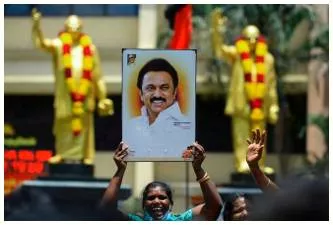
A mirror to the future of tamil nadu and india
DMK must use its win to sustain pluralism at the national level and also guard the State’s trajectory of development.Having been in power for two terms, it was clear that it was not going to be easy for the All India Anna Dravida Munnetra Kazhagam (AIADMK) to win again. Further, given that the AIADMK was always seen to be held together by strong personalities, many anticipated an implosion following the passing away of former Chief Minister and party leader Jayalalithaa. Nevertheless, the Tamil Nadu Assembly election was closely fought. Under these circumstances, what does the victory of the Dravida Munnetra Kazhagam (DMK) mean for the future of the State and for the pan-Indian polity?
The narratives and campaign
The election can be seen as a referendum on both Tamil Nadu’s as well as India’s future. At the State level, the election foregrounded three fundamentalisms; the religious fundamentalism of the Bharatiya Janata Party (BJP), the language fundamentalism of the fringe Tamil nationalists exemplified by the Naam Tamizhar Katchi (NTK) and the caste fundamentalism of sections of intermediate caste groups that are anxious about Dalit mobility. In a sense, all three have come together in this election to challenge the Dravidian-Tamil identity that enabled the State to forge a relatively inclusive developmental trajectory as well as a composite electoral bloc. The DMK’s campaign sought to not only counter the three narratives, but it also revolved against the erosion of State autonomy, a core ideal of Dravidian politics.
Despite its electoral insignificance, the BJP emerged as an ideological opponent to Dravidian mobilisation in this election. Unlike in the past, the BJP targeted DMK’s role in the Sri Lankan Tamil issue, and conducted the ‘Vel Yatra’ to promote Murugan, a popular Tamil deity, to exploit the politics of Tamil nationalism. ‘Tamil’ can now be imagined as a constituent of a glorious Hindu past, with the Dravidian identity being merely a colonial construct.
The BJP was aided in this project by NTK which again sought to pit the Dravidian parties against the Tamil identity and hence opened up the possibility of constituting a Hinduised Tamilness. They sought to foreground a ‘pure Tamil’ identity through caste lineage. To them, the Dravidian parties, the DMK in particular, have denied ‘Tamils’ their rights because of the ‘non-Tamil’ origin of some of their leaders. This attack helped the BJP to push the narrative of a ‘Hindu-Tamil’ identity at the expense of ‘Dravidian-Tamil’.
Issue of caste
The third factor that this election brings to the forefront is caste. For the AIADMK, apart from its leader (and Chief Minister) Edappadi K. Palaniswamy projecting himself subtly as a leader from the numerically large Kongu Vellala Gounder caste, it also passed a Bill just before the election to provide the most backward Vanniyars a 10.5% internal reservation within the 20% Most Backward Community quota to assuage the anxiety of this caste group over Dalit mobility. It may have led to the AIADMK alliance winning a few seats but at the cost of a caste-based polarised polity. The DMK’s victory suggests that despite such mobilisations, the ideological basis of Dravidian commonsense continues to resonate with large sections of its traditional bloc of voters and which may have in fact been strengthened in response to what are seen as attempts by the central government to undermine the State’s autonomy. State autonomy thus constituted another crucial line of battle. The DMK highlighted the AIADMK’s surrender of the State’s rights through its inability to act against a centralising New Education Policy, imposition of the National Eligibility-cum-Entrance Test, and its support for the Farm Bills and Goods and Services Tax implementation. The DMK spotlighted such incursions as an attack on the State’s political and cultural autonomy.
Results and the idea of India
The DMK’s victory, along with that of the All India Trinamool Congress (TMC)’s in West Bengal and the Left Front’s in Kerala, therefore, have a lot to offer to the pan-Indian polity. To begin with, it has a key role in preserving the idea of a pluralistic India. It is ironic that a party which was perceived to be anti-national is now leading the battle for the protection of the core ideals that define India’s Constitution, its secularism and its federalism. Given that constitutional powers including fiscal relations are heavily biased towards the Centre, the limits and possibilities of federalism are largely a function of two variables; the nature of political coalitions at the Centre and the role of States in such coalitions, and sustaining regional diversity. Tamil Nadu’s political history offers lessons for re-imagining India as a substantive federal entity by locating the political in the aspiration for autonomy of self-governing States. There is a clear need for struggles around federal autonomy to be fought collectively with other States that calls for credible political coalitions to strengthen federalism. The Indian variety of federalism — which is very flexible — can be sustained only by such political coalitions. With its strong legacy of fighting for the rights of States, it is imperative that the DMK uses this win to sustain that legacy for pluralism at the national level, and also to guard the unique trajectory of the development of the State which is under attack now.
Obstacles to navigate
Internally, the victory notwithstanding, the DMK faces several challenges as it assumes power. In the domain of development, the huge fiscal burden compounded by the decline in transfers from the Union government and limited avenues for autonomous resource mobilisation make the task of identifying resources for investments daunting. Clearly, the need for economic governance cannot be overstated.
The key, therefore, would be to leverage existing resources effectively, educational institutions and resources being probably the most important. In terms of school education, a shift towards privatisation and poor learning outcomes poses challenges for deepening social justice. A social segmentation in the school education is likely to feed into the uneven quality of higher educational institutions, and what seems to be a potential segmentation of access in terms of caste, class and gender. If broad-basing of education and resultant opportunities in the modern sectors was the core pillar of social justice, effective governance of education needs to address such emerging imbalances.
Focus on welfare
The DMK’s election manifesto has been hailed for its emphasis on welfare. However, the manifesto and the 10-year vision document put forth by the DMK promises a lot on the governance of development. The promise of a Right to Services Act, emphasis on learning outcomes and university-industry linkages, and efforts to revive State public sector enterprises all augur well on this front. The manifesto also emphasises sustaining agriculture through exploring the possibility of providing a minimum support price for all agricultural products, the promotion of organic farming as well as water resource conservation and management.
Politically, the continued electoral dominance of the AIADMK in western Tamil Nadu and the fact that the Pattali Makkal Katchi in alliance has managed to win a few seats in northern Tamil Nadu suggest a partial victory for caste-based mobilisation. The DMK must genuinely renew its anti-caste agenda if its legacy of social justice is to survive in the future. Hence, the party will be tested strongly on whether it can live up to the faith posed in it by the people and their mandate. A series of youth initiatives in the domain of civil society seeking to secure the ideals of social justice that informs the Dravidian movement offers hope.



Top court quashes FIRs against Gen Z protesters
Sep 04, 2026






Stay updated with The Hindu Editorial Vocab24 app, your definitive source for breaking news and comprehensive coverage from India and around the globe. Whether it's political developments, business updates, sports highlights, the latest technology trends, or current events, The Hindu brings live, accurate, and reliable news directly to your device.
Don’t fall for sensationalized or fake news shared online. Read and share accurate updates with friends and family through The Hindu Editorial Vocab24 app. Download it today!
News Coverage in The Hindu Editorial Vocab24 App
Breaking News: Receive instant notifications on breaking news stories as they unfold. Stay informed about major events and developments in India and around the world with live blogs, news in shorts videos, and concise articles.
Politics: Get the latest updates on Indian politics, including elections, policy changes, government decisions, and political events that shape the nation.
Business and Economy: Stay ahead in the economic landscape with detailed business news and market analysis. Learn about stock market trends, financial reports, corporate news, and economic developments to make informed investment decisions.
Current Events: Follow stories on social issues, policy changes, global events, and daily current affairs, tailored for UPSC and other competitive exam preparations.
Technology: Keep up with the latest gadgets, innovations, and tech trends. Read expert reviews and analyses in short, concise updates on cutting-edge technology from India and beyond.
Sports: Never miss a moment of your favorite sports. Get live scores, match reports, and expert analysis on cricket, football, tennis, and more.
International News: Stay informed about global events and geopolitical developments, including the Russia-Ukraine war, Israel-Palestine conflict, and other key international stories.
Local News: Stay connected to your community with the latest updates on city events, issues, and local news. Coverage includes hyperlocal updates from cities like Bangalore, Chennai, Delhi, Hyderabad, Mumbai, Kolkata, and more.
Trending Topics: Discover what's trending today with the most talked-about stories and hot topics across India and the world.
Experience journalism that values integrity, accuracy, and reliability. Download The Hindu Editorial Vocab24 app today and stay connected with the world.
Subscribe to our newsletter!







