

A guide to resolving the assam mizoram issue
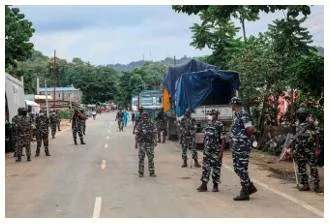
Historical knowledge, sensitivity and an accommodative spirit need to accompany any dialogue and negotiation.The violent stand-off between the Assam and Mizoram armed policemen at Vairengte in Mizoram, on July 26, about six kilometres from Lailapur, Assam which took six lives and left over 50 injured is the culmination of a long-standing border dispute.
History and a boundary
Almost one and a half centuries ago and 17 years before the Lushai hills was annexed to British Assam in 1892, the ‘inner line’ boundary of the Lushai hills was ‘fixed’ in 1875 on the southern border of Assam’s Cachar district. In line with the colonial practice of ‘fixing’ borders, this boundary was however not ‘precise’ as it was drawn largely using natural markers such as rivers and hills. In post-independent India, the Mizoram government has accepted this boundary in preference over the subsequent revisions made by the colonial government when the Inner Line Permit under the Bengal Eastern Frontier Regulation, 1873 was extended to the Lushai hills district in 1930 and 1933.
Unlike the 1875 boundary, which involved a proxy of Suakpuilala, one of the Lushai chiefs, the Mizoram government perceives that the boundary instituted by these revisions sidestepped them and amounted to unilateral superimposition — driven as it were by ‘administrative convenience’. These revisions are also seen to conspicuously fail to recognise the Mizo’s long-standing historical rights to use the un-demarcated southern border of Cachar as their hunting ground, for jhum cultivation, and as sites of their resource extraction including rubber and timber. The enclosure of about 509 square miles of the Lushai hills under the Inner Line Reserve Forest area via the Assam Forest Regulation, 1877, is being cited as one of the glaring exemplars of ‘encroachment’ by the Assam government into the Lushai hills (now Mizoram). However, considering that borders cannot be driven by perception but by institutionalised rules and laws, Assam’s government continues to refuse to accept Mizoram’s standpoint.
Assam’s stand
Seen from this standpoint, the Assam government considers Mizo plantation and settlements in the Inner Line Reserve Forest areas as an ‘encroachment’. Such a standpoint is oblivious to the fact that Seipuia, a Lushai chief, established a village, Seidpur, on a hill nearly 10 miles from Silchar, the capital of Cachar. The Jalenga tea estate located in Tlangpui village and Paloi tea estate near Vairengte — both in Cachar — took their names after Zalenga and Palawia, two Lushai chiefs. Given that the Lushai (also known as old Kukis — Hrangkhawl, Biete, Ralte, etc.) are among the earliest settlers of Cachar, many villages in Cachar (and Karimganj) have Lushai settlements. Sporadic incidents of evictions or arrests by the Assam officials were reported in the 1970s and 2000s. A recent allegation of ‘encroachment’ happened in October 2020 when Assamese officials burnt down Mizo huts and other settlements in the Singla Reserve Forest which led to border clashes and a 12-day blockade of National Highway 306.
Although Assam Chief Minister Himanta Biswa Sarma is partially right in claiming that the dispute is about ‘reserve forest’ and not ‘land’, what is at the heart of this dispute is the contending approaches of the Assam and Mizoram governments to ‘borders’, namely ‘state-centric’ and ‘people-centric’ approaches.
Mr. Sarma and the Assam government represent a continuum of the colonial ‘state-centric’ approach to borders which gives premium to legal, juridical and administrative recognition and protection of the border. Colonial state-making and state-expansion entail a ‘fixing’ of borders. The discovery of oil, tea, rubber and coal around the middle of the 19th century in the ‘outer limits’ of Assam proper and the concomitant attempt to commercialise these commodities impel the regulation of trade and commerce between the British and their competitors. The enclosure of land in these ‘outer limits’ by declaring them either as ‘forest reserve areas’ or imposing an inner line permit raj system stem from this.
This development leverages a new land-use regime which is principally driven by efforts to augment State revenues. Forest conservation and the protection of tribal/indigenous land interests are peripheral concerns. One of the unintended consequences was the large-scale migration of labour from various parts of British India into Cachar, Hailakandi, and Karimganj. The ‘encroachment’ and ‘enclosure’ of their land and forest ‘commons’ reinforced the steely resolve of the tribal groups such as the Lushais to ‘protect’ their land. The series of raids since the mid-1840s, which culminated in the famous raid of Alexandrapore tea garden in Cachar in early January 1871, stems from this. In this raid, James Winchester, a British tea planter, was killed, and Mary Winchester, his daughter, captured. The British launched the Lushai Expedition (1871-72) partly to secure Mary’s release.
The recent overtures by Mr. Sarma to approach the Supreme Court of India, and raise a 4,000-strong commando battalion to ‘protect’ the ‘forest reserve’ areas need to be seen against this backdrop. Parading a bullet-proof armoured vehicle is intended to drive home this message. The muscular display of power also becomes fully evident in the way in which a contingent of about 200 Assam armed policemen along with Karimganj forest officials overran the central paramilitary outpost, marched and ‘encroached’ deep into Mizoram’s border at Vairengte a day after the dispute had already flared up.
Critics squarely blamed Mr. Sarma for this misadventure and political upmanship which cost the lives of five of of Assam’s armed policemen and a civilian and left over 50 people injured. It remains to be seen if the immediate valorisation, ex gratia payment of ₹50 lakh and securing jobs to each family of the ‘martyrs’, and ₹1 lakh relief to the injured edify his image as a ‘decisive’ Chief Minister or expose him as a regional bully. The last image has gained traction given that Assam has a long-standing border dispute with Arunachal Pradesh, Meghalaya and Nagaland.
Mizoram’s approach
In contrast to the above, Chief Minister Zoramthanga and the Mizoram government advocate a ‘people-centric’ approach which seeks to give a premium to the historical and traditional rights of the local indigenous people on the one hand and to the principle of uti possidetis juris (‘as you possess under law’, including customary law) on the other hand. Mr. Zoramthanga and his predecessors have made concerted attempts to forge a consensus around this approach. The two-member boundary committee report of 1973 and the memorandum prepared by the Joint Action Committee, non-governmental organisations and all-political parties in Mizoram in 2018, which has been submitted to the Prime Minister of India, are pointers to this.
At the negotiating table
Given that ‘borders’ are contested social constructs, ‘mental maps’ which are given subjective meanings and interpretations, the endeavours by Mr. Sarma and Mr. Zoramthanga to ‘fix’ the Assam-Mizoram border and resolve the dispute need to be sensitive to the historical context in which local land owners and protectors have transformed overtime as ‘encroachers’ of land across the two States. Such a resolution should be sensitive to the possibility of fluid and overlapping sovereignty, where forest ‘commons’ are seen not simply as sites of revenue-extraction but as powerful symbols of identity and sustainable livelihood resources for the local people.
Deep historical knowledge, sensitivity and an accommodative spirit need to inform Mr. Sarma and Mr. Zoramthanga even as they sit down peacefully to enter into dialogue and negotiation under the neutral supervision of the Centre. It is about time that the Centre sets up a permanent inter-governmental forum to involve important stakeholders in order to effectively manage border and territorial conflicts. Any quick-fix solution driven by temporal electoral considerations should be avoided if we were to resuscitate and sustain interdependent Assam-Mizoram borders and beyond.




Top court quashes FIRs against Gen Z protesters
Sep 04, 2026






Stay updated with The Hindu Editorial Vocab24 app, your definitive source for breaking news and comprehensive coverage from India and around the globe. Whether it's political developments, business updates, sports highlights, the latest technology trends, or current events, The Hindu brings live, accurate, and reliable news directly to your device.
Don’t fall for sensationalized or fake news shared online. Read and share accurate updates with friends and family through The Hindu Editorial Vocab24 app. Download it today!
News Coverage in The Hindu Editorial Vocab24 App
Breaking News: Receive instant notifications on breaking news stories as they unfold. Stay informed about major events and developments in India and around the world with live blogs, news in shorts videos, and concise articles.
Politics: Get the latest updates on Indian politics, including elections, policy changes, government decisions, and political events that shape the nation.
Business and Economy: Stay ahead in the economic landscape with detailed business news and market analysis. Learn about stock market trends, financial reports, corporate news, and economic developments to make informed investment decisions.
Current Events: Follow stories on social issues, policy changes, global events, and daily current affairs, tailored for UPSC and other competitive exam preparations.
Technology: Keep up with the latest gadgets, innovations, and tech trends. Read expert reviews and analyses in short, concise updates on cutting-edge technology from India and beyond.
Sports: Never miss a moment of your favorite sports. Get live scores, match reports, and expert analysis on cricket, football, tennis, and more.
International News: Stay informed about global events and geopolitical developments, including the Russia-Ukraine war, Israel-Palestine conflict, and other key international stories.
Local News: Stay connected to your community with the latest updates on city events, issues, and local news. Coverage includes hyperlocal updates from cities like Bangalore, Chennai, Delhi, Hyderabad, Mumbai, Kolkata, and more.
Trending Topics: Discover what's trending today with the most talked-about stories and hot topics across India and the world.
Experience journalism that values integrity, accuracy, and reliability. Download The Hindu Editorial Vocab24 app today and stay connected with the world.
Subscribe to our newsletter!







