

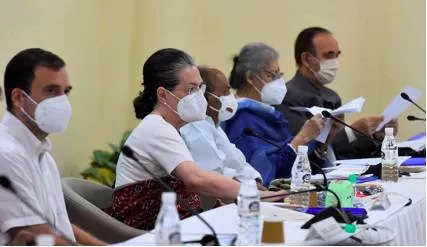
A grand old party the demanding path to its revival
The Congress’s decline is to be seen in the context of majoritarianism as well as internal factors related to the party.The Congress party is no stranger to crises, but those it has faced since 2014 are unprecedented and probably the worst in the course of its long history. The party reached a historic low of 44 Lok Sabha seats in 2014 and that only increased to 52 in 2019. It has lost 39 out of 49 State elections since 2014. It managed to win only 55 of the 690 seats in the recent Assembly elections held in Uttar Pradesh, Punjab, Uttarakhand, Manipur and Goa. A series of leaders have deserted the party — even those close to the Gandhi family. These defeats and desertions have raised questions and concerns about its very survival. The fact that Congress leaders held extensive talks with a much sought-after election consultant, and was planning to employ his services to revamp the party, brings into sharp relief the existential crisis of the Congress. How do we understand Congress’s existential crisis, and what are the prospects of revival?
A platform that does not work
Historically, the Congress had always come to power on a centrist platform reflecting its varied social base, but centrism does not work in a deeply divided polity dominated by a politics of polarisation and communal mobilisation. Essentially, the old form of accommodative politics, which for long held together the Congress’s social coalition, is not capable of galvanising the imagination of new India. The Gujarat model of politics marked by an exclusive focus on individual leadership as the driver of election campaigns, a strong sense of Hindu pride, a shift in popular attention to aggressive nationalist appeals regardless of reality or facts, and a complete rejection of the entire democratic past and superimposition of perception over performance appears to hold voters in thrall. Changes unleashed by liberalisation, globalisation, and the information-communication revolution initiated by the Congress have undercut its political ethos and ideological architecture to a greater degree than that of its principal rival. The Congress’s decline (and that of other Centre-Left and Left parties) needs to be seen in the context of transformations provoked by the growth and expansion of neoliberalism and majoritarianism, and other factors that are internal to the Congress, most notably, the strong resistance to structural changes within the party.
The party’s main problems
The Congress has faced three major structural problems in a political conjuncture defined by ‘the great moving Right show’, to borrow a phrase from cultural theorist Stuart Hall, and the polarisation engendered by it. These include the leadership issue, organisational stagnation, and the need to project and propagate a clear ideological alternative to the Bharatiya Janata Party (BJP). I have explored these themes in my recent book on the Congress and am taking up some aspects of that here.
The Congress’s leadership crisis has undoubtedly played a role in its decline; however, the challenge facing the party is not just about the ineffectual leadership. Simply appointing a non-Gandhi will not dramatically alter the party’s dwindling fortunes. In fact, removing them might well reinforce the right-wing agenda. What the Congress needs is an organisational regeneration, with democratisation at the front and centre. But fundamental issues concerning organisational change have been repeatedly set aside and weighed down by the debate on dynastic leadership and an obsessive focus on the Gandhis.
It is, however, important to reconstitute the party’s leadership at various levels through internal elections. This can transform the Congress into a more representative organisation and could give a boost to the party by changing the perception that it is a family business. At present, the top decision-making bodies are occupied by people who have either never contested a Lok Sabha or Vidhan Sabha election or did so decades ago. Their influence has however grown in direct proportion to the weakening of the party across India. These structural problems have existed for years, and yet the party has not faced them head on. It has demonstrated no urgency for drastic remedial measures despite defeat after defeat. The feeble attempts at revitalisation have focused more on regaining quick electoral viability than on addressing long-term structural issues.
Short on communication
By far the Congress’s biggest shortcoming is its inability to communicate its ideological positions and values clearly. The great challenge is to define its message and communicate it to the electorate as an underpinning for political mobilisation. For this, it must unequivocally reaffirm its inclusive vision for a democratic India, and take credit for its past achievements, which resulted from an adherence to these commitments.
One big failure has been the Congress’s reluctance to tell its own story. The party did not publicise or highlight its distinctive approach, and that was one reason why it did not play to its strengths during the United Progressive Alliance (UPA) rule, allowing itself to be outsmarted by its critics. The BJP has correctly calculated that so long as it sustains the argument that the Congress was elitist, corrupt and dynastic, it can prevent the Congress from emerging as a credible alternative. What aids and abets these half-truths is the passivity of the Congress in defending its record and letting its achievements to be dismissed and derided, even as the National Democratic Alliance (NDA) government successfully obfuscates data on its own underperformance in the last eight years.
Combating the communal
The key issue for the Opposition is defining its response to Hindu nationalism. While the Congress is largely agreed on the necessity of combating communal ideas, politics and policies, it has swung between making ideological compromises with majoritarian nationalism and plotting a frontal battle against it. It has often adopted a majoritarian tenor on certain controversial issues in the name of religious sentiment. However, this makes no sense amidst the growing influence of the Hindu Right. Both as a strategy and as an actuality, the mixing of religiosity and politics does not guarantee electoral dividends. Moreover, the conflict in India is not about the growing prominence of Hinduism in our public life, which most parties accept and promote, but about the BJP’s idea of nationalism, which is utterly exclusivist, pitted against the inclusive nationalism championed by the Congress during the freedom struggle.
Indian politics has never been more polarised than it is today; never before has the gulf been so wide. Hence, today, the battle is more fundamental; it is about the very idea of India — the idea of a diverse, pluralistic nation committed to liberal values. By remaining silent on the way in which nationalism has been redefined, the Congress has ceded the nationalist space to Hindu Right which poses as the pre-eminent torch-bearer of nationalism today even though organisations associated with it made no contribution to the freedom struggle, the crucible which defined Indian nationalism from which they were absent. Yet, its conception of Indian nationhood which it has fought for has prevailed, over the past decade and more, against the Congress’s inclusive ‘Idea of India’.
Defending a pluralist view of politics and governance is one aspect of the political strategy; the other is grounding its politics in the idiom of social justice which both sidesteps identity politics and resonates with an aggrieved population, alienated by the current dispensation’s policies and politics. Overall, the 137-year-old party’s revival depends on three things — a consistent narrative to counter divisive politics, the will to restructure the organisation, and drawing strength from constant public action rather than just elections.



Top court quashes FIRs against Gen Z protesters
Sep 04, 2026






Stay updated with The Hindu Editorial Vocab24 app, your definitive source for breaking news and comprehensive coverage from India and around the globe. Whether it's political developments, business updates, sports highlights, the latest technology trends, or current events, The Hindu brings live, accurate, and reliable news directly to your device.
Don’t fall for sensationalized or fake news shared online. Read and share accurate updates with friends and family through The Hindu Editorial Vocab24 app. Download it today!
News Coverage in The Hindu Editorial Vocab24 App
Breaking News: Receive instant notifications on breaking news stories as they unfold. Stay informed about major events and developments in India and around the world with live blogs, news in shorts videos, and concise articles.
Politics: Get the latest updates on Indian politics, including elections, policy changes, government decisions, and political events that shape the nation.
Business and Economy: Stay ahead in the economic landscape with detailed business news and market analysis. Learn about stock market trends, financial reports, corporate news, and economic developments to make informed investment decisions.
Current Events: Follow stories on social issues, policy changes, global events, and daily current affairs, tailored for UPSC and other competitive exam preparations.
Technology: Keep up with the latest gadgets, innovations, and tech trends. Read expert reviews and analyses in short, concise updates on cutting-edge technology from India and beyond.
Sports: Never miss a moment of your favorite sports. Get live scores, match reports, and expert analysis on cricket, football, tennis, and more.
International News: Stay informed about global events and geopolitical developments, including the Russia-Ukraine war, Israel-Palestine conflict, and other key international stories.
Local News: Stay connected to your community with the latest updates on city events, issues, and local news. Coverage includes hyperlocal updates from cities like Bangalore, Chennai, Delhi, Hyderabad, Mumbai, Kolkata, and more.
Trending Topics: Discover what's trending today with the most talked-about stories and hot topics across India and the world.
Experience journalism that values integrity, accuracy, and reliability. Download The Hindu Editorial Vocab24 app today and stay connected with the world.
Subscribe to our newsletter!







