

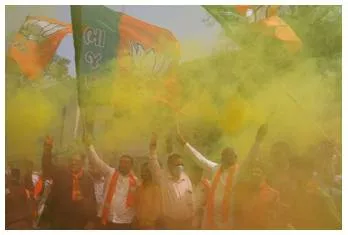
A demonstration of a durable political phenomenon
U.P., much like Gujarat, is now a State where Hindu majoritarianism is deeply embedded in the political common sense.Uttar Pradesh has entered a new political era. The Bharatiya Janata Party (BJP) has romped back with a two-thirds majority: the first incumbent to return to power in over three decades. The project of the Samajwadi Party (SP) to transcend its Muslim-Yadav social base has come a cropper. The Bahujan Samaj Party and the Congress have been virtually annihilated.
Mandate as a meta narrative
The triumph of the BJP is not surprising, even if its scale was largely unanticipated. A common theme of the reportage from Uttar Pradesh has been the existence of a wave-less election. The antennae of journalists neither caught strong sentiments of pro-incumbency nor a widespread sentiment of anti-incumbency. What then explains the decisive mandate given to the BJP?
Decoding a political mandate is a complicated affair. There are several components that go into the making of a political majority. Some pundits have read into the mandate a validation of the governance achievements of the Yogi Raj, particularly welfare provisioning and tough law and order: a ‘ rashan’ and ‘ shasan’ mandate. Others maintain that the BJP was saved from a sticky wicket by its structural advantages: organisational machinery and media management. There is some truth in both the explanations, yet, they both miss what is essentially the ideological driving force behind the mandate, which is Hindu majoritarianism. This was the meta narrative of the BJP campaign, in reference to which all the smaller narratives were stitched together.
The principal challenge facing the BJP in these elections was keeping together the sprawling social coalition of Hindu voters it had assembled over the last decade: the upper castes, non-Yadav backward castes, and non-Jatav Dalits. This task was made even more daunting by the prevalence of multiple sources of discontent, which had also hurt the BJP in previous State elections. These include the usual litany of unemployment, price rise, stagnant incomes and rural distress, coupled with a particularly disastrous impact that the COVID-19 pandemic and the lockdown had wrought in the State.
To say that an expanded provisioning of rations outweighed the combined effects of all these governance deficits stretches credulity. It is hard to think of an Indian electorate in the third decade of the 21st century being swept off its feet with bags of food grains — something they have come to expect from the government for at least half a century.
More than just welfare
Cash transfers for a variety of welfare schemes — farmer income support, toilets, houses, school bags, etc. — present a stronger case. Though, here too, analysts reading an election-swaying effect need to tread with caution, for two reasons. One, welfare transfers on their own did not save the BJP from a voter backlash in recent State elections in Haryana, Maharashtra and Jharkhand. And two, neither survey data nor journalistic accounts indicated a whirlwind of public enthusiasm that could explain such a huge mandate. In fact, two months before the election, a survey finding highlighted the ambiguous nature of the public mood: while more than two-thirds of respondents claimed to be broadly dissatisfied with the State government, a slim majority still wanted it back in power. Clearly, something else was also in play.
And that decisive factor is Hindu majoritarianism, which has forged an emotional bond between the BJP and Hindu voters, barring the Yadavs and the Jatavs. The political activist, Yogendra Yadav, reported from his travels in Uttar Pradesh the existence of a political and moral ‘common-sense’ shared by Hindu voters of the State. This ‘common sense’, borne out of what he calls the ‘Hindu-Muslim divide’, led them to excuse material suffering and misgovernance because they wished to stay on their ‘own’ side.
BJP versus SP
Make no mistake, this was primarily an ideological clash between the BJP and SP, waged mainly over non-Yadav backward caste voters. With the rest of the voters — upper castes, Muslims, Yadavs and Jatav Dalits — firmly in different camps, backward castes (and to a lesser extent, the non Jatav Dalits) were supposed to decide the fate of the election.
They were the fulcrum of Akhilesh Yadav’s campaign, who leaned heavily on the Mandal lexicon of ‘ haq’ (due rights) and ‘ hissedari’ (equal representation), promising a ‘revolution of the backwards’.
How did the BJP then manage to keep its backward caste voters from falling under the sway of the SP’s Mandal politics? Or in other words, how did Hindu majoritarianism reinforce the Hindu political identity of the backward castes that made them indifferent to Mandal politics? There are two aspects to this.
The first aspect is providing the backward castes with a sense of physical security — the law-and-order pitch of the Yogi government, symbolised by bulldozers and encounters. Under the Hindu umbrella, they are safe from the depredations of the Yadav and (even more so) Muslim criminals. The securitisation of communal prejudice has reached its highest form in Uttar Pradesh. There was an explicit conflation of ‘mafias’ with Muslim strongmen such as Mukhtar Ansari and Atiq Ahmad; rioters with Muslim anti-Citizenship (Amendment) Act protesters; and anti-social elements with Muslim cow smugglers and love jihad conspirators. For instance, more than a third of all National Security Act (NSA) detentions by the U.P. government (2018-2020) have been against cow smugglers. Thus, the law-and-order pitch of the BJP largely comprised converting Muslims into a security threat and then making high-pitched demonstrations of taming that threat. Many journalists who reported the absence of overt Hindu-Muslim tensions on the ground missed the potency of the communal assumptions that have become normalised among wide swathes of the electorate.
Economic security
The second aspect is providing the backward castes with a sense of economic security — without reference to their caste identity. The latter part (mechanism) here is as politically crucial as the former part (delivery). As I have argued in a previous article in The Hindu, “In Uttar Pradesh the crux of welfare politics”, historically, Mandal and Dalit politics had gained ground in Uttar Pradesh by turning caste mobilisation into a pathway for greater access to public goods. The welfare regime instituted by the BJP, where provisions are made in a universal and programmatic manner, cutting out the middlemen particularly through cash transfers, dilutes the political salience of caste identity. Thus, this type of welfare politics works in tandem with a Hindu majoritarian discourse towards the political transformation of Dalits and backward castes into Hindus.
We must also consider why the Mandal strategy of the SP party failed in disturbing this Hindu political majority. In another article in The Hindu, “Re-establishing ownership of the Mandal space”, my argument was that it was an enormous challenge to resurrect Mandal politics in the space of an election campaign.
On the eve of the elections, the SP engineered defections from the ranks of the BJP of prominent backward caste leaders such as Swami Prasad Maurya and Dara Singh Chauhan. This was meant to underline the dissatisfaction of backward castes under the Yogi regime, and make backward caste assertion a central theme of the election. As it turned out, most of these leaders did not have a hold on their own caste beyond their constituencies, and their record of opportunistic and transactional politics did not fit well with their pious ideological refrains. These efforts of the SP were, in short, too little too late.



Top court quashes FIRs against Gen Z protesters
Sep 04, 2026






Stay updated with The Hindu Editorial Vocab24 app, your definitive source for breaking news and comprehensive coverage from India and around the globe. Whether it's political developments, business updates, sports highlights, the latest technology trends, or current events, The Hindu brings live, accurate, and reliable news directly to your device.
Don’t fall for sensationalized or fake news shared online. Read and share accurate updates with friends and family through The Hindu Editorial Vocab24 app. Download it today!
News Coverage in The Hindu Editorial Vocab24 App
Breaking News: Receive instant notifications on breaking news stories as they unfold. Stay informed about major events and developments in India and around the world with live blogs, news in shorts videos, and concise articles.
Politics: Get the latest updates on Indian politics, including elections, policy changes, government decisions, and political events that shape the nation.
Business and Economy: Stay ahead in the economic landscape with detailed business news and market analysis. Learn about stock market trends, financial reports, corporate news, and economic developments to make informed investment decisions.
Current Events: Follow stories on social issues, policy changes, global events, and daily current affairs, tailored for UPSC and other competitive exam preparations.
Technology: Keep up with the latest gadgets, innovations, and tech trends. Read expert reviews and analyses in short, concise updates on cutting-edge technology from India and beyond.
Sports: Never miss a moment of your favorite sports. Get live scores, match reports, and expert analysis on cricket, football, tennis, and more.
International News: Stay informed about global events and geopolitical developments, including the Russia-Ukraine war, Israel-Palestine conflict, and other key international stories.
Local News: Stay connected to your community with the latest updates on city events, issues, and local news. Coverage includes hyperlocal updates from cities like Bangalore, Chennai, Delhi, Hyderabad, Mumbai, Kolkata, and more.
Trending Topics: Discover what's trending today with the most talked-about stories and hot topics across India and the world.
Experience journalism that values integrity, accuracy, and reliability. Download The Hindu Editorial Vocab24 app today and stay connected with the world.
Subscribe to our newsletter!







