

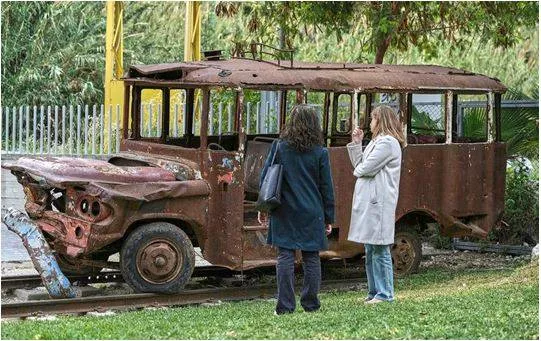
50 years after lebanon’s civil war a bullet riddled bus stands as a reminder
What happened on April 13, 1975, plunged Lebanon into 15 years of civil war that killed 1,50,000 people; Lebanon has never fully grappled with the war’s legacy, and in many ways, it has never fully recovered; govt. on Sunday marked the anniversary with a small ceremony and minute of silence.It was an ordinary day in Beirut. In one part of Lebanon’s capital, a church was inaugurated, with the leader of the Christian Phalange party there. In another, Palestinian factions held a military parade. Phalangists and Palestinians had clashed, again, that morning.
What happened next on April 13, 1975, would change the course of Lebanon, plunging it into 15 years of civil war that would kill about 1,50,000 people, leave 17,000 missing and lead to foreign intervention. Beirut became synonymous with snipers, kidnappings and car bombs.
Lebanon has never fully grappled with the war’s legacy, and in many ways, it has never fully recovered, 50 years later. The government on Sunday marked the anniversary with a small ceremony and minute of silence, a rare official acknowledgement of the legacy of the conflict.
Unrest had been brewing. Palestinian militants had begun launching attacks against Israel from Lebanese territory. Leftist groups and many Muslims in Lebanon sympathised with the Palestinian cause. Christians and some other groups saw the Palestinian militants as a threat.
At the time, Mohammad Othman was 16, a Palestinian refugee in the Tel al-Zaatar camp east of Beirut.
Three buses had left camp that morning, carrying students like him as well as militants from a coalition of hardline factions that had broken away from the Palestinian Liberation Organisation. They passed through the Ein Rummaneh neighbourhood without incident and joined the military parade.
The buses were supposed to return together, but some participants were tired after marching and wanted to go back early. They hired a small bus from the street, Mr. Othman said. Thirty-three people packed in.
They were unaware that earlier that day, small clashes had broken out between Palestinians and Phalange Party members guarding the church in Ein Rummaneh. A bodyguard for party leader Pierre Gemayel had been killed.
45 minutes of shooting
Suddenly the road was blocked, and gunmen began shooting at the bus “from all sides,” Mr. Othman recalled.
The man’s nine-year-old son was also killed.
“The shooting did not stop for about 45 minutes until they thought everyone was dead,” he said.
Twenty-two people were killed.
Some Lebanese say the men who attacked the bus were responding to an assassination attempt against Gemayel by Palestinian militants. Others say the Phalangists had set up an ambush intended to spark a wider conflict.
Marwan Chahine, a Lebanese-French journalist who wrote a book about the events of April 13, 1975, said he believes both narratives are wrong.
Mr. Chahine said he found no evidence of an attempt to kill Gemayel, who had left the church by the time his bodyguard was shot. And he said the attack on the bus appeared to be more a matter of trigger-happy young men at a checkpoint than a “planned operation.”
The Lebanese Army had largely ceded control to militias, and it did not respond to the events in Ein Rummaneh that day. The armed Palestinian factions had been increasingly prominent in Lebanon after the PLO was driven out of Jordan in 1970, and Lebanese Christians had also increasingly armed themselves.
“The Kataeb would say that the Palestinians were a state within a state,” Mr. Chahine said, using the Phalange Party’s Arabic name. “But the reality was, you had two states in a state. Nobody was following any rules.”
War inevitable
Selim Sayegh, a member of Parliament with the Kataeb Party who was 14 and living in Ein Rummaneh when the fighting started, said he believes war had been inevitable since the Lebanese Army backed down from an attempt to take control of Palestinian camps two years earlier.
Mr. Sayegh said men at the checkpoint that day saw a bus full of Palestinians “and thought that is the second wave of the operation” that started with the killing of Gemayel’s bodyguard.
The war unfolded quickly from there. Alliances shifted. New factions formed. Israel and Syria occupied parts of the country. The United States intervened, and the U.S. embassy and Marine barracks were targeted by bombings. Beirut was divided between Christian and Muslim sectors.
In response to the Israeli occupation of southern Lebanon, a Shia militant group was formed in the early 1980s with Iranian backing: Hezbollah. It would grow to be arguably the most powerful armed non-state group in the region.
Hezbollah was the only militant group allowed to keep its weapons after Lebanon’s civil war, given special status as a “resistance force” because Israel was still in southern Lebanon. After the group was badly weakened last year in a war with Israel that ended with a ceasefire, there has been increasing pressure for it to disarm.
Of the 10 others who survived the bus attack, he said, three were killed a year later when Christian militias attacked the Tel al-Zaatar camp. Another was killed in a 1981 bombing at the Iraqi embassy. A couple died of natural causes, one lives in Germany, and he has lost track of the others.
The bus has also survived, as a reminder.
Ahead of the 50th anniversary of the attack, it was towed from storage on a farm to the private Nabu Museum in Heri, north of Beirut. Visitors took photos with it and peered into bullet holes in its rusted sides.


U k budget increases child welfare allowance taxes
Nov 29, 2025







Stay updated with The Hindu Editorial Vocab24 app, your definitive source for breaking news and comprehensive coverage from India and around the globe. Whether it's political developments, business updates, sports highlights, the latest technology trends, or current events, The Hindu brings live, accurate, and reliable news directly to your device.
Don’t fall for sensationalized or fake news shared online. Read and share accurate updates with friends and family through The Hindu Editorial Vocab24 app. Download it today!
News Coverage in The Hindu Editorial Vocab24 App
Breaking News: Receive instant notifications on breaking news stories as they unfold. Stay informed about major events and developments in India and around the world with live blogs, news in shorts videos, and concise articles.
Politics: Get the latest updates on Indian politics, including elections, policy changes, government decisions, and political events that shape the nation.
Business and Economy: Stay ahead in the economic landscape with detailed business news and market analysis. Learn about stock market trends, financial reports, corporate news, and economic developments to make informed investment decisions.
Current Events: Follow stories on social issues, policy changes, global events, and daily current affairs, tailored for UPSC and other competitive exam preparations.
Technology: Keep up with the latest gadgets, innovations, and tech trends. Read expert reviews and analyses in short, concise updates on cutting-edge technology from India and beyond.
Sports: Never miss a moment of your favorite sports. Get live scores, match reports, and expert analysis on cricket, football, tennis, and more.
International News: Stay informed about global events and geopolitical developments, including the Russia-Ukraine war, Israel-Palestine conflict, and other key international stories.
Local News: Stay connected to your community with the latest updates on city events, issues, and local news. Coverage includes hyperlocal updates from cities like Bangalore, Chennai, Delhi, Hyderabad, Mumbai, Kolkata, and more.
Trending Topics: Discover what's trending today with the most talked-about stories and hot topics across India and the world.
Experience journalism that values integrity, accuracy, and reliability. Download The Hindu Editorial Vocab24 app today and stay connected with the world.
Subscribe to our newsletter!







